
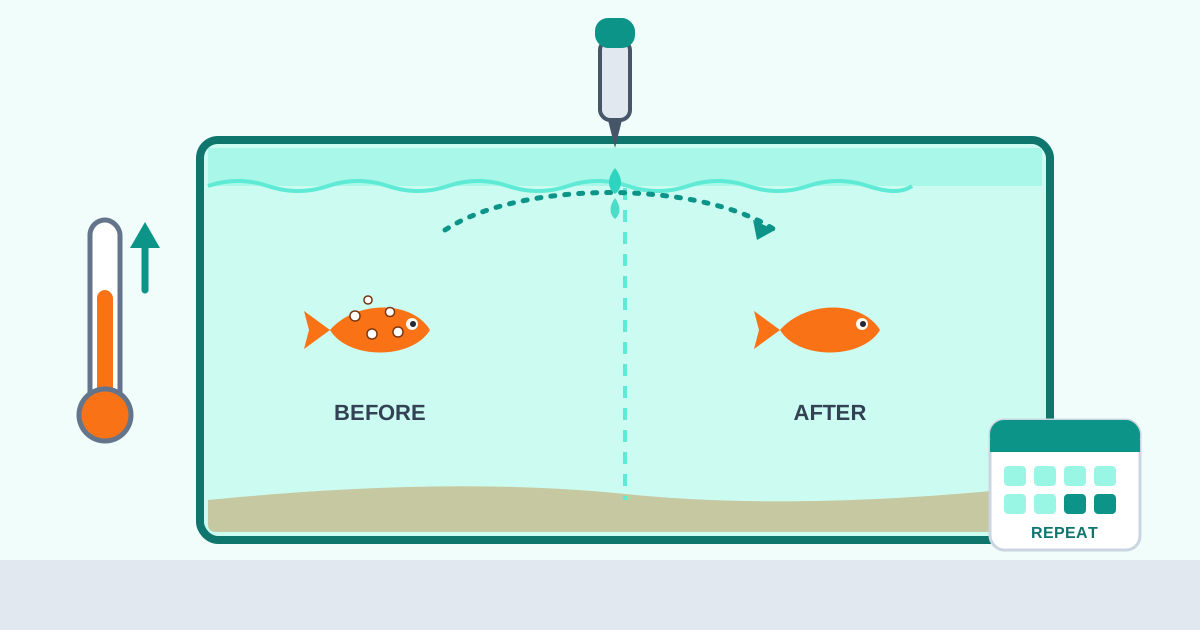
Ich is very treatable, and you don't need anything exotic to beat it — you need the right product at the right dose, repeated long enough to break the parasite's life cycle. This guide gives the husbandry-first plan; if you're still confirming what you're looking at, start with white spots on fish or ich vs velvet.
There's no one-shot ich cure in a bottle, and that's not a failing of the products — it's the biology. The whole strategy rests on one fact: only the free-swimming stage of ich can be killed. The University of Florida describes how the feeding parasite on your fish and its reproductive cyst in the gravel are both shielded from chemicals — so a single dose never works. You treat repeatedly, catching each new wave of parasites as it hatches and goes hunting.
Before you start: get your volume right
Every ich medication and every salt dose is measured against actual water volume — and an overdose can be as dangerous as the disease. The number on the tank box is the empty-glass capacity, not what's really in there once you subtract glass, substrate and decor.
Free tool
Calculate your tank's true water volume first — every dose below depends on it, and guessing high risks poisoning your fish.
Aquarium volume calculator →Step 1 — Confirm and test
Make sure you're seeing countable white salt-grains, not the fine gold dust of velvet, which needs different treatment. Then test ammonia, nitrite and nitrate — a reliable test kit is essential — and fix any water problem in parallel. Ich thrives on stressed fish, and bad water is the most common stressor.
Step 2 — Raise the temperature (carefully)
If your fish tolerate warmth, raise the tank gradually toward about 86°F (30°C) over a day or two. This speeds the parasite's cycle so the treatable stage emerges sooner. Two rules: add extra aeration (warm water holds less oxygen, and ich damages gills), and go gently — or skip it — for coldwater fish like goldfish. Heat is an accelerator, not a cure by itself.
Step 3 — Clean, then dose
Do a large water change (a third or more) and gravel-vac before you medicate — this physically lifts cyst stages out of the substrate. Remove activated carbon from the filter, or it will strip the medication straight back out. Leave the filter running otherwise.
Then dose a dedicated ich medication at its label rate:
- Ich-X — Hikari's product data sheet lists the dose as 1 teaspoon (~5 mL) per 10 gallons, added after a water change. Repeat as directed, and continue for three days after the last spot. Its label warns not to combine it with other treatments, including salt.
- Faunamor — the first FDA-legal ich drug (indexed April 2025). Follow the bottle's schedule and per-volume dose exactly; the FDA notice describes it as an over-the-counter immersion treatment for ornamental fish.
I relay label doses — I never invent one
The dose above is transcribed from Hikari's own published product data sheet and cited. Always defer to the current label on the bottle in your hand, and dose from your tank's real water volume. If a product isn't listed here, use its own label — never a figure someone guessed.
From my own tank
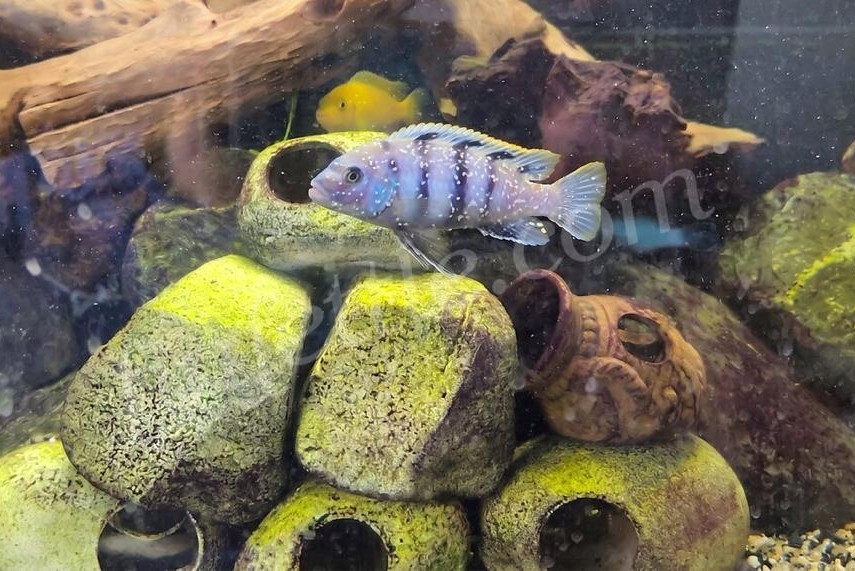
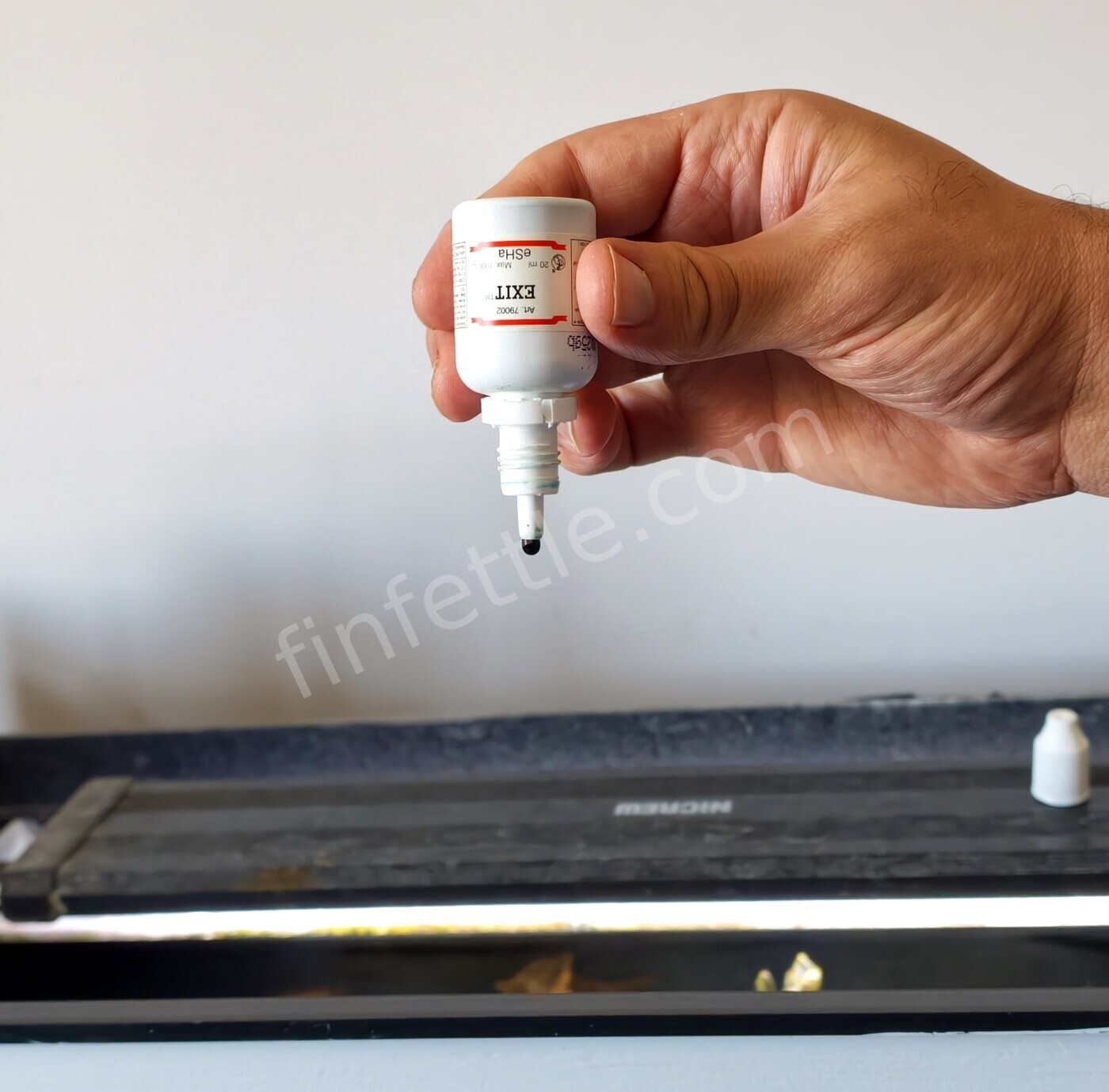
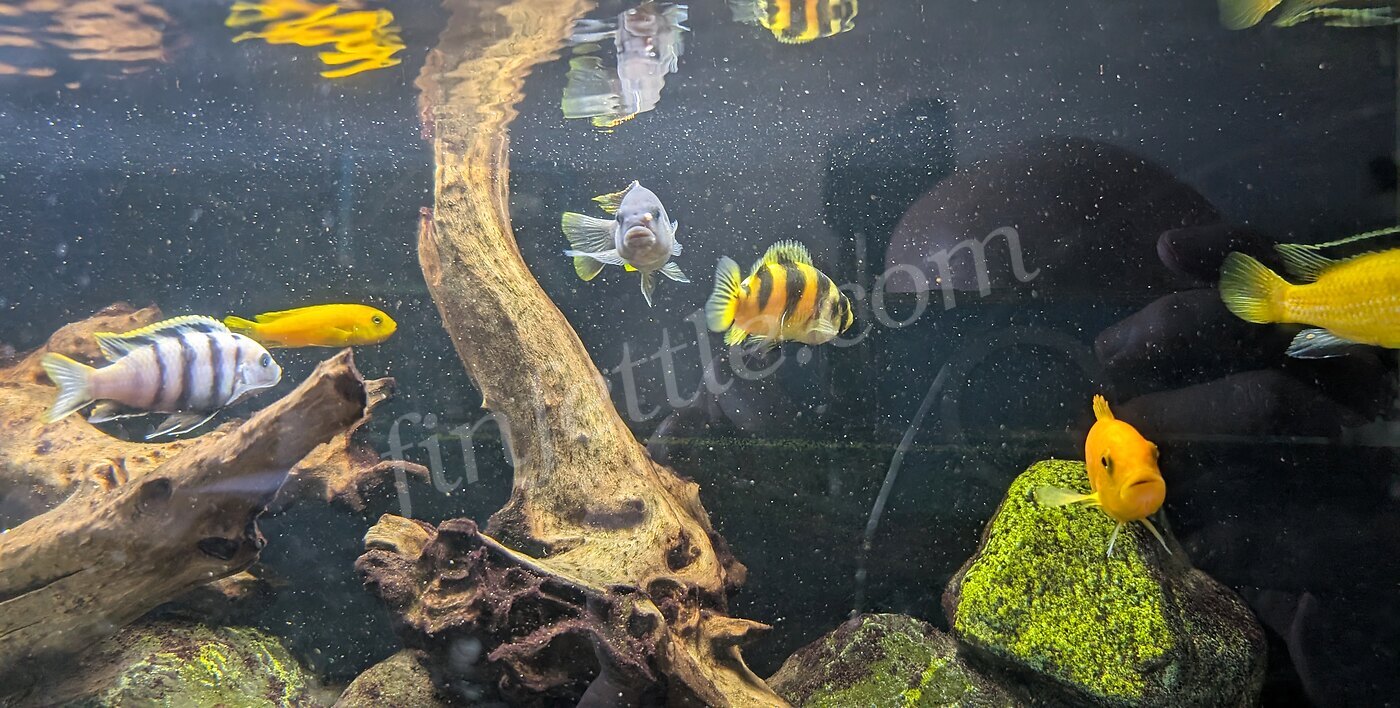
When ich hit one of my mbuna, I treated it with eSHa EXIT and followed the label — 20 drops per 100 litres on day one, then 10 drops on days two and three. It's an anti-whitespot treatment that also covers velvet, it's shrimp-safe, and unlike formalin/malachite products it doesn't ask you to raise the temperature. The named picks above (Ich-X, Faunamor) do exactly the same job — whatever you can get hold of, the principle is identical: a proper antiparasitic, dosed to your real volume, repeated across the whole course.
Step 4 — Repeat until the cycle breaks
Redose as the label directs — for formalin/malachite products this is typically daily, with a partial water change (10–25%) before each dose. Keep going through the whole outbreak. At warm temperatures the parasite's cycle runs about 3–6 days, so expect a minimum of several doses, and don't stop the moment the spots vanish — continue for roughly three more days. This last part is the single most common reason ich comes roaring back.
Where salt fits (and where it doesn't)
Aquarium salt is genuinely effective against the free-swimming stage, and some keepers rely on it. But I deliberately don't lead with it, because the same salt that helps can harm the bystanders in a community tank: scaleless fish — loaches, many catfish, some algae-eaters — and a lot of aquarium plants tolerate salt poorly, as Aquarium Co-Op and others note. Treating in a hospital tank sidesteps that, but not every hobbyist can set one up on short notice. For exact dosing, how to add and remove it safely, and the full tolerant/intolerant species list, see my aquarium salt guide.
So: if your tank has salt-sensitive species or planted aquascaping, favour a dedicated ich medication and skip the salt, or move the affected fish to a bare hospital tank. If you do use salt, raise it in stages, use the lower end of the range, and watch every fish closely. (And remember Ich-X's label says not to run salt alongside it.)
When to escalate
If fish keep dying despite correct treatment, are gasping with gill involvement, or you can't tell ich from velvet, stop guessing. If you have access to mature, cycled water — a spare tank of your own, or through a friend in the hobby or your local shop — move the worst-affected fish there. This guide is educational and husbandry-first, not a substitute for hands-on help with a fish that's crashing.
What to use
My shortlist of ich treatments — Ich-X and Faunamor for the US, eSHa EXIT and other Schedule-6 options for the UK — plus where salt fits, is on those pages. For the two most common patients, see betta ich and goldfish ich.