
Ich and velvet are both external parasites that dust a fish with pale specks, and panicked keepers mix them up constantly. The velvet vs ich call matters because the best treatment differs — and velvet is the less forgiving of the two, so getting it wrong wastes days you may not have.
Here's the short version: ich is distinct white spots you can count; velvet is a fine gold or rust dust you can't. Everything below helps you act on that.
Quick verdict
| Ich (white spot) | Velvet (gold dust) | |
|---|---|---|
| Appearance | Distinct raised white spots, like salt or sugar grains | Fine gold, yellow or rust dust — a dusty sheen |
| Can you count them? | Yes, usually individually countable | No — too fine and numerous |
| Best seen | In normal light, on body and fins | With a torch in a dim room, catching a metallic glint |
| Speed | Fast, but gives you a little time | Faster, often fatal within days |
| Gills / breathing | Can affect gills; breathing distress in bad cases | Hits gills early — breathing distress often comes first |
| Parasite | Ichthyophthirius multifiliis (a ciliate) | Piscinoodinium (a light-dependent dinoflagellate) |
| Key treatment difference | Formalin/malachite-green meds (e.g. Ich-X); heat + clean water | Copper-based meds; dim the tank (velvet needs light) |
The single most reliable tell: grain size and colour. Countable white salt-grains = ich. An uncountable golden haze = velvet.
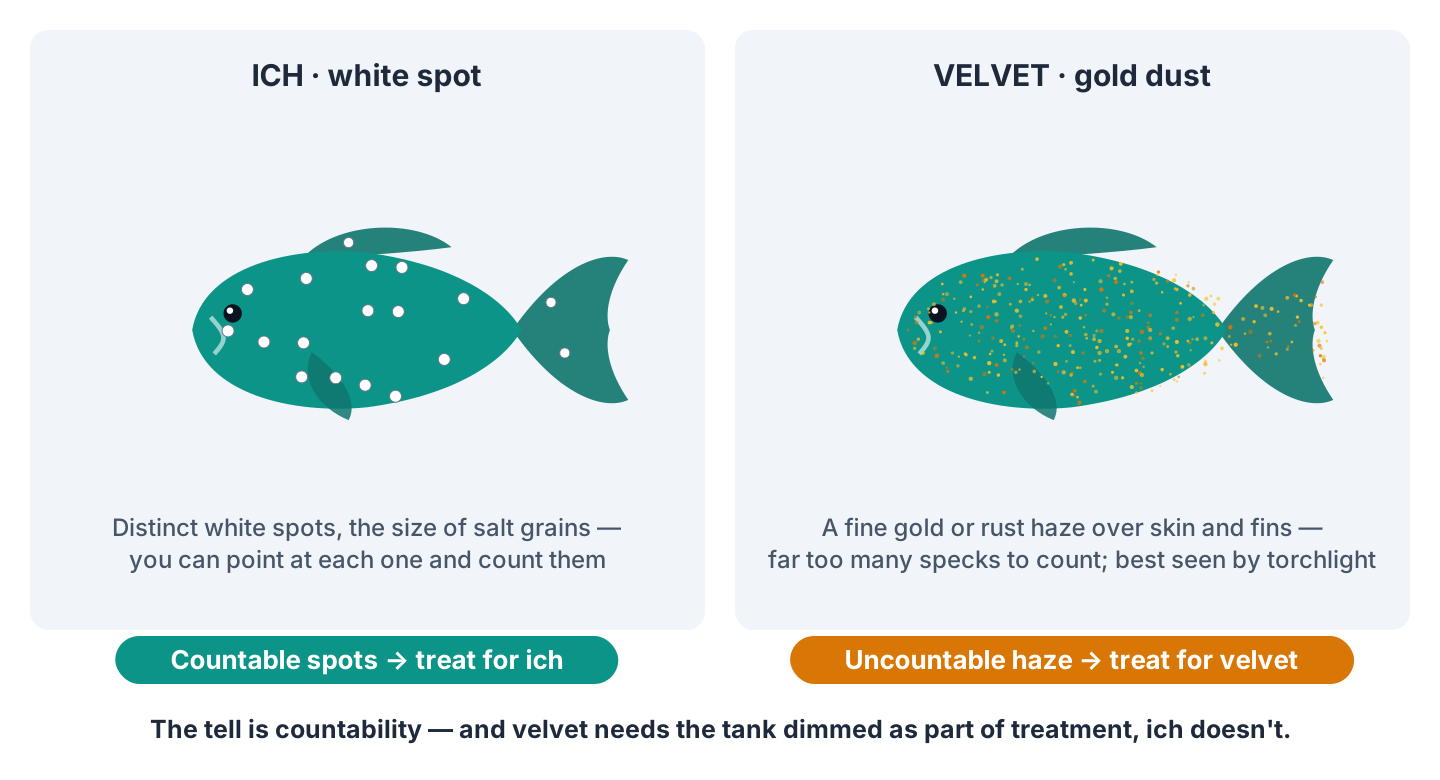
The fastest way to tell them apart
Turn off the room lights, then shine a torch across the fish at an angle. Velvet throws back a fine gold or rust shimmer, almost like the fish has been dusted with metallic powder — and there are far too many specks to count. Ich looks like discrete white dots you could tally on your fingers, and it's just as visible in normal light.
Behaviour helps too. Both cause flashing (scraping against surfaces) and clamped fins, but velvet's early assault on the gills means laboured, rapid breathing often shows up before the coating is obvious. A fish gasping with only a faint golden haze is a velvet red flag.
Ich in detail
Ich is caused by Ichthyophthirius multifiliis, a ciliated protozoan. It produces the classic countable white spots as the parasite burrows into the outer skin layers to feed. It's highly contagious and, untreated, the University of Florida describes outbreaks as capable of 100% mortality — but it responds well to prompt, repeated treatment. Full detail on the symptoms is on the white spots on fish page, and the protocol is in how to treat ich.
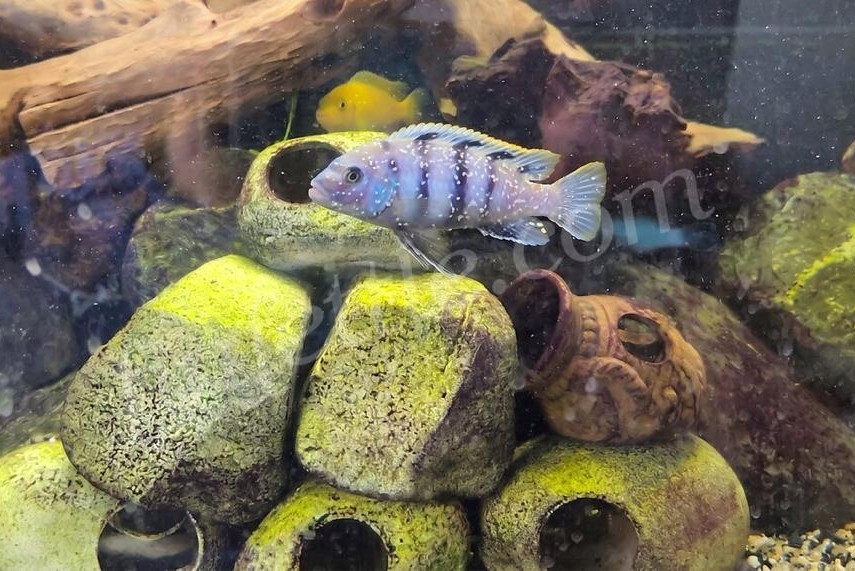
Velvet in detail
Velvet is caused by Piscinoodinium, a parasitic dinoflagellate that — unusually — relies on light to photosynthesise during part of its life. That's why dimming or blacking out the tank is a standard velvet tactic that does nothing for ich. Velvet's dust is finer and usually gold-toned, it moves faster, and it goes for the gills early, which is what makes it more often lethal. Copper-based medications are the common treatment; because velvet spreads so fast, don't wait for certainty if the golden-dust picture is clear. The full velvet plan — signs, lights-off, water checks and when to get help — is on the velvet disease page.
Still not sure?
Gill-heavy cases of either parasite can show almost nothing on the body, and without a microscope you can't be 100% certain — UF/IFAS is explicit that white spots alone aren't a diagnosis. If you truly can't tell:
- Improve aeration immediately — both parasites damage gills, and extra oxygen buys time and is never harmful.
- Raise temperature cautiously and keep water pristine — helpful for both.
- Act on the more likely of the two based on grain size and colour, and watch closely for 24 hours.
- Escalate to an experienced fishkeeper or the shop you bought from if the fish is deteriorating.
What to do for each
For ich, the mainstay is a malachite-green-based product — Ich-X or Faunamor in the US, eSHa EXIT and other Schedule-6 options in the UK — at its label dose, repeated with water changes, plus optional heat. See how to treat ich and my ich treatment picks for the US or UK.
For velvet, reach for a copper-based treatment, dim the tank, and remove invertebrates first (copper is lethal to shrimp and snails). Getting your true water volume right matters for both, since these are dose-by-volume medications:
Free tool
Copper and formalin/malachite treatments are dosed by actual water volume — get the real number before you measure anything out.
Aquarium volume calculator →