
If your betta has developed white spots like grains of salt across its fins and body, that's ich — white spot disease (spellings vary: betta fish ick, betta fish white spot; it's all the same parasite). It's common in bettas, and the cause is usually less about bad luck and more about the tank: bettas are tropical fish, and ich loves a chilled, stressed betta in a small or unheated tank.
That's why a betta with white spot needs two fixes, not one: the parasite, and whatever chilled or stressed the fish in the first place. This page covers what's specific to bettas. For the general picture of the disease, see white spots on fish; for the full protocol, see how to treat ich.
Why ich happens in bettas
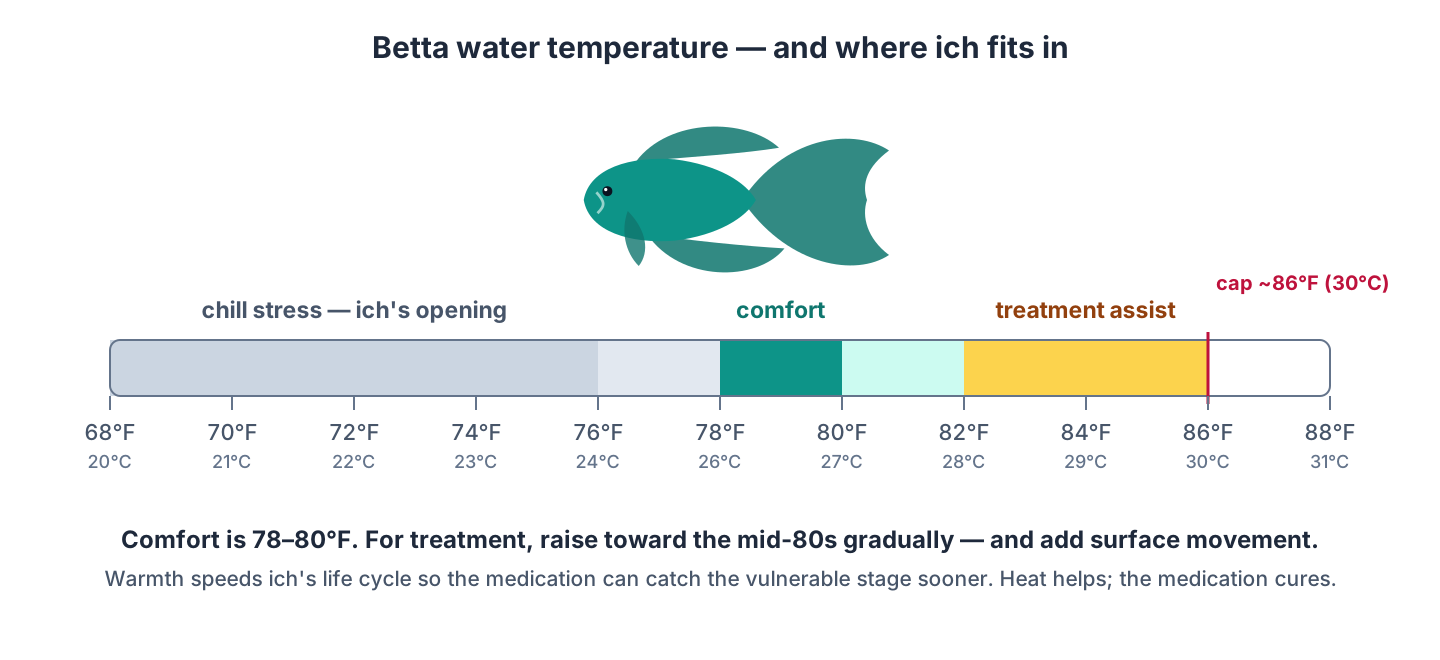
Bettas are often kept in exactly the conditions ich exploits: small tanks, sometimes unheated, sometimes unfiltered. A betta held below its comfortable 78–80°F range is a stressed, immune-suppressed betta, and stress is the opening ich needs. Temperature swings — a tank near a draughty window, or one that cools overnight — are just as bad as being simply too cold.
So with a betta, treating the spots is only half the job. If the tank is a small unheated bowl, the tank is the real diagnosis, and ich will keep coming back until the betta has stable, filtered warmth in enough water volume to hold conditions steady (a heated 5 gallons or more is a sensible floor).
Treating ich in a betta safely
The method is the same as for any fish — warmth, clean water, and a dedicated medication — with two betta-specific cautions:
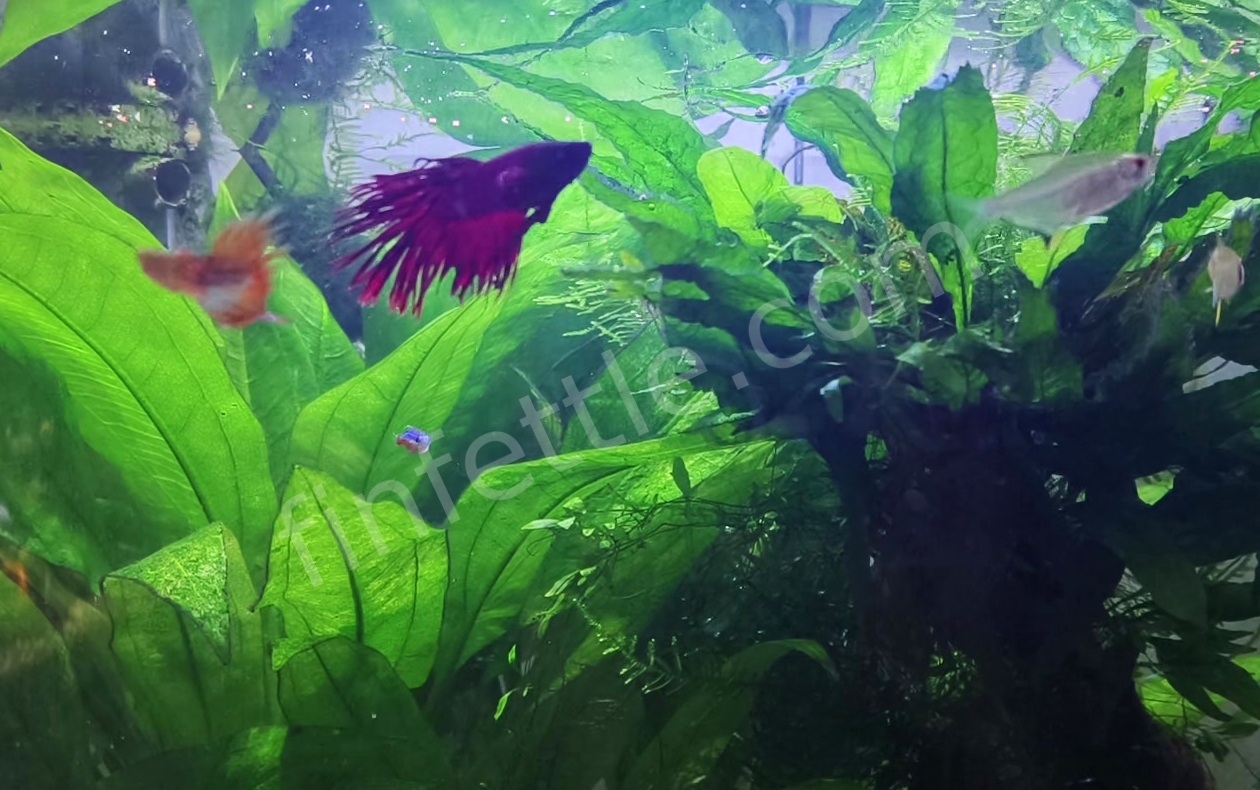
Dosing accuracy matters more. Betta tanks are small, and small volumes are the easiest to overdose. A "5 gallon" tank holds noticeably less than 5 gallons once you account for substrate and decor, and dosing on the box figure can push you over. Work from the real number. (My own betta — a red crowntail — lives in a planted community tank, and it's the same trap I guard against whenever I medicate any of my tanks: measure the water, not the box.)
Free tool
Betta tanks are small enough that a volume error becomes a dosing error fast — get the true water volume before you measure any medication.
Aquarium volume calculator →Heat is on your side here. Because bettas are warm-water fish, a gentle rise toward the mid-80s°F is usually well tolerated and speeds the parasite's cycle so treatment works faster. Raise it slowly and add a little surface movement for oxygen.
On salt: bettas tolerate modest salt better than scaleless fish, but I still don't default to it — if the betta shares a planted or invert tank, salt harms the bystanders, and most malachite-green medications (Ich-X included) say not to run salt alongside them. For a betta kept alone, a proper medication dosed to the real volume is usually cleaner.
Preventing it coming back
Once the ich is gone, prevention is a heating and husbandry problem: a reliable heater set to 78–80°F, a filter, enough water volume to keep conditions stable, and quarantining any new tankmate for about 30 days before it joins the betta. Most ich arrives on new fish, so quarantine is the highest-value habit you can build.
Related
- Ich vs velvet — bettas get velvet too, and it's easy to confuse the two.
- Betta fish velvet — gold dust rather than white spots: signs, look-alikes and what to do.
- Goldfish ich — the coldwater counterpart, where heat and salt need more care.
- Best ich treatments: US · UK — with bettas in mind.