Every new aquarium starts out unable to keep fish alive. Not because of the water, the tank, or the fish — but because it has no way to process fish waste yet. Learning how to cycle an aquarium is the single most important thing you'll do before adding livestock, and it's the reason so many first tanks lose fish in the first month.
This guide walks through what cycling actually is, the two ways to do it, and — the part most guides skip — how to know for certain when it's finished. The method is the same for any tank, from a small betta setup to a six-footer.
What "cycling" actually means
Fish continuously produce ammonia, mostly through their gills and waste. Ammonia is highly toxic; even a small amount burns gills and damages fish. In an established tank you never see it, because two colonies of beneficial bacteria eat it as fast as it appears.
The first colony converts ammonia into nitrite. Nitrite is also toxic. A second colony then converts nitrite into nitrate, which is far less harmful and only needs to be kept in check with routine water changes. This ammonia → nitrite → nitrate chain is the nitrogen cycle aquarium keepers are referring to when they talk about cycling, and it means growing enough of both bacteria colonies so that any ammonia your fish produce is dealt with almost immediately.
Why new tanks kill fish
A brand-new tank has almost none of these bacteria. Add a full load of fish on day one and ammonia climbs with nothing to stop it — the classic "new tank syndrome" that takes out beginner fish. The whole point of cycling is to grow the bacteria first.
The bacteria live on surfaces — mainly your filter media, plus substrate and decor — not floating in the water. That's why you never throw away or deep-clean all your filter media at once: you'd be flushing your biological filter.
Fishless cycling (the forgiving route)
Fishless cycling grows the bacteria colonies before any fish are at risk. You supply the ammonia yourself, so there's nothing living in the tank to harm while the colonies build. That's what makes it the most forgiving route — if life gets in the way and you miss a day of testing, no fish pays for it — which is why it's the easy recommendation for a first tank.
The steps below are the fishless cycle in order. There's a short summary at the top of the page; here's the detail.
Set up and run everything first
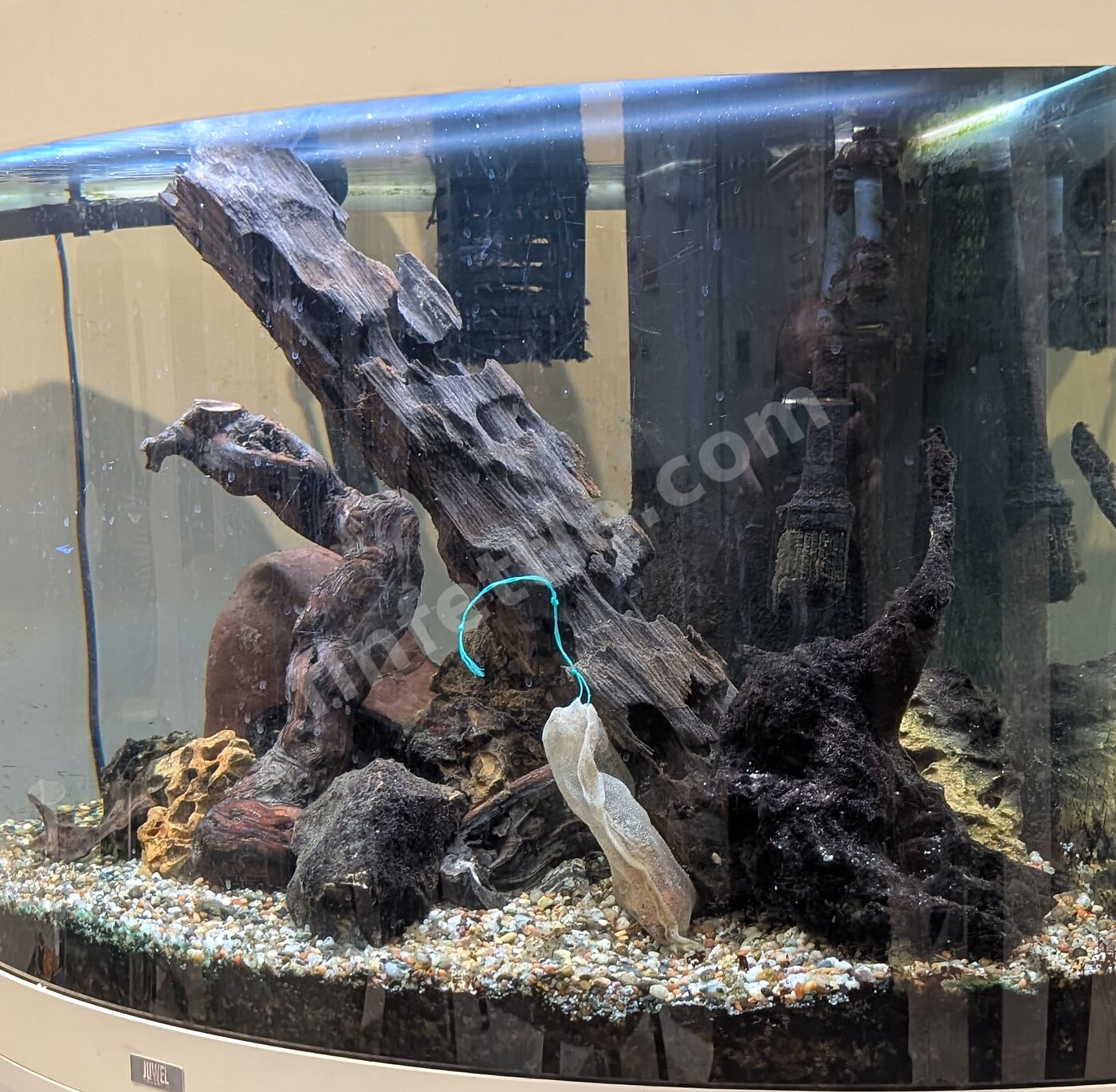
Fill the tank, add substrate and hardscape, and get the filter and heater running 24/7. The bacteria need flowing, oxygenated, warm water and a surface to colonise — running the equipment from the start gives them all three.
Feed it ammonia
Dose bottled ammonia to roughly 2–4 ppm, or drop in a pinch of fish food and let it decay. Both give the first bacteria colony something to eat. Bottled ammonia is cleaner and easier to control, which is why most people prefer it. If yours is Dr Tim's, its drops-per-gallon dose and day-by-day routine are in Dr Tim's ammonia.
Test every day and be patient
Test daily and write the numbers down. You'll watch ammonia rise, then start to fall as the first colony grows — and as it falls, nitrite appears. The second colony grows more slowly, so nitrite often lingers for a couple of weeks. Whenever ammonia reads 0, dose it back up to about 2 ppm so neither colony starves.
Tip
Knowing your tank's real water volume matters here — dosing ammonia (and later, medications) to the box rating instead of the actual volume is a common mistake. My volume calculator gives you the number to dose against.
Confirm it's done — the test that actually matters
This is the step to get right. Your aquarium tank cycle is complete when you can dose ammonia to ~2 ppm and, 24 hours later, read 0 ppm ammonia and 0 ppm nitrite, with nitrate now showing on the test. That's proof both colonies are large enough to clear a full day's waste overnight. A calendar can't tell you this — only the test kit can.
Water change, then stock slowly
Cycling produces nitrate, which builds up over weeks and can read very high by the end. Do a large water change to bring nitrate under 40 ppm, then add fish a few at a time. A fully cycled filter can still be overwhelmed if you add a big group at once, because the colonies size themselves to the waste load they've been fed.
Aquarium cycle with fish (fish-in cycling)
If you're asking how to cycle a fish tank that already has fish in it, this is that method — and it's a proven one that plenty of experienced keepers choose deliberately. It's how I cycled my own first tank. Instead of dosing ammonia yourself, a few hardy fish provide it, and you keep them safe by staying on top of the water while the bacteria establish. Done properly it's often faster to a fully stocked tank than a fishless cycle, because the tank is producing ammonia from day one — there's no waiting to add fish at the end.
The trade-off is diligence. Start with only a few hardy fish, never a full stocking. Test daily, and any time ammonia or nitrite climbs above about 0.25 ppm, do a water change to bring it back down. A dechlorinator that detoxifies ammonia buys you a safety margin between changes. Keep on top of those daily checks and water changes and fish-in cycling works well — the reason beginners are often steered to fishless is simply that it's more forgiving of a missed day, not that fish-in is a worse method.
When it's not just cycling
If fish are gasping at the surface, clamped, or dying despite good numbers, something else may be going on. Sustained ammonia exposure causes lasting gill damage, so persistent problems are worth investigating rather than waiting out.
Common mistakes that stall a cycle
Most stalled cycles come down to a handful of things: cleaning or replacing all the filter media at once (you remove the bacteria you grew); running the tank with no ammonia source, so the colonies starve before fish arrive; dosing to the wrong volume; and — the big one — trusting the calendar instead of a test kit. "It's been two weeks, it must be ready" is how fish die in week three.
How to speed it up
You can't rush biology much, but you can give it a head start. The fastest way to clear the wait is to seed the new filter with material from an established, healthy tank — a handful of mature media, some substrate, or a sponge that's been running elsewhere brings live bacteria with it. Bottled bacteria starters do the same in a bottle, with more variable results — see what controlled tests found in my Fluval Cycle guide. Warmth, oxygen and a steady ammonia supply do the rest.
Once your numbers hold at zero and you've done that final water change, you're ready for fish — added slowly, tested along the way.