
If you set up a tank, added fish the same day, and watched them sicken or die over the next couple of weeks, you almost certainly hit new tank syndrome. It's the single most common reason a first aquarium fails, and the frustrating part is that the tank looks perfectly clean while it's happening. The problem isn't dirt — it's chemistry.
New tank syndrome is really just cycling gone wrong: fish added before the tank could grow the bacteria that process their waste. This page explains what's going on, how to rescue fish that are already in trouble, and how to make sure it never happens again. If you haven't added fish yet, skip ahead to my full guide on how to cycle an aquarium and avoid the problem entirely.
What new tank syndrome actually is
Fish constantly produce ammonia through their gills and waste. Ammonia is highly toxic — even a small amount burns gills and stresses fish. In an established tank you never see it, because colonies of beneficial bacteria eat it as fast as it appears and convert it, in two steps, first to nitrite (also toxic) and then to nitrate (far less harmful).
A brand-new tank has almost none of those bacteria yet. So when you add a full load of fish on day one, ammonia climbs with nothing to stop it. A week or two later, as the first bacteria appear and start making nitrite, nitrite spikes too — and nitrite is dangerous in its own right. This double spike, hitting fish that have nowhere to escape it, is new tank syndrome.
Why the tank looks clean the whole time
Ammonia and nitrite are invisible and odourless in water. The tank can look crystal clear while the levels are lethal. That's exactly why a liquid test kit — not your eyes — is the only way to know what's happening.
How to tell it's new tank syndrome
Two things point to it: the timing and the numbers.
The timing is the giveaway — trouble in the first two to six weeks of a tank's life, especially if you stocked quickly. The fish may gasp at the surface, clamp their fins, rest on the bottom, stop eating, or show reddened gills. Often new fish simply start dying with no spots, fungus, or obvious disease.
The numbers confirm it. Test ammonia and nitrite with a liquid kit: in a new tank with fish, either one reading above 0 ppm is new tank syndrome. According to Texas A&M AgriLife Extension, un-ionised ammonia becomes toxic to fish at very low concentrations, and the toxic fraction rises as pH and temperature climb — so even a "small" ammonia reading can matter more than it looks. Nitrite is the second hit: it converts fish blood to methemoglobin, which can't carry oxygen, so the fish effectively suffocate even in well-aerated water (this is why it's nicknamed "brown blood disease").
Free tool
Rescue water changes are sized against the water that's really in the tank — usually well under the box rating once substrate and rockwork have taken their share. Get your true number here.
Aquarium volume calculator →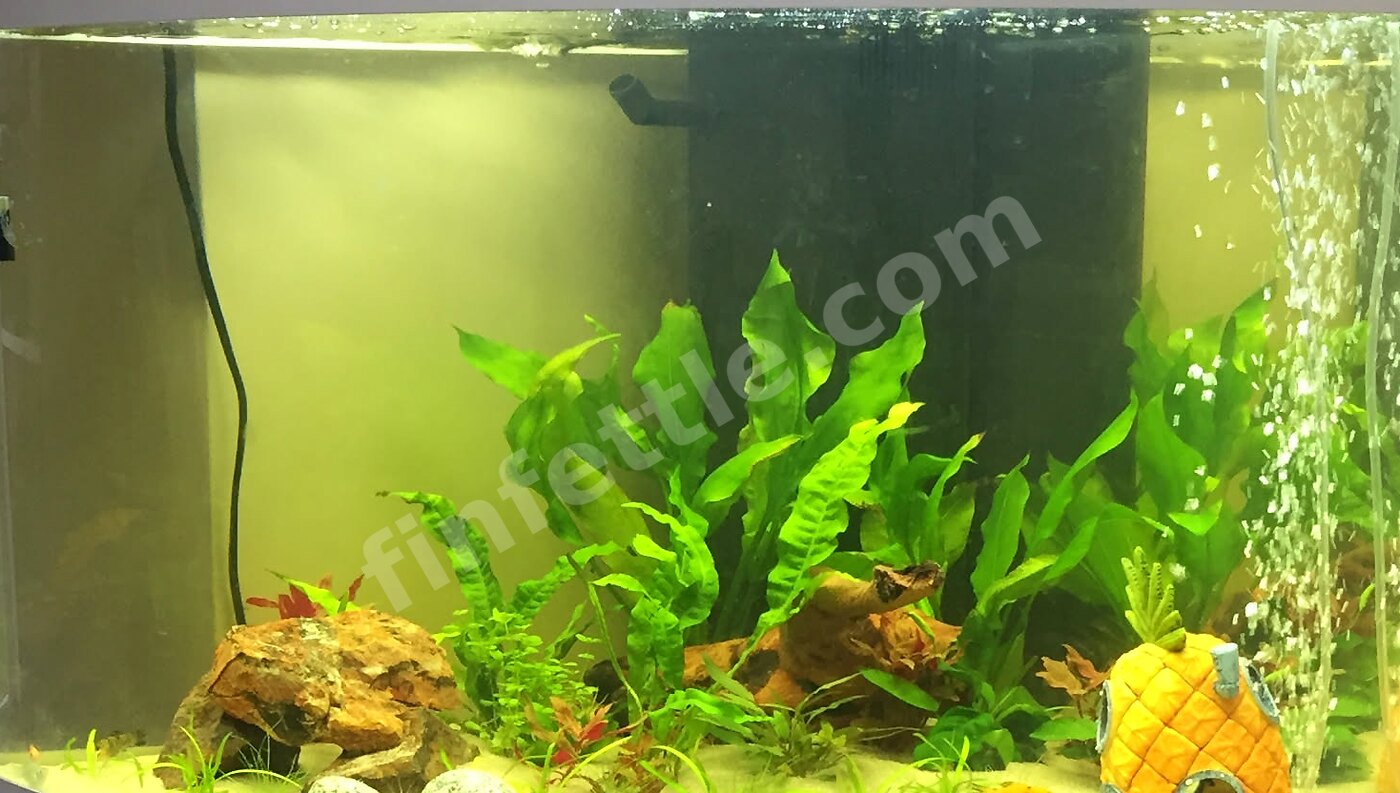
How to fix new tank syndrome (rescue the fish you have)
If fish are already in the tank and struggling, you're going to protect them by hand until the bacteria catch up. The short version is in the step box above; here's the detail.
Test, then change water immediately
Confirm ammonia and nitrite with a test kit, then do a 25–50% water change with dechlorinated, temperature-matched water. This dilutes the toxins straight away — it's the fastest relief you can give. A water conditioner (dechlorinator) is essential, because tap-water chlorine would harm both fish and the bacteria you're trying to grow. Some conditioners also temporarily detoxify ammonia, which buys a margin between changes.
Stop overfeeding
Feed lightly and less often — every other day is fine for most fish short-term. Uneaten food and heavy waste are just more ammonia. Underfeeding for a couple of weeks won't hurt healthy fish; ammonia will.
Keep testing daily and keep changing water
Test every day. Any time ammonia or nitrite rises above about 0.25 ppm, do another water change to pull it back down. It's repetitive, but this is the whole job: hold the toxins low while the filter bacteria multiply. Don't clean or replace the filter media during this — those surfaces are where your new bacteria are living.
Let the cycle finish
Keep the filter and heater running 24/7. Over the following weeks the bacteria colonies grow until they can clear a full day's ammonia and nitrite on their own, and your test readings will settle at 0 ppm for both. That's the tank finishing its cycle — the same finish line described in the cycling guide.
If fish are crashing fast
Sustained ammonia and nitrite exposure causes lasting gill and organ damage, so don't just wait it out if fish are declining rapidly or dying despite water changes. Large, frequent water changes are the safest lever you have; if several fish are affected at once and not improving, something beyond cycling may be involved.
How to prevent it next time
The permanent fix is simple: grow the bacteria before the fish depend on them. The most forgiving route is a fishless cycle — you supply the ammonia yourself, so nothing living is at risk while the colonies build. My cycling guide walks through it step by step.
To be clear, new tank syndrome is not the same as fish-in cycling. Cycling with a few hardy fish is a proven method — often faster, and how many keepers (myself included) started. The difference is management: fish-in cycling means a small number of fish plus daily testing and water changes to keep ammonia and nitrite in check. New tank syndrome is what happens when fish go into an uncycled tank without that — usually too many fish, too soon, and no testing.
The single biggest shortcut is seeding: take mature filter media, a used sponge, or a handful of substrate from an established, healthy tank and put it in your new filter. It carries live bacteria with it and can cut weeks off the wait. Bottled bacteria starters do the same from a bottle, with more variable results.
Whatever you do, stock slowly. A cycled filter sizes itself to the waste load it's been fed, so adding a big group of fish all at once can still trigger a mini-spike. A few fish at a time lets the colonies keep pace.
Keeping a betta? Betta fish new tank syndrome covers what's different in a small betta tank — and why breathing air doesn't protect it.
New tank syndrome vs. cloudy water — not the same thing
New keepers often conflate these. A milky haze in a young tank is usually a bacterial bloom — free-floating bacteria feeding on dissolved nutrients — and it's generally harmless and clears on its own. New tank syndrome is invisible and dangerous. You can have one, the other, both, or neither. The test kit tells them apart: cloudy water with ammonia and nitrite at 0 is cosmetic; clear water with ammonia or nitrite showing is the real problem. If your water is cloudy, see cloudy aquarium water too.
Once your numbers hold at zero without your help, the tank is through it — and if you cycle properly next time, you won't see new tank syndrome again.