
White spots on a goldfish are usually ich (white spot disease), the same parasite that affects tropical fish, especially when they're salt-grain spots scattered over the fins and body. The main harmless look-alike is breeding stars on a male fish (see "One goldfish look-alike to rule out" below). What's different with goldfish is how you apply the treatment, because goldfish are coldwater fish with a heavy waste load, and the usual "crank the heat" advice needs tempering.
This page covers the goldfish-specific angle (and yes — goldfish ick, gold fish ich, white spot: all names for the same disease). The general picture is on white spots on fish, and the full protocol is in how to treat ich.
Why ich happens in goldfish
Goldfish are messy. They eat a lot and produce a lot of waste, so their water fouls faster than most, and poor water quality is the stress that opens the door to ich. They're also very commonly kept in tanks that are too small, underfiltered, or subject to temperature swings — all of which pile on stress. As with any fish, the University of Florida's point holds: ich takes hold most easily on fish that are already struggling.
The practical upshot: a goldfish that keeps getting ich almost always has a tank-size or filtration problem underneath. Solve that and the outbreaks tend to stop.
Treating goldfish ich — the coldwater cautions
The core method is unchanged — confirm it's ich, keep the water pristine, dose a dedicated medication at its label rate, repeat over days, and continue three days past the last spot. (Full transparency: my own tanks are tropical cichlids, not coldwater fish — the goldfish-specific cautions here come from the cited sources, not my fishroom.) Two adjustments matter for goldfish:
Go easier on the heat. With tropical fish, the standard move is to raise temperature toward the mid-80s°F to speed the parasite's cycle. Goldfish are coldwater fish, so a big jump stresses them, and warm water holds less oxygen — a real issue for such a high-waste fish. If you raise the temperature at all, do it gradually, keep it moderate, and add strong aeration. Many goldfish keepers rely more on medication and rigorous water changes than on heat.
Mind the whole tank before using salt. Goldfish tolerate salt reasonably well themselves, but goldfish tanks often contain plants, and sometimes scaleless tankmates like loaches, which don't. Salt that helps the goldfish can harm those bystanders — so I don't default to it. A dedicated ich medication dosed to the true water volume is usually the safer first choice.
Free tool
Goldfish tanks are often large, so a volume mistake becomes a big dosing mistake — get the true water volume before measuring any medication.
Aquarium volume calculator →Then dose. In the US, Ich-X at its label rate (the exact per-volume figure is on Hikari's data sheet and in my treatment guide) or the FDA-legal Faunamor; in the UK, eSHa EXIT or another Schedule-6-exempt product — repeated with water changes as directed, following the current bottle label.
One goldfish look-alike to rule out
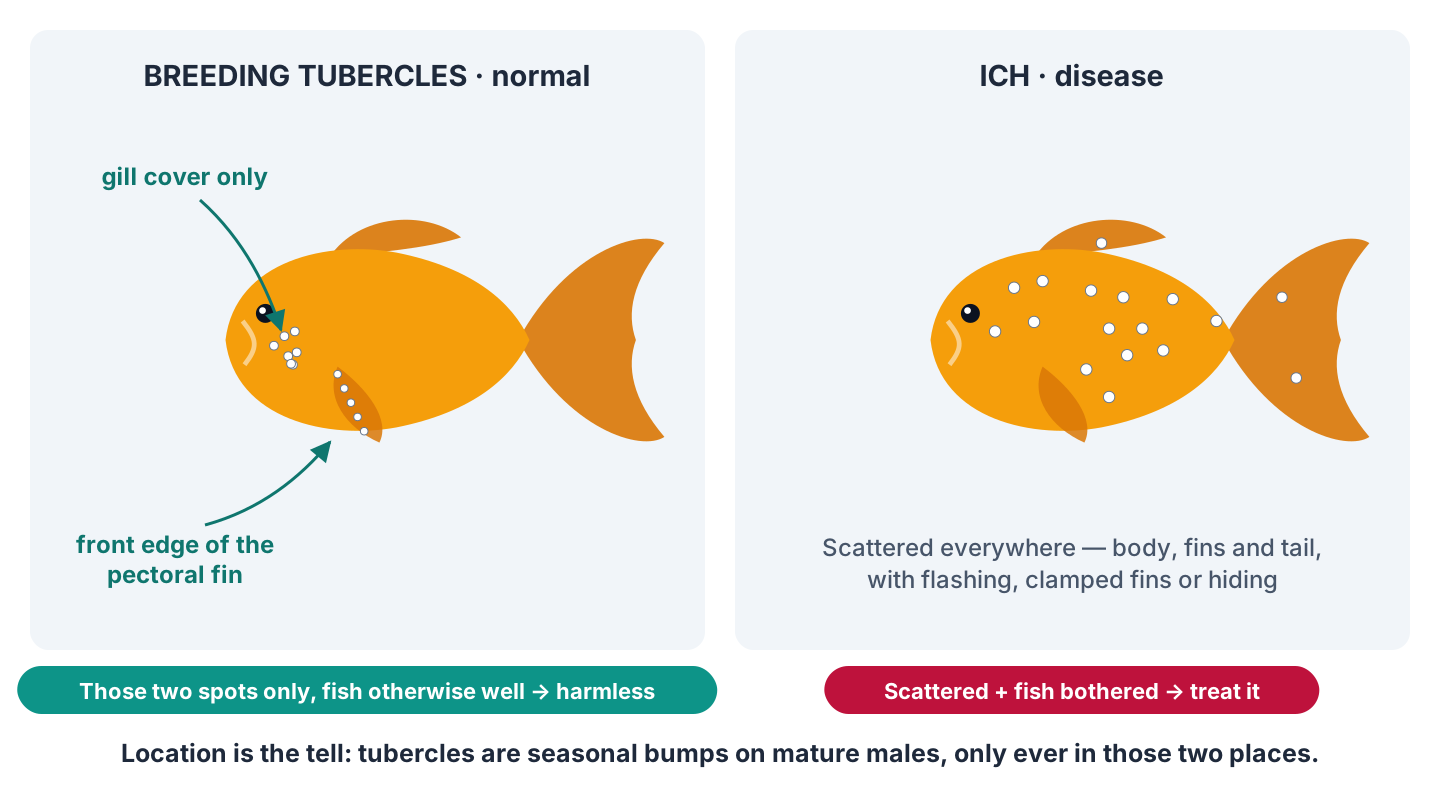
Mature male goldfish in breeding condition grow small white bumps called breeding tubercles (often called breeding stars) on their gill covers and the leading edge of the pectoral fins. These are completely normal and seasonal — not ich. The tell is location: tubercles sit only in those specific spots, while ich scatters across the whole body and fins. If your fish is otherwise healthy and the bumps are only on the gill plates and pectorals, don't treat for a disease that isn't there.
Preventing recurrence
For goldfish, prevention is mostly about space and filtration: a tank large enough for the bioload, strong mechanical and biological filtration, regular water changes, and stable temperature. And as always, quarantine new fish for about 30 days before adding them — the most reliable way to keep ich out of an established goldfish tank.
Related
- Betta ich — the warm-water counterpart, where heat is more freely used.
- Ich vs velvet — telling the two dusty parasites apart.
- Best ich treatments: US · UK.