
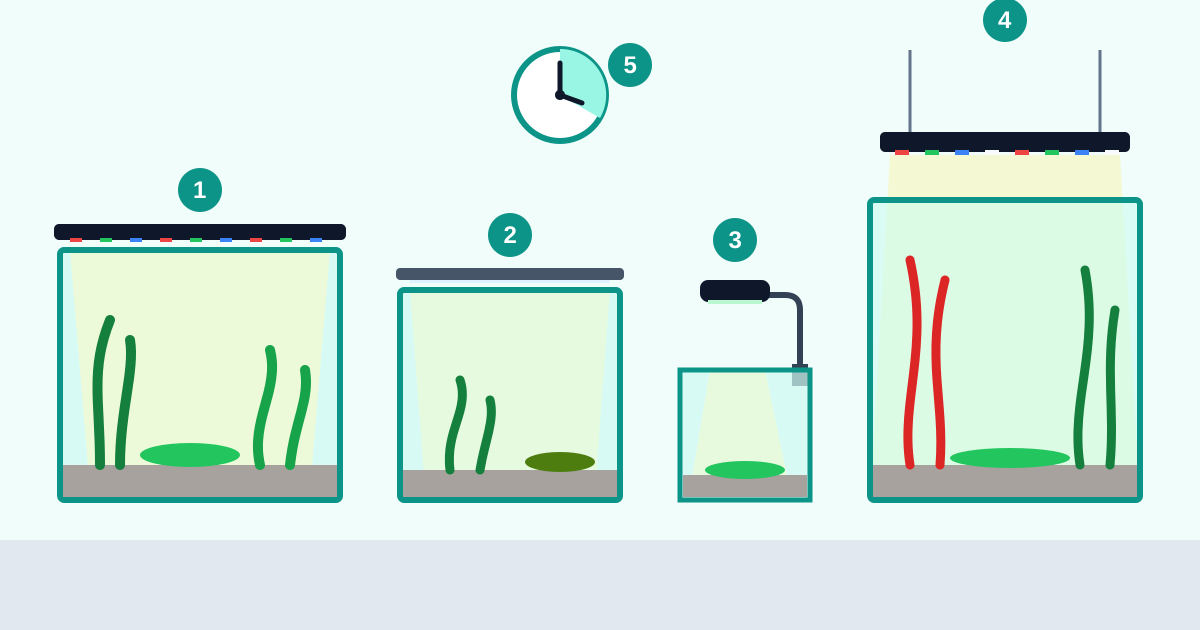
The best planted aquarium light for most tanks is a dimmable LED with separate red, green and blue channels, a built-in timer and a published PAR chart, long enough to cover your tank. If you only keep easy shade plants, a budget LED — or even a decent kit light on a timer — can be enough. Only demanding plants and deep tanks need a high-output light.
This is a short list of five light types, numbered and kept in the same order, each with the one thing it's best for and an honest drawback. It isn't twenty products, and none of the slots is sponsored.
How to read this page
The picks are product types, not lights I've tested side by side. Where I name a model, it's an example a cited reviewer recommends, not a claim from my own bench. How many hours to run the light and how bright it should be are in the planted aquarium lighting guide.
The short answer
Match the light to the plants you want, not to the biggest number on the box:
- Easy, low-light plants (Anubias, Java fern, most crypts): a budget planted LED, or the light you already have on a timer.
- Most common aquarium plants: a dimmable RGB planted LED with a built-in timer — pick 1.
- Red plants, carpets or a CO2-injected tank: a high-output, app-controlled RGB light — pick 4.
- A small nano or rimless tank: a clip-on nano LED — pick 3.
Aquarium Gardens' advice for beginners is to start with a low-light tank: plants grow more slowly, but they need less CO2 and fertiliser and there's less risk of algae. Glass Box Diaries makes the same point more bluntly — more light isn't always better.
The picks
Quick comparison
| # | Light type | Best for | Light level | Control | Relative cost |
|---|---|---|---|---|---|
| 1 | Dimmable RGB planted LED with timer | Most planted tanks | Low to medium | Dimmer, timer, RGB channels | Mid |
| 2 | Budget planted LED with simple timer | Easy low-light plants | Low | Preset timer, brightness steps | Low |
| 3 | Clip-on nano LED | Nano and small rimless tanks | Low to medium (small area) | Varies; often a dimmer | Low to mid |
| 4 | High-output app-controlled RGB LED | CO2 tanks, red plants, deep tanks | Medium to high | App: per-channel dimming, ramps, schedules | High |
| 5 | Plug-in light timer | Any light without a timer | — | On/off schedule | Lowest |
"Relative cost" is a rough ranking, not a price. Prices for these lights change often, so check the current price on the retailer's page.
How I chose
Four things decide whether a light suits a planted tank:
It fits the tank. Check the light's length against the tank so the ends aren't left dark. Glass Box Diaries lists each light it reviews by the tank lengths it suits, and says a size mismatch was behind one of the bad reviews it saw.
It has a PAR chart for your depth. PAR is the plant-usable light reaching the substrate. The 2Hr Aquarist's advice is to read the PAR chart, look at the spectrum, and find photos of real tanks running that light — rather than trusting wattage, LED count or the word "full spectrum", which it calls a marketing term. Deeper tanks need stronger fixtures, because water eats light.
It's dimmable, with a timer. Aquarium Co-Op suggests starting at about 20–40% brightness and turning it up slowly only if there's no algae, and putting the light on a timer so it runs the same hours every day. A light that does both saves you buying pick 5.
It shows plant colour. The 2Hr Aquarist says lights with separate red, green and blue diodes tend to show plant colour better than plain white LEDs, which are often short on red. It also says the Kelvin rating describes the colour your eye sees, not how well a light grows plants — so don't choose on Kelvin.
Free tool
Light needs depend on your tank's length and depth, and fertiliser and CO2 later on depend on how much water it really holds. Measure the tank once and work out its real volume.
Aquarium volume calculator →Each pick, honestly
1. Dimmable RGB planted LED with built-in timer — best overall. This is the light most planted tanks should start with: enough output for most common plants without CO2, colour control to make plants look right, and a timer so you don't need extra kit. As one example, Sunken Treasure Aquatics rates the MagTool Brite as its best bang-for-the-buck light for medium-tech tanks: bright, a good spectrum, and app control. Whatever you buy, check it ticks the boxes under "How I chose". Drawback: turned up too high, it grows algae as happily as plants, so it needs to start dim and short. Check that a PAR chart exists before you buy.
2. Budget planted LED with a simple timer — best budget. For a low-tech tank of easy plants, a cheap light with a few timer settings and a brightness control is often all you need. Glass Box Diaries gives its top entry-level spot to the Seaoura SR616 for beginners and easy plants, citing its 6/10/12-hour timer and separate white and blue channels. Drawback: less control and, the same review notes, a slightly weaker red peak than pricier lights — so red and carpeting plants won't do as well. Sunken Treasure Aquatics' spectrum tests also show cheap "full spectrum" lights vary a lot, from washed-out white to almost no red.
3. Clip-on nano LED — best for nano and small rimless tanks. A rimless or lidless nano has nothing for a light bar to sit on, so a light that clamps to the glass is the neat fix. Sunken Treasure Aquatics calls the LEDSTAR AQ-N "the ultimate nano tank light", and recommends the Week Aqua Z250 Pro as a clip-on for tanks up to about 29 US gallons. Drawback: light from one point spreads over a small area, so the far corners of anything bigger than a nano can be left dim.
4. High-output app-controlled RGB LED — best for CO2 tanks, red plants and deep tanks. If you inject CO2, want red stem plants to colour up, or have a tall tank, this is where more power earns its keep. Sunken Treasure Aquatics' pick for high-tech tanks is the Week Aqua L Series; it also rates the Chihiros WRGB II highly but calls it expensive next to Week Aqua. Drawback: cost, and all that light needs CO2, fertiliser and pruning to keep up — otherwise it feeds algae. Glass Box Diaries says of its own advanced pick that most low-tech planted tanks don't need lighting this powerful. If you're heading this way, read the aquarium CO2 system guide first.
5. Plug-in light timer — best cheap upgrade. If your light has no timer, this is the cheapest improvement you can make to a planted tank. Aquarium Co-Op's case for it: a timer keeps the same schedule every day, even when you forget or go away. Drawback: it only controls when the light runs, not how bright or what colour, so it can't rescue a light that's too weak for your plants.
My own planted tank
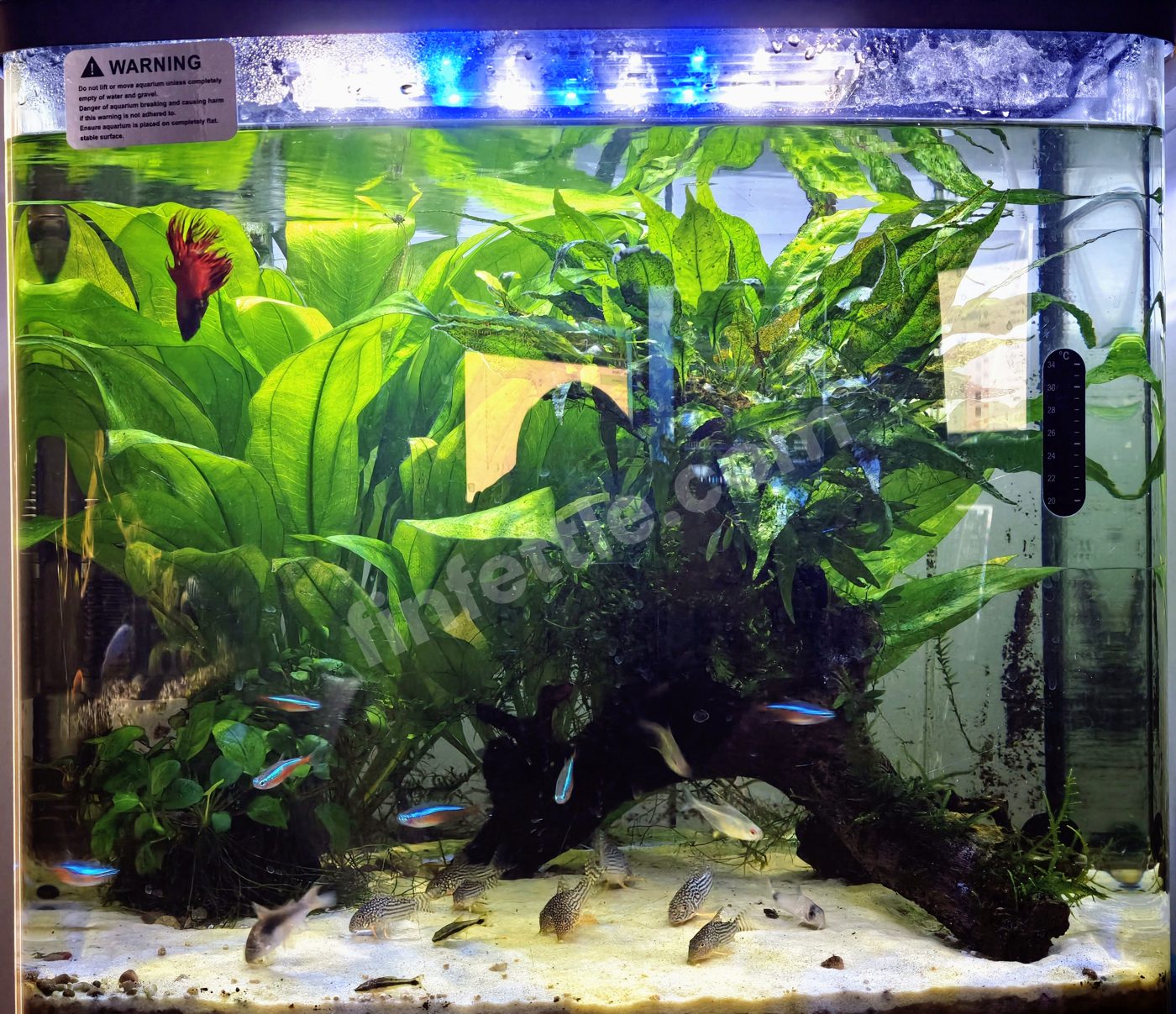
My 90-litre community tank is a Love Fish Vantage aquarium from Pets at Home, and it has been planted from the start. I still run the light it came with: three LED strips, a mix of blue and white. It grows two Amazon swords, an Anubias nana on a coconut shell and a Java fern on driftwood — all easy, low-light plants. I changed the lighting schedule because of algae, and the change helped. The light has no dimmer or built-in timer, so I switch it with a GHome Smart plug, which I schedule from its app and can also control through Google Home.
My Juwel Trigon 190 started out as a planted tank too. I fitted two LED tubes into its original fluorescent tube holders, and the plants grew without problems under them.
So for easy plants, a kit light on a fixed schedule has done the job for me — that's the case for picks 2 and 5. Red and carpeting plants are where, according to the sources above, a stronger RGB light like pick 1 or 4 earns its price.
What you can skip
- Buying on watts or LED count. Glass Box Diaries warns that LED count doesn't tell the whole story; the size and type of LED matter. Look for a PAR chart instead.
- Choosing on Kelvin or "full spectrum". The 2Hr Aquarist calls both marketing shorthand rather than a growing specification.
- Shop lights and DIY bulbs as your main light. Aquarium Co-Op says cheap shop lights may not spread the light properly across a tank.
- More light than your plants need. If you keep Anubias and Java fern, a high-output light mostly buys you algae. Aquarium Gardens recommends beginners start low-light for exactly this reason.
- Leaving it on all night. Aquarium Co-Op says to switch planted-tank lights off at night — even a blue moonlight mode — because plants need a dark period and algae will use the spare light.
Put it to work
Once you have a light, the planted aquarium lighting guide covers how many hours to run it, how bright to set it, and what to change when algae shows up. Planning CO2 alongside a brighter light? See the aquarium CO2 system guide. And if the tank is brand new, make sure it's cycled before fish go in.