
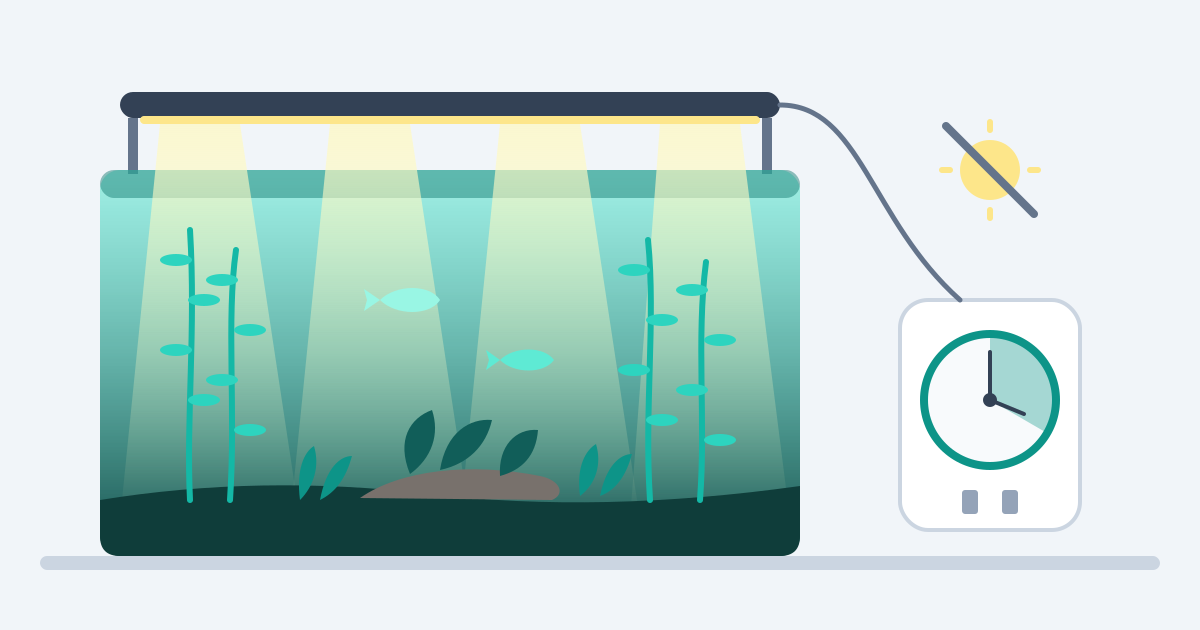
Lighting for planted aquariums comes down to three things: how many hours the light is on, how bright it is where the plants actually grow, and whether the light fits your tank. For most tanks that means about 6–8 hours a day on a timer, a brightness matched to the plants you keep, and a dimmable aquarium LED that covers the tank's length and reaches its depth.
Too little light and plants struggle. Too much and algae gets in first. This guide covers lighting a planted aquarium step by step — hours, intensity, choosing a light, and what to change when algae shows up — and points out where the main sources on planted aquarium lighting disagree, because they do.
How many hours a day should the light be on?
Plants and algae use the same light, so more hours isn't automatically better. Here's what three well-known planted-tank sources recommend:
| Situation | The 2Hr Aquarist | Aquarium Gardens | Aquarium Co-Op |
|---|---|---|---|
| New planted tank | 5–6 hours (first 4–6 weeks) | No more than 6 hours (first month) | Start at 6–8 hours |
| Established tank, no CO2 | 7–8 hours | No more than 8 hours | Up to 8–12 hours as plants grow |
| Established tank with CO2 | 8–9 hours | — | — |
| Fighting algae | 5–6 hours | — | Cut the hours back |
The overlap is about 6–8 hours for an established tank, with a shorter start while new plants settle in. The 2Hr Aquarist adds that past about 12 hours you get little extra growth and more algae risk.
Three more points worth following:
- Use a timer. Aquarium Co-Op's point is simple: timers are more reliable than people. The light comes on and goes off at the same time every day, even when you're ill or away.
- Don't run it all night. Aquarium Co-Op says to switch the light off at night — even a blue "moonlight" mode — because plants need a dark period and algae will use the spare light.
- Keep the tank out of direct sunlight. Sun changes with the weather and the seasons, so you lose control of how much light the plants get. Both Aquarium Co-Op and the 2Hr Aquarist say this.
Where they disagree: the midday "siesta". Aquarium Co-Op mentions splitting the day — light on in the morning, off while you're out, on again in the evening — as something some keepers do. The 2Hr Aquarist says a split photoperiod isn't useful for plants and recommends one continuous window. If you don't need the split to see the tank, one block is the simpler choice.
How bright does a planted aquarium light need to be?
Hours are only half of it. The other half is intensity — how much usable light reaches the plants. Planted-tank keepers measure it as PAR (photosynthetically active radiation), in µmol per square metre per second, at the substrate, not at the lamp.
The 2Hr Aquarist's rough bands:
| Light level at the substrate | Suits |
|---|---|
| Low: 10–30 µmol | Shade plants — Java fern, Anubias, most Cryptocorynes, mosses, Bucephalandra |
| Medium: 40–90 µmol | Most common aquarium plants |
| High: 90–150 µmol | Red plants and more demanding species; faster growth, more upkeep |
| Very high: 200+ µmol | Denser growth and colour, at a higher algae risk |
Other sources draw these lines a little differently, so treat them as a guide rather than exact cut-offs. Two points from the same source matter more than the exact numbers:
- Depth eats light. Light weakens as it passes through water, so a fixture that's plenty for a shallow tank can be weak at the bottom of a deep one. Dirty glass and cover glass block some light too.
- More hours won't fix too little intensity. If your plants need more light than they're getting, running the light 12 hours instead of 8 doesn't close the gap — it mostly feeds algae.
You'll still see the old watts-per-litre rule. Aquarium Gardens gives it for T5 fluorescent tubes: about 0.25 W per litre for low light, 0.5 for medium and 0.8–1.0 for high. It was written for fluorescent tubes, so it doesn't carry over neatly to LEDs. For an LED, the manufacturer's PAR chart is the better guide.
Most beginners do best at the low end. Aquarium Gardens' advice is that a low-light tank is easier: plants grow more slowly, but they need less CO2 and fertiliser and there's less risk of algae. More light means faster growth, and faster growth needs more CO2, nutrients and pruning to keep up.
Free tool
Light needs depend on how deep your tank is, and fertiliser and CO2 later on depend on how much water it really holds. Measure the tank once and work out its real volume.
Aquarium volume calculator →Choosing a planted aquarium light
Aquarium Co-Op says the lights that come with aquarium kits are often too dim for a planted tank, and cheap shop lights may not spread the light properly. If you're buying lights for planted aquariums, this is what to check:
- It fits the tank. Check the light's length against your tank so the ends aren't left dark.
- There's a PAR chart for your depth. The 2Hr Aquarist's advice is to read the PAR chart, look at the spectrum, and find photos of real tanks running that light — rather than trusting wattage or marketing terms.
- It's dimmable. Aquarium Co-Op suggests starting at about 20–40% brightness and turning it up slowly only if there's no algae. A dimmer lets one light handle both low-light and higher-light plants.
- It has a timer, or you add one. If the light has no built-in timer, a cheap plug-in one does the job.
- Don't buy on Kelvin or "full spectrum". Aquarium Gardens says plants aren't fussy about colour temperature and suggests 6,000–8,000K because it looks good. The 2Hr Aquarist goes further: the K number only describes the colour your eye sees, and "full spectrum" is a marketing term. It also says lights with separate red, green and blue diodes tend to show plant colours better than plain white LEDs.
If a light isn't dimmable and turns out too strong, Aquarium Co-Op and Aquarium Gardens both suggest raising it higher above the water. Aquarium Co-Op also suggests covering some of the LEDs with black electrical tape.
Too much light and algae
Algae is the usual sign the light is out of balance with everything else. Aquarium Co-Op's method for tanks without CO2: make one change at a time and wait two weeks before the next, so you can tell what worked. Shorten the hours or dim the light first.
But light isn't the only cause. The 2Hr Aquarist points out that some algae, such as black brush algae, can grow in low light if other triggers are there: decaying old leaves, organic waste on the substrate, a filter that's choked, ammonia spikes or newly planted stems that haven't settled. Trimming old leaves, vacuuming waste and keeping the filter working matter as much as the timer. It also says blue light doesn't cause algae on its own.
If the water is milky rather than green, that's more likely a bacterial bloom than algae — see the bacterial bloom guide. And if the tank is brand new, make sure it's cycled first: the cycling guide covers it.
My own planted tank
I keep a 90-litre community tank that has been planted from the start. The hours and PAR figures on this page come from the sources cited below, not from measurements I've taken on my tank.