
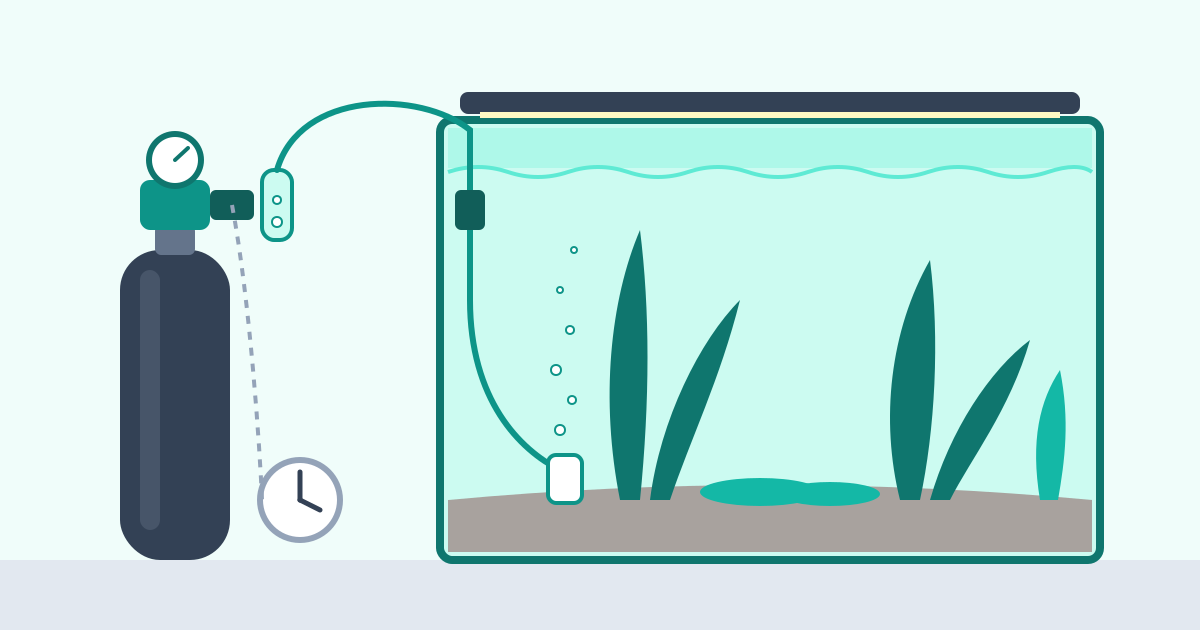
An aquarium CO2 system adds carbon dioxide gas to the water so your plants can grow faster, fuller and more evenly. The standard pressurised setup is a cylinder, a regulator with a solenoid, a bubble counter, CO2 tubing, a check valve and a diffuser or reactor, switched on and off by a timer. Cheaper DIY generators and gas-free liquid carbon also exist — and plenty of low-light planted tanks don't need any of them.
This guide covers whether your tank needs CO2, the main types of system, what to look for in an aquarium CO2 regulator, how to set one up, and how to keep CO2 at a level that helps plants without hurting fish.
Do you need CO2 at all?
Not every planted tank does. Aquarium Co-Op splits planted tanks into two broad styles:
- Low tech: modest lighting, no added CO2 and light fertilising about once a week. Cheaper to set up and easier to look after.
- High tech: bright lighting, pressurised CO2 and heavier fertilising. Faster, denser growth, but it costs more and needs more upkeep.
Slow, undemanding plants such as Java fern and Anubias grow well in a low-tech tank. CO2 starts to matter when you want carpets, dense stem plants or strong red colour. Aquarium Co-Op gives dwarf baby tears as an example: a thick carpet is hard to get without high light and pressurised CO2, though it can be done slowly in a lower-tech tank.
One myth worth dropping: CO2 isn't only for bright tanks. The 2Hr Aquarist says low-light tanks with CO2 are viable and easier to manage than high-light ones, and that bright light with too little CO2 is the riskier mix, because it hands algae the advantage. If you're still choosing your light, the planted aquarium lighting guide covers that side.
Types of aquarium CO2 system
| Type | How it works | Good for | Watch out for |
|---|---|---|---|
| Pressurised | A cylinder of CO2, a regulator and solenoid on a timer, and a diffuser or reactor | Any size of tank; steady, adjustable CO2 | Highest upfront cost; the cylinder needs refilling every few months |
| Citric acid kit | Citric acid and baking soda react in a bottle and release gas | Smaller tanks | Output isn't as precise as a cylinder |
| DIY yeast | Yeast and sugar ferment in a bottle | Small tanks, modest expectations | Frequent remixing; output drifts, and swings can trigger algae |
| Liquid carbon | A carbon supplement dosed into the water — no gas | Low-tech tanks wanting a boost | Less effect than real CO2; some plants are sensitive to it |
The first three rows follow the 2Hr Aquarist's comparison. It says citric acid kits are steadier than old-style yeast bottles and work for smaller tanks, while yeast is the cheapest but needs the most attention. For serious planted tanks, its recommendation is a pressurised system. Liquid carbon gets its own section below.
Parts of a pressurised CO2 system
According to the 2Hr Aquarist's setup guide, a complete pressurised system has six parts:
- Cylinder — stores the CO2 under pressure. Pick a size that fits your cabinet and that you can carry for refills; bigger cylinders cost less per kilo to fill, and one cylinder can feed several tanks through a manifold.
- Regulator with solenoid — the regulator brings the cylinder pressure down to something the tank can use, and the solenoid is an electric valve that lets a timer switch the gas on and off. They're usually sold as one unit.
- Bubble counter — a small liquid-filled chamber that shows gas flowing. It gives a rough idea of the rate, not a measurement of CO2 in the water.
- CO2 tubing — dedicated polyurethane tubing. Standard silicone airline lets gas escape and can't take the higher working pressure some diffusers need.
- Check valve — stops tank water flowing back up the line into the bubble counter and regulator. It goes before the diffuser.
- Diffuser, inline atomiser or reactor — dissolves the gas into the water. You only need one. In-tank diffusers sit inside the aquarium; atomisers and reactors fit on the filter's outflow, and the 2Hr Aquarist says inline reactors dissolve CO2 50–100% more efficiently than in-tank diffusers.
A timer and a way to measure CO2 (next sections) complete the setup.
Choosing an aquarium CO2 regulator
The regulator is the part people spend most time comparing, and it's the one that's hardest to swap later. When you shop for a CO2 regulator, the aquarium-specific things to check are:
- A solenoid. This is the non-negotiable one. The 2Hr Aquarist says regulators without a solenoid can't be turned off by a power timer and should be avoided — otherwise CO2 runs through the night, when plants aren't using it.
- A needle valve that adjusts smoothly. The needle valve sets the flow, and the 2Hr Aquarist stresses making CO2 changes gradually, so you want a knob that moves in small, repeatable steps.
- A fitting that matches your cylinder. Check that the regulator fits the cylinder you'll actually buy and get refilled locally before you order either.
- Room to grow. If you might run more than one tank, a regulator that takes a manifold lets one cylinder serve them all.
There's no single best aquarium CO2 regulator for everyone: a nano tank and a 300-litre tank need different cylinders and diffusion, and what matters most is a solenoid, smooth adjustment and a fit with the cylinder you can get filled. Complete kits bundle the regulator with a bubble counter, check valve and diffuser, which saves matching parts yourself.
Setting it up and timing it
The 2Hr Aquarist's setup order, in short:
- Screw the regulator onto the cylinder. The seal comes from the O-ring, so don't add thread-seal tape to that joint.
- Open the cylinder valve, then connect the bubble counter, tubing, check valve and diffuser.
- Check for leaks by brushing soapy water on every joint while gas flows. Large bubbles mean a leak.
- Put the solenoid on a timer. Start the CO2 2–3 hours before the lights come on and switch it off about an hour before lights out. CO2 takes hours to build up in the water, so starting early means it's there when the plants need it.
- Start conservatively. The 2Hr Aquarist's starting point is 1 bubble per second for every 2 square feet of water surface, then gradual increases.
- Keep the water surface clean with a slight ripple, so excess CO2 can escape and oxygen stays up.
If you're adding fish to a tank that already runs CO2, the 2Hr Aquarist suggests doing it when CO2 is at its lowest, so they can get used to it gradually.
Free tool
CO2 starting rates are based on surface area, and liquid carbon is dosed by litres. Measure your tank once and work out its real volume.
Aquarium volume calculator →How much CO2, and how to measure it
The 2Hr Aquarist suggests 25–35 ppm as a starting target. You can't read that off the bubble counter — bubble sizes differ between counters, and tank shape, flow and diffusion all change how much dissolves — so measure the water instead:
- Drop checker. A small glass with a colour-changing solution that sits in the tank: blue is low, green is the target, yellow is too much. The 2Hr Aquarist warns that the usual solution turns green at only about 10–15 ppm, not 30, and lags the tank by 60–90 minutes. It's a fair minimum check for easy plants.
- pH-drop method. CO2 lowers pH, so you compare the tank's pH at peak CO2 with a degassed sample of the same water — shaken or stirred in the air for a few minutes first. With KH between 1 and 10 dKH, a drop of about 1.0 corresponds roughly to 30 ppm or more.
The best sign it's working is the plants' new growth: fuller, larger, better-formed leaves. Old leaves grew under the old conditions and won't change.
Too much CO2: signs and what to do
CO2 helps plants grow, but too much of it harms fish. The 2Hr Aquarist's warning signs:
- Early: fish become lethargic and less keen to feed.
- Serious: fish gasping at the surface. Turn the CO2 down and improve surface movement. In an emergency, a large water change brings the level down quickly.
The margin is fairly wide for most community fish. The same source says small tetras and barbs typically show distress only around 60–70 ppm and Otocinclus hang near the surface around 60 ppm, but discus react nearer 40 ppm. If your fish are gasping and you don't run CO2, the cause is something else — see why fish gasp at the surface.
Liquid carbon: the no-gas option
Liquid carbon is a bottle you dose into the water instead of a gas system. Seachem's Flourish Excel is the best-known example. Seachem calls it a bioavailable organic carbon source, not CO2, and says it doesn't affect pH. Its own comparison: if CO2 is a 10, Flourish Excel is a 6–7, and the two can be used together. The trade-off is no equipment cost, set against less growth than real CO2.
Seachem's label directions, word for word: "On initial use or after a major (> 40%) water change, use 1 capful (5 mL) for every 40 L (10 US gallons). Thereafter use 1 capful for every 200 L (50 US gallons) daily or every other day." Seachem also notes that Anacharis is sensitive to it and recommends dosing every other day rather than daily if you keep that plant, and warns against overdosing it or applying it directly onto plants. Follow the label on the bottle you buy.
On my own tanks I've used Seachem Flourish Excel occasionally, and only when a tank is first being set up.
Where CO2 fits in a planted tank
CO2 is one of three things plants need in balance: light, carbon and nutrients. Adding more of one without the others usually feeds algae rather than plants. If you're starting a new planted tank, make sure it's cycled before adding fish, get the lighting right, and decide on CO2 based on the plants you actually want to grow.