
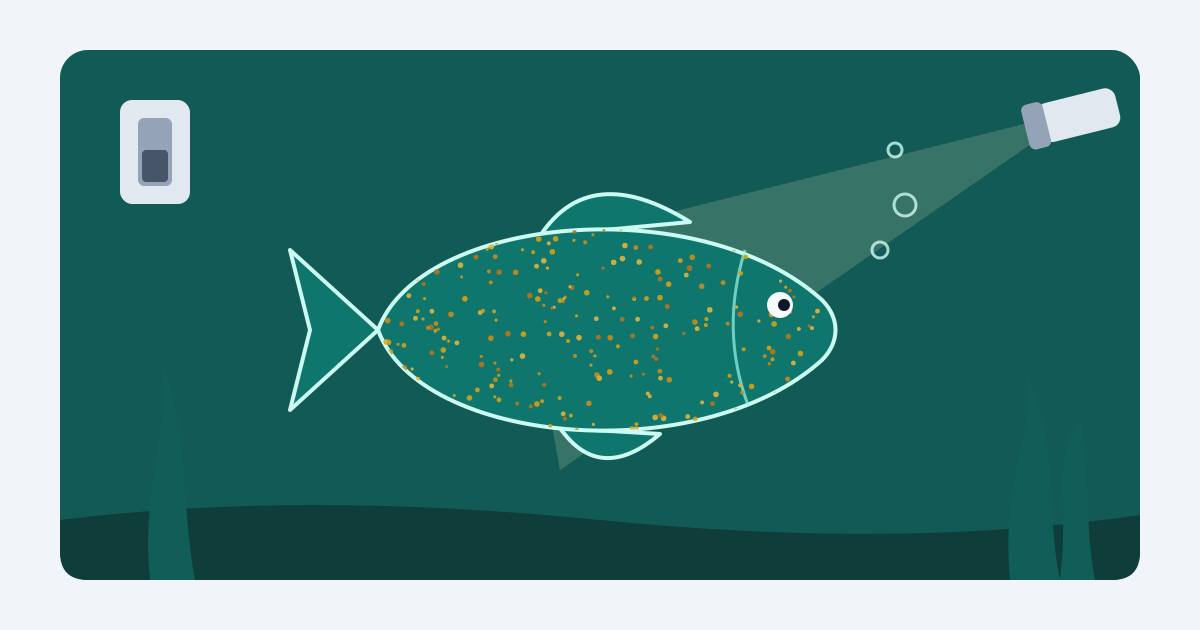
If your fish looks like it's been dusted with fine gold, yellow or rust-coloured powder, the most likely cause is velvet disease — a parasite that's rare in freshwater tanks, but can move fast and kill fish quickly if it's left untreated. (You'll also see it searched as fish velvet disease or fish disease velvet; it's also called gold-dust or rust disease.)
Velvet is treatable, but it doesn't give you much time. The plan is simple: confirm it's velvet, dim the lights, check your water, then treat properly and finish the course. This page leans on vet and specialist sources, cited as it goes.
Is it actually velvet?
The Merck Veterinary Manual describes velvet as causing "small golden spots on skin", which is where the gold-dust and rust names come from. In practice it looks less like spots and more like a fine, even film or sheen — far too many specks to count.
What to look for:
- A gold, yellow or rust-coloured dust that can appear anywhere on the body and fins. AquariumScience.org is blunt about it: velvet has to be gold-coloured — white patches are something else.
- Fast or laboured breathing, sometimes gasping at the surface. The parasite goes for the gills early, and AquariumScience.org notes it can be hard to spot at first for exactly that reason. Merck adds that on the gills it may not be visible at all.
- Flashing (scraping against rocks or substrate), clamped fins, lethargy and going off food — listed by Tree of Life Exotics as common signs (Fritz Aquatics describes the clamped fins, scratching and poor appetite too).
A common hobby tip — the torch test: turn off the room lights and shine a torch across the fish at an angle. Velvet catches the light as a golden shimmer that's hard to see in normal lighting.
The look-alike that matters most is ich (white spot): distinct white dots, like grains of salt, that you can count one by one. If the spots are white and countable, start with white spots on fish instead. If you're torn between the two, the side-by-side table and diagram in ich vs velvet is the quickest way to decide — the right treatment differs.
Freshwater velvet isn't the same as marine velvet
Many of the top search results for velvet are about saltwater tanks. Marine velvet is caused by a different parasite (Amyloodinium); freshwater velvet is Piscinoodinium (Merck). Treatments and timings from reef forums don't transfer directly — this page is about freshwater tanks.
Check your water first
Poor water stresses fish and leaves them less able to cope with any parasite, and Tree of Life lists good water quality alongside quarantine as the way to prevent velvet. Before you treat, test ammonia, nitrite, nitrate and temperature. Any ammonia or nitrite above 0 ppm needs fixing alongside the velvet — a water change with dechlorinated, temperature-matched water is the first move. If the tank is new, how to cycle an aquarium explains why those numbers spike.
More options and how I chose them are on my aquarium test kit page.
What to do now — the plan
Velvet can kill quickly if it's left untreated (Tree of Life Exotics), so don't wait days to be sure if the gold-dust picture is clear. The parasite has three stages: one attached to the fish, a cyst that divides, and free-swimming spores that look for a new host. Tree of Life notes that only the free-swimming stage can be killed by treatment, and that the whole cycle can run in as little as 4–7 days in warm water — which is why treatment has to run long enough to catch every new wave.
- Dim or switch off the tank lights. Freshwater velvet uses light to photosynthesise for part of its life (Fritz Aquatics; Tree of Life), so darkness takes away one of its energy sources. Keep the tank dark during treatment (Fritz suggests dimming for several days). It won't cure velvet on its own, but it's a step that's specific to velvet.
- Add aeration. Velvet damages the gills, so extra surface movement or an air stone helps the fish while its gills are struggling.
- Take out shrimp, snails and other invertebrates. Copper, the usual velvet treatment, is toxic to them — AquariumScience.org advises against using copper in any tank with shrimp, snails or crayfish. Moving them to another tank before you dose is the simplest way round that.
- Treat with a copper-based medicine, exactly as its label directs. Merck, Tree of Life and Fritz all point to copper as the usual treatment. Dose by your real water volume, not the size printed on the box, and follow the label on course length. Copper can harm fish too if it's overdosed — Tree of Life stresses that copper levels must be monitored closely, so measure carefully and never top up "just in case". Fritz notes to stop carbon filtration during treatment, since carbon pulls medicine out of the water — check what your product's label says.
- Finish the full course, even if the dust fades early. Treatment only kills the free-swimming stage, so stopping as soon as the fish look clean can leave cysts behind to release a new wave.
Free tool
Copper treatments are dosed by true water volume — substrate and rocks can take a real bite out of the number on the box. Work it out before you measure anything.
Aquarium volume calculator →On temperature, sources disagree. Tree of Life suggests raising it slightly, if your species tolerates it, to speed up the parasite's cycle; AquariumScience.org says not to raise it. If you do raise it, go slowly, stay within your fish's range, and add extra aeration — warmer water holds less oxygen, and velvet has already damaged the gills.
Treat the whole tank. Tree of Life describes velvet as highly contagious and advises treating the main aquarium when other fish are present. If one fish has velvet, assume the others are exposed: the free-swimming stage is already in the water.
I don't name specific copper products here on purpose. None has yet been through the same UK check I use for treatment picks (see my UK ich treatment page for how that works), so I'd rather you pick one from a reputable aquatics shop and follow its label than trust a name from me.
When to get expert help
Don't just keep dosing
Get help from an aquatic vet (or at least an experienced fishkeeper or the shop you bought the fish from) if fish are dying despite correct treatment, several fish are gasping at the surface, or you can't tell velvet from ich. A vet can confirm velvet with a "wet mount" (Merck's listed diagnostic) — a small skin or gill sample looked at under a microscope. This page is educational and husbandry-first; it's not a substitute for a vet.
If breathing is the main symptom and you're not seeing any dust at all, other causes are possible too — low oxygen, ammonia, a recent water change. Fish gasping at the surface walks through those.
Preventing velvet
Tree of Life recommends quarantining every new fish for 2–4 weeks in a separate tank before it joins your main tank, and keeping an eye on it during that time.
AquariumScience.org describes velvet as very rare in tropical freshwater tanks. That's reassuring, but it also means many keepers have never seen it, so it's easy to mistake for ich or to miss until the gills are badly affected.