
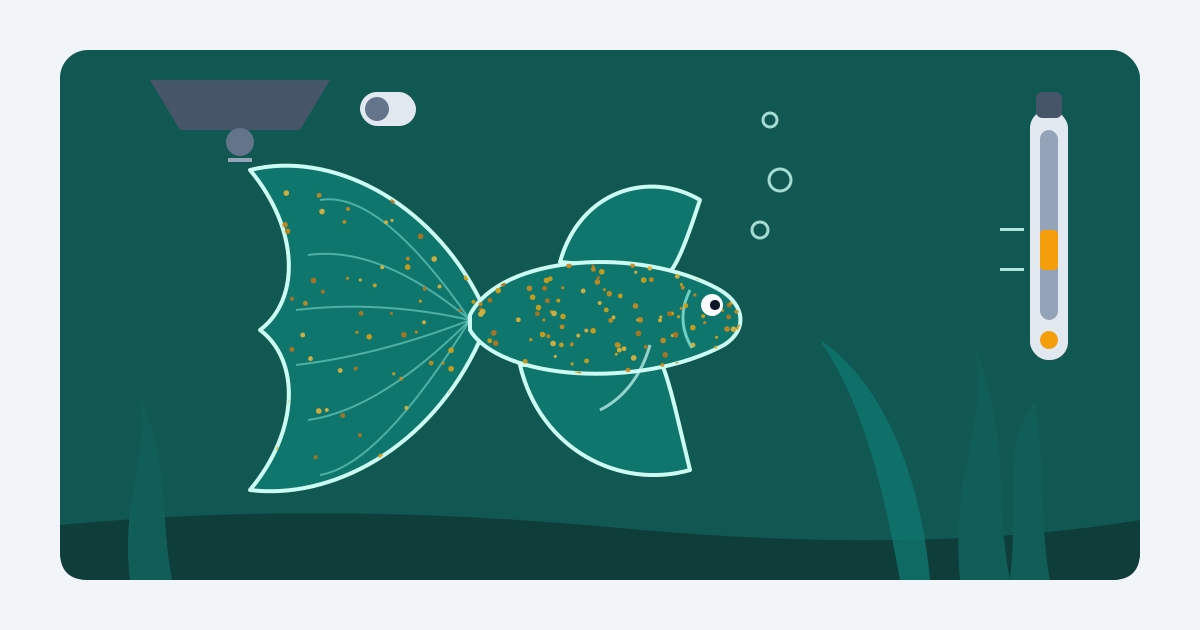
If your betta looks like it's been dusted with fine gold, yellow or rust-coloured powder, the most likely cause is velvet — a parasite that can move fast and kill fish quickly if it's left untreated. (It's also searched as betta fish velvet disease; other names are gold-dust and rust disease.)
This page is the betta lens. For the full picture of the disease in any freshwater fish, see velvet disease. Here's what's different when the fish is a betta: what to look for, what velvet gets confused with, and why the heater is part of the fix.
What velvet looks like on a betta
Tree of Life Exotics, a vet practice, lists the early signs as a fine yellow-gold or rust-coloured "dust" on the skin that may be easier to see under a torch, plus more flashing (scratching against objects), clamped fins and lethargy. Later, it lists laboured breathing and loss of appetite. Fritz Aquatics describes the dust as a velvety film.
On a betta, look for:
- A gold or rust sheen you can't count speck by speck — on the body, and often along the fins.
- Clamped fins. A betta that normally fans its fins out and suddenly holds them tight against its body is telling you something's wrong.
- Flashing — darting and rubbing against plants, decor or the substrate.
- Lethargy and refusing food. Sitting low or tucked away, ignoring food it would normally take.
The torch test: turn off the room lights and shine a torch across the betta at an angle. Velvet catches the light as a golden shimmer that's hard to see under normal lighting.
Why "gasping" is a weak sign in bettas. Bettas have a labyrinth organ, which lets them breathe air, according to the University of Florida's betta care guide. Swimming up for a gulp of air is normal betta behaviour. So surface trips alone don't point to velvet — but a betta breathing fast and hard at rest, alongside the dust or clamped fins, is worth taking seriously. If breathing is the only thing you're seeing, fish gasping at the surface covers the other causes.
Velvet, or something else?
Bettas come in so many colours that a gold or metallic sheen can be perfectly normal. A few honest checks before you treat:
- Ich (white spot) shows as distinct white dots, like grains of salt, that you can count. AquariumScience.org is blunt: velvet has to be gold-coloured, and patches of white are not velvet. If your betta's spots are white, go to betta fish ich instead.
- Natural colouring. A gold or yellow betta, or one with metallic scales, can shimmer under a torch too. The difference is behaviour: a healthy betta with that colouring isn't clamping its fins, flashing or refusing food. If the colour has always been there and your betta is acting normally, it's probably just its colour.
- Grey patches or a frayed tail. AquariumScience.org notes these often get labelled "graphite disease" online and treated as a kind of velvet. It says true graphite disease is an unusual mycobacterial infection, unrelated to velvet, that only occurs in blue or blue-black bettas. Either way, grey isn't gold.
Still unsure? The side-by-side table and diagram in ich vs velvet is the quickest way to decide, and the treatment differs.
Why bettas get velvet
Fritz Aquatics says velvet attacks all fish but names anabantoids — the group bettas belong to — among those "particularly susceptible". Tree of Life's betta care guide lists velvet as one of the common betta diseases.
The usual opening is stress and a cold or unstable tank. Tree of Life recommends keeping bettas at 78–80°F (25.5–26.5°C) with a reliable heater, in at least 5 gallons for a single betta, and warns that temperatures below 76°F (24°C) can weaken the immune system. The University of Florida's guide puts it simply: bettas do not do well in cold water. A small unheated bowl, or a tank that cools overnight, is exactly where problems start.
Velvet has to arrive from somewhere, and new fish are the usual route — which is why Tree of Life's prevention advice centres on quarantine (see below).
Treating velvet in a betta
The plan is the same as for any freshwater fish (full detail on the velvet disease page). Tree of Life explains why it has to run long enough: the parasite has an attached stage, a cyst stage and a free-swimming stage, and only the free-swimming stage can be killed by treatment. The whole cycle can turn over in as little as 4–7 days in warm water.
- Switch the tank lights off. Velvet gets part of its energy from light (Fritz Aquatics; Tree of Life), so darkness takes that away. Fritz describes a week of total darkness as a helpful supplement to medicine — not a cure on its own.
- Check the heater and the thermometer. If the tank has been running cold, bring it gradually back into the 78–80°F range Tree of Life recommends. On raising it above that, sources disagree: Tree of Life suggests raising the temperature slightly; AquariumScience.org says not to. If you do, go slowly and keep some surface movement for oxygen.
- Test the water. Any ammonia or nitrite reading adds stress on top of the parasite; a water change with dechlorinated, temperature-matched water comes first. If the tank is new, how to cycle an aquarium explains why those numbers spike.
- Move shrimp and snails out. Copper, the usual velvet treatment, is toxic to them — AquariumScience.org advises against copper in any tank with shrimp, snails or crayfish. If your betta shares its tank with snails or shrimp, move them before you dose.
- Treat with a copper-based medicine, exactly as its label directs. Tree of Life, Fritz and Merck all point to copper. Take carbon out of the filter if the label says so — Fritz notes carbon pulls medicine out of the water.
- Finish the full course, even if the dust fades early. Stopping as soon as your betta looks clean can leave cysts behind to release a new wave.
Measure the water, not the box. Betta tanks are small, and a small volume is the easiest to overdose — a "5 gallon" tank holds noticeably less once the substrate and decor are in. Copper can harm fish if it's overdosed, so work from your real number and never top up "just in case".
Free tool
In a small betta tank, a volume error turns into a dosing error fast. Work out the true water volume before you measure any medicine.
Aquarium volume calculator →If your betta shares a tank, treat the whole tank. Tree of Life describes velvet as highly contagious, and the free-swimming stage is already in the water.
I don't name a specific copper product here on purpose. None has yet been through the same UK check I use for treatment picks (see my UK ich treatment page for how that works), so pick one from a reputable aquatics shop and follow its label rather than trusting a name from me.
When to get expert help
Get help from an aquatic vet (or at least an experienced fishkeeper or your local fish shop) if your betta keeps getting worse despite correct treatment, stops eating for days, or you can't tell whether it's velvet, ich or just its colouring. A vet can confirm velvet with a "wet mount" — a small skin or gill sample checked under a microscope (Merck). This page is educational and husbandry-first; it's not a substitute for a vet.
Keeping velvet away
- A reliable heater, set in the 78–80°F range, and a thermometer you actually look at.
- Enough water to stay stable — Tree of Life suggests at least 5 gallons for one betta.
- Clean water, tested regularly, with treated tap water for water changes.
- Quarantine new fish for 2–4 weeks before they join your betta (Tree of Life). Most parasites arrive on new fish.
More test-kit options, and how I chose them, are on my aquarium test kit page.
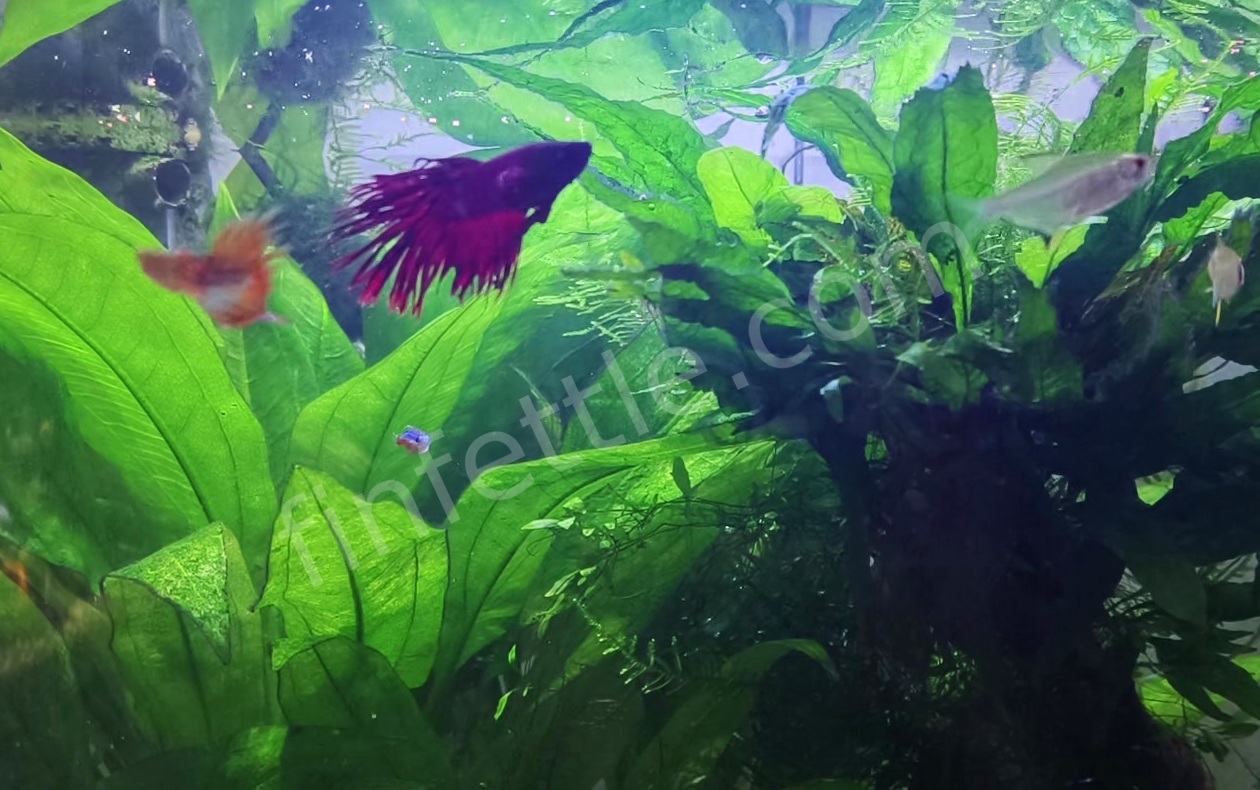
My own red crowntail betta lives in a heated, planted community tank. I haven't seen velvet on any of my fish since I started keeping them in 2017, so everything on treatment here comes from the vet and specialist sources cited above, not from my own tank.
Related
- Velvet disease — the full guide for any freshwater fish.
- Ich vs velvet — the side-by-side check.
- Betta fish ich — white spot in bettas, the more common problem.