
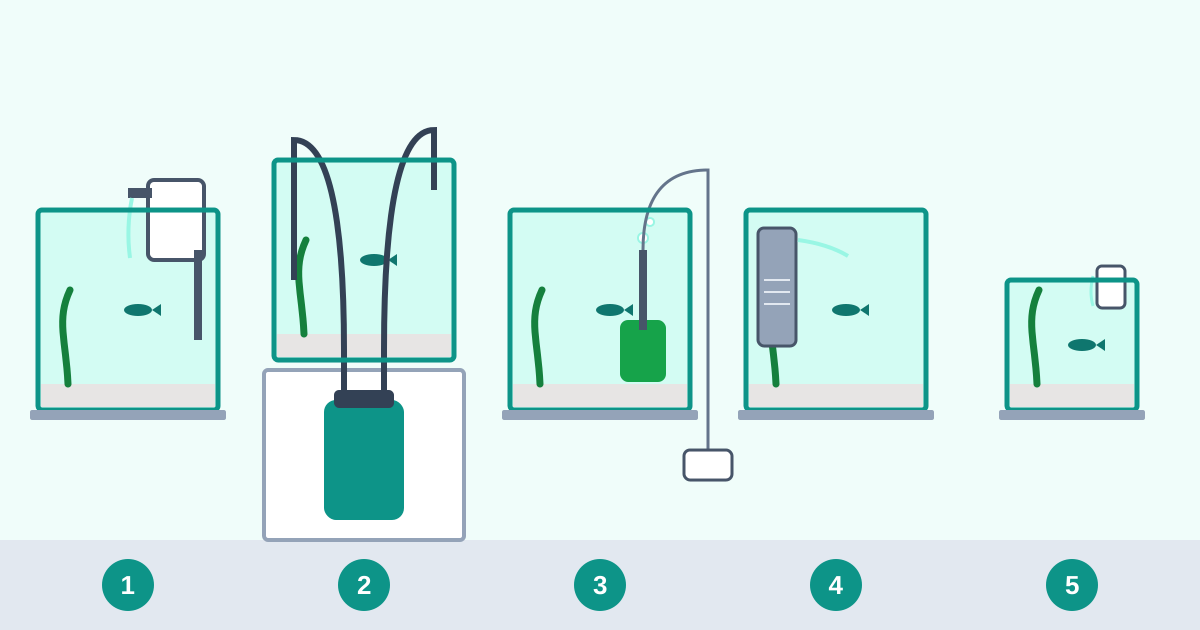
The best aquarium filter for most tanks under about 100 litres is a hang-on-back filter; for bigger, planted or heavily stocked tanks it's a canister. Sponge, internal and nano filters each win for a particular kind of tank, so this page picks by filter type rather than naming one winner.
This is a short list of five filter types, numbered and kept in the same order, each with the one thing it's best for and an honest drawback. None of the slots is sponsored.
How to read this page
The picks are filter types, not filters I've tested side by side. I run internal, external (canister), sponge and under-gravel filters across my own tanks (details below); where I name any other model, it's an example a cited reviewer recommends, not a claim from my own tanks. Prices change often, so check the retailer's page.
The short answer
Pick by the size of the tank and what lives in it:
- Most beginner and small-to-mid tanks: a hang-on-back (HOB) filter — pick 1. The 2Hr Aquarist calls them easy and cheap for tanks under roughly 100 litres.
- Big, planted or heavily stocked tanks: a canister, also called an external filter in the UK — pick 2. The 2Hr Aquarist calls it the best all-rounder above 50 litres.
- Bettas, shrimp, fry or a quarantine tank: a sponge filter — pick 3.
- A tank where a hang-on-back won't fit behind the lid or against the wall: an internal filter — pick 4.
- A nano tank: a small filter sized for it — pick 5.
Whatever type you choose, size it for about 6–10 times your tank's volume per hour (the 2Hr Aquarist's target), and go bigger for a heavily stocked tank.
The picks
Quick comparison
| # | Filter type | Best for | Typical tank size | Key thing to check | Relative cost |
|---|---|---|---|---|---|
| 1 | Hang-on-back (HOB) | Most beginner tanks | Up to ~100 L | Flow rating; easy access to the media | Low |
| 2 | Canister (external) | Big, planted, heavily stocked | Above ~50 L | Shut-off valves, primer, cabinet space | Mid to high |
| 3 | Sponge | Bettas, shrimp, fry, quarantine | Small tanks | Air pump size | Low |
| 4 | Internal | Lidded tanks, no room behind | Small to mid | Adjustable flow; foams that come out easily | Low to mid |
| 5 | Nano | Nano tanks | Very small tanks | Flow gentle enough for the tank | Low |
"Relative cost" is a rough ranking, not a price. Tank sizes are approximate; check the rating for the exact model you buy.
How I chose
Three things decide which aquarium filter is right for your tank:
It moves enough water for the tank. The 2Hr Aquarist's target is a rated 6–10 turnovers per hour. As an example, a 100-litre tank needs a filter rated for roughly 600–1,000 litres an hour. It also warns that rated flow is often measured with no media and no hoses, so the real figure is lower once the filter is running.
It's sized for what lives in the tank, not the budget. The same source says to size for your tank's bio-load: a heavily stocked tank needs more filtration than a lightly stocked one of the same size. Messy fish are where a canister earns its price.
The flow suits the fish. Bettas, shrimp and fry need gentle flow and nothing that can pull them in. AquaLogic HQ calls sponge filters the safest option for them because they're air-driven and have no intake.
After that, look at how easy it is to clean.
Free tool
Filters are rated in litres or gallons per hour. Work out how much water your tank really holds before you compare flow ratings.
Aquarium volume calculator →Each pick, honestly
1. Hang-on-back (HOB) filter — best overall. A hang-on-back hooks over the back rim, so the media is easy to reach and there's nothing in the cabinet. The 2Hr Aquarist calls them easy and cheap for tanks under roughly 100 litres, and says the waterfall outflow drives gas exchange, which is good for oxygen. AquaLogic HQ says this is the type most beginners should start with; its top pick is the Fluval AquaClear 50, which it lists at 200 gallons an hour for 20–50 gallon tanks. Drawback: the 2Hr Aquarist says hang-on-backs usually hold less media, most can't change the direction of flow, and the flow and surface agitation shift as the water level drops — which matters on a CO2-injected tank.
2. Canister (external) filter — best for big, planted or heavily stocked tanks. A canister sits in the cabinet with hoses to and from the tank. The 2Hr Aquarist calls it the best all-rounder above 50 litres for its large media volume, and says it suits CO2-injected planted tanks because the inflow and outflow can go where you want them. AquaLogic HQ says a canister is "the only way to go" for tanks over 40 gallons or messy fish. Drawback: the 2Hr Aquarist says canisters cost more and have more parts to set up, and AquaLogic HQ points out that cleaning one means unhooking the hoses and carrying it to the sink. The best canister filter page splits this pick into five canister types.
3. Sponge filter — best for bettas, shrimp, fry and quarantine tanks. A sponge filter is a block of foam on an uplift tube, driven by an air pump. The 2Hr Aquarist says the whole filter is media, so it handles both mechanical and biological filtration, and that these are the cheapest filters to run with the fewest parts. AquaLogic HQ calls them the safest option for bettas, shrimp and fry. It's also what I use in my quarantine tank. Drawback: you need an air pump, AquaLogic HQ says sponge filters aren't great at polishing the water, and the 2Hr Aquarist notes they take up space in the tank and are hard to hide.
4. Internal filter — best when a hang-on-back won't fit. An internal filter sits inside the tank, usually stuck to the glass with suckers, so it works under a closed lid or with the tank close to a wall. The 2Hr Aquarist groups internal filters with sponge filters as the cheapest to run with the fewest parts. As one example, the OASE BioPlus 100 I run on my planted tank is listed for aquariums up to 30 US gallons, with three flow settings on its outlet and foam modules that lift out while the pump stays in the tank. Drawback: the 2Hr Aquarist's main complaint is that internal filters take up space inside the tank and are hard to hide, so they suit holding tanks better than display tanks.
5. Nano filter — best for nano tanks. A very small tank needs a filter scaled to it rather than one built for a bigger tank. That's usually a small hang-on-back, a small internal filter or a sponge filter; AquaLogic HQ uses sponge filters on its own nano tanks. Drawback: a small filter holds little media, so there's not much margin if you overstock or overfeed.
My own tanks
I don't run one kind of filter everywhere, which is part of the point of this page. I've never run a hang-on-back filter on any of my tanks, though, so pick 1 rests on the cited reviewers rather than on my own setup:
- 90-litre planted community tank: a Love Fish Vantage from Pets at Home, which came with its own filter and heater. I still use the heater, but I bought an OASE BioPlus 100 internal filter, which is more powerful than the filter supplied with the tank. Under the substrate there's also an under-gravel filter that I run as an anoxic filter. I clean the BioPlus 100's foams once a week, sometimes every two weeks, and always rinse them in tank water.
- 150-litre mbuna tank: an AllPondSolutions EF2 external filter alongside an under-gravel filter set up as an anoxic filter.
- Juwel Trigon 190: an AllPondSolutions 2000EF external filter working alongside the internal filter built into the tank.
- 64-litre quarantine tub: a sponge filter run off an air pump, which I seeded from the Trigon 190.
Whatever filter you choose, don't start it empty. Every tank I've cycled has had fish in it, and since my first tank I've seeded each new filter with media from an established tank plus a bottled bacteria starter — mostly FritzZyme 7 now. The cycling guide covers how.
What about under-gravel filters?
An under-gravel filter is a plate under the substrate that pulls water down through the gravel, turning the substrate into the filter. The 2Hr Aquarist says they can work but aren't a popular choice in planted tanks: debris collects and compacts in the substrate, and they aren't ideal with aqua soils. I run them on two of my tanks as anoxic filters, each alongside a second filter, and on the planted tank it sits under Seachem Flourite and sand rather than aquasoil. For a new tank, one of the five types above is the simpler start.
What you can skip
- Buying on the box's flow figure alone. The 2Hr Aquarist says rated flow is often measured with no media and no hoses; the real flow is lower.
- A filter that only just matches your tank's volume. Size for the stocking, not the budget — go up a size for heavily stocked or messy fish.
- A strong filter in a betta, shrimp or fry tank. A sponge filter is the gentler choice.
- Rinsing the filter's biological media under the tap. Aquarium Store Depot traces tanks that crashed "out of nowhere" to exactly this. If you clean bio media, do it in tank water taken out during a water change.
- A canister on a small, lightly stocked tank if you don't need the kit hidden. A hang-on-back does the job for less money.
Put it to work
Building a planted tank? The best canister filter shortlist goes deeper on pick 2, the aquarium CO2 system guide covers what fits on a canister's outflow, and the planted aquarium lighting guide covers the light. Setting up a hospital tank? See the quarantine tank guide. And if the tank is new, make sure it's cycled before fish go in.