
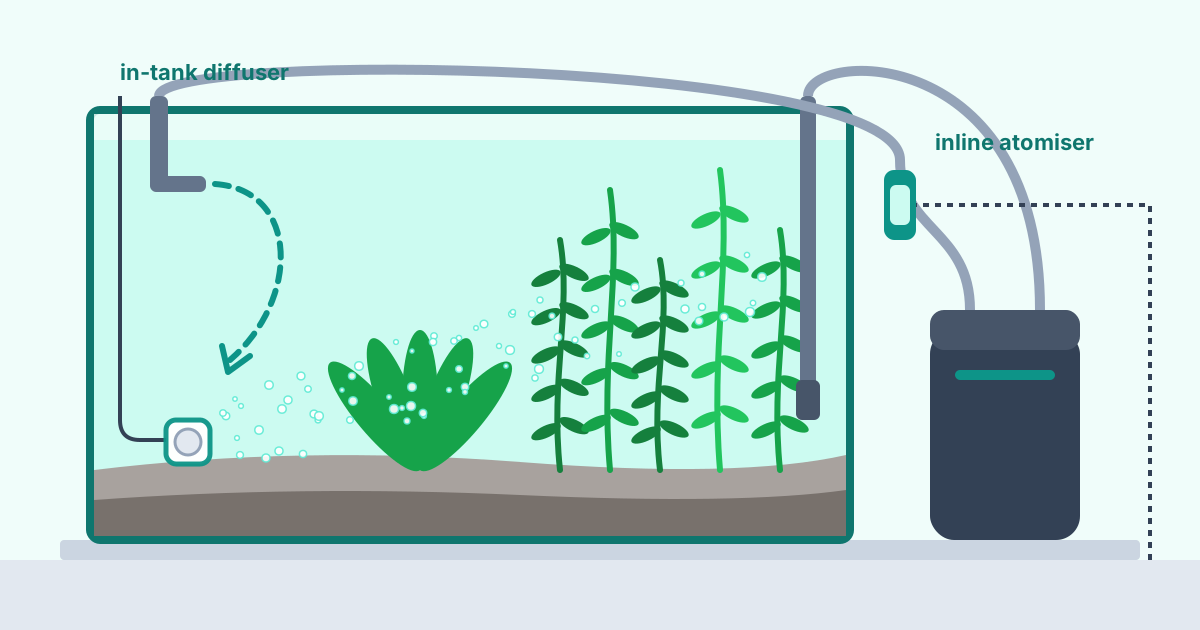
The right aquarium CO2 diffuser depends on your tank's size and the filter you run. For most small and medium planted tanks, an in-tank ceramic diffuser sized to the tank and placed low in the filter's downward flow does the job. With a canister filter, an inline atomiser on the outflow hose takes the equipment out of the tank. If you don't want visible mist, or the tank is large, a properly sized inline reactor dissolves the most gas.
This is a short list of five diffuser types, numbered and kept in the same order, each with what it's best for and a real drawback. None of the slots is sponsored.
How to read this page
The picks are diffuser types, not products I've tested side by side. I haven't run pressurised or DIY CO2 on any of my tanks, so everything here comes from the sources cited at the end — my own planted tanks are low-tech. Where a product is named, it's an example a cited source gives.
The short answer
Pick by your tank size and filter first, then by how much you mind seeing bubbles:
- A small or medium tank with any filter: an in-tank ceramic diffuser — pick 1.
- A nano tank: a compact nano diffuser — pick 2.
- A tank with a canister (external) filter, and you'd rather not see equipment: an inline atomiser — pick 3.
- You can't stand mist in the water, or the tank is large: an inline reactor, sized for your tank — pick 4.
- You want an in-tank diffuser with a body that won't snap: stainless steel — pick 5.
The 2Hr Aquarist sums up the split: in-tank diffusers suit small to medium tanks and easy installation, inline atomisers suit most high-tech set-ups, and reactors suit larger tanks and people who want clear water with no visible bubbles.
The picks
Quick comparison
| # | Type | Best for | Where it sits | Visible in tank? | Cleaning | Relative cost |
|---|---|---|---|---|---|---|
| 1 | In-tank ceramic diffuser | Small and medium tanks | Inside the tank | Yes — diffuser and mist | Often | Low |
| 2 | Nano diffuser | Nano tanks | Inside the tank | Yes, but compact | Often | Low |
| 3 | Inline atomiser | Tanks with a canister filter | On the filter outflow hose | Mist only | Every 2–3 months | Mid |
| 4 | Inline reactor | No mist; large tanks | On the filter line | No | Depends on design | Mid–high |
| 5 | Stainless-steel diffuser | A tougher in-tank body | Inside the tank | Yes | Often | Low–mid |
"Cleaning" for picks 1 and 3 follows The 2Hr Aquarist; check the maker's instructions for the one you buy. "Relative cost" is a rough ranking: on 28 October 2026, Glass Aqua listed in-tank ceramic diffusers at $12.99–$16.99 and inline diffusers and atomisers at $27.99–$31.99. Prices change, so check the retailer's page.
How I chose
Four questions sort CO2 diffusers:
How good is the disc? The 2Hr Aquarist calls the ceramic membrane the heart of the diffuser: the finer the pores, the finer the bubbles and the more gas dissolves. It says glass, acrylic, plastic and stainless-steel bodies can all work well if the membrane is good, and that a well-made cheap diffuser can outperform an expensive decorative one.
What filter do you run? Inline atomisers and reactors fit on the hose of an external filter, so they need a canister filter. In-tank diffusers work with any filter, but The 2Hr Aquarist warns that a hang-on-back filter's flow pattern changes with the water level, which makes CO2 less stable.
How big is the tank? Diffusers are sized by water volume, and reactors in particular have a maximum injection rate for their size. The 2Hr Aquarist says that above about 250 litres (66 US gallons), most commercial reactors shorter than your arm aren't built to dissolve CO2 at a high injection rate.
Can your CO2 source push it? The 2Hr Aquarist says fine-pored discs and atomisers generally need around 20–30 psi of working pressure, so the diffuser and the regulator have to be chosen together. It also recommends dedicated polyurethane CO2 tubing, because silicone airline leaks gas and can't take the higher pressure some atomisers need.
Free tool
Diffusers and reactors are sized by water volume. Work out your tank's real volume — not just the number on the box — before you pick a size.
Aquarium volume calculator →Each pick in detail
1. In-tank ceramic CO2 diffuser — best overall for small and medium tanks. A ceramic disc in a glass, acrylic or plastic body, held low in the tank with a suction cup or a pipe that hooks over the rim. CO2 is pushed through the disc and leaves as a fine mist. The 2Hr Aquarist calls it the most conventional device and says it can be effective if used correctly. It's the easiest type to fit and works with any filter. Size it to your tank: Glass Aqua's guide to the Aquario Neo range, for example, matches a 12 mm disc to tanks up to 26 US gallons, 17 mm to 26–53 gallons and 24 mm to 53 gallons and up. Drawbacks: it sits in the tank, so it collects debris and biofilm, and The 2Hr Aquarist says its efficiency drops as it clogs. It also depends on steady flow; dense plant growth or a slowing filter can change the flow and make CO2 levels swing.
2. Nano CO2 diffuser — best for nano tanks. The same in-tank design, made smaller. Glass Aqua's guide puts the tiny 8 mm Aquario Neo disc at tanks up to 13 US gallons (about 49 litres), in its most compact body for nano aquariums. The 2Hr Aquarist says a small tank can use a glass diffuser and still look tidy if it's serviced often. Drawbacks: it needs the same regular cleaning as pick 1, and The 2Hr Aquarist notes that equipment can look even more obvious in a small tank — it uses an inline atomiser on its own 36-litre tank to keep the layout clean.
3. Inline CO2 atomiser — best for tanks with a canister filter. Fitted into the hose between the external filter and its outlet, usually on the outflow. The 2Hr Aquarist prefers atomisers to in-tank diffusers: they need cleaning far less often — about every two to three months — and they're less affected by changes in the tank's flow. It says a single well-designed atomiser can saturate even a very large tank at normal injection rates, given strong enough flow. Drawbacks: you need a canister filter, and the atomiser needs decent pressure and flow. The fine mist it puts into the tank can be visually distracting. The 2Hr Aquarist also says quality varies even within brands, and advises buying from a shop that accepts returns if the mist isn't fine enough. If you're choosing the filter too, see the canister filter shortlist.
4. Inline CO2 reactor — best for no visible mist and large tanks. A chamber on the filter line where the gas dissolves before the water returns to the tank. The 2Hr Aquarist says reactors aim for complete dissolution and should be the default if you don't want mist, and its setup guide puts inline reactors at 50–100% more efficient at dissolving CO2 than in-tank diffusers. Drawbacks: reactors are bulkier, harder to size and tune, and slightly reduce the filter's flow. Each design has a maximum injection rate, so a small reactor on a big tank won't keep up — above about 250 litres, The 2Hr Aquarist says you'd need a larger specialist or DIY reactor. You also lose the fine mist, which it says plants can use directly, though many tanks grow well without it.
5. Stainless-steel CO2 diffuser — best for a tougher in-tank body. An in-tank diffuser with a metal body instead of glass. The 2Hr Aquarist says stainless-steel models are noted for easy installation and are often chosen by hobbyists who want a more durable body alongside fine diffusion. Drawback: the body doesn't make the mist — the disc does. The 2Hr Aquarist says the material of the outer body matters less than the quality of the disc, so this pick buys you toughness, not better diffusion, and it still needs the same cleaning as pick 1.
Where to put it, and how to keep it working
Whichever in-tank type you choose, placement matters as much as the diffuser:
- Low and in the flow. The 2Hr Aquarist says to place it low in the tank, in the downward flow from the filter outlet, so the current carries the mist across the aquarium and gives the bubbles more time to dissolve.
- Watch the mist. If the bubbles shoot straight up instead of drifting along, the diffuser is dirty, its pores are too coarse, or the flow is too weak.
- With a hang-on-back filter, The 2Hr Aquarist says the outlet should flow horizontally, not downwards, so the mist travels the length of the tank.
- Soak it first. Soak a new ceramic disc in water for 30 minutes before first use; a dry disc releases large, uneven bubbles until it wets through.
- Clean it when the bubbles get bigger. The 2Hr Aquarist cleans clogged discs with a short soak in dilute household bleach, then rinses very thoroughly and dechlorinates before the disc goes back in.
- Don't judge it by bubble count. The bubble counter shows what leaves the cylinder, not what dissolves. A drop checker shows whether CO2 is reaching the water, but The 2Hr Aquarist says it lags real conditions by an hour or more and tells you nothing about how evenly the CO2 is spread.
Uneven plant growth across the tank, or mist that stays in one corner, usually points to a flow problem rather than the diffuser. The 2Hr Aquarist also links black beard algae in very turbulent, mist-filled spots to flow — see the black beard algae guide.
What you can skip
- A bigger bubble rate to make up for a poor diffuser. Large bubbles mostly vent at the surface; fix the disc or the flow instead.
- Paying extra for the body. Glass, acrylic, plastic and steel can all work; The 2Hr Aquarist says the disc quality and the working pressure it needs are what count.
- A small commercial reactor on a big tank. The 2Hr Aquarist says many people who do this can't reach good saturation.
- Silicone airline for the CO2 line. The 2Hr Aquarist says it lets gas escape; use dedicated CO2 tubing, with a check valve before the diffuser.
- A diffuser for liquid carbon. Liquid carbon is dosed straight into the water; a diffuser only matters with gas CO2.
Put it to work
A diffuser is the last link in a CO2 system. If you haven't chosen the cylinder, regulator and solenoid yet, start with the aquarium CO2 system guide, which also covers the CO2 levels fish tolerate. If fish start gasping at the surface after you turn the gas up, that guide explains what to check. And because CO2 only pays off with enough light, the planted aquarium light shortlist is the next stop.