
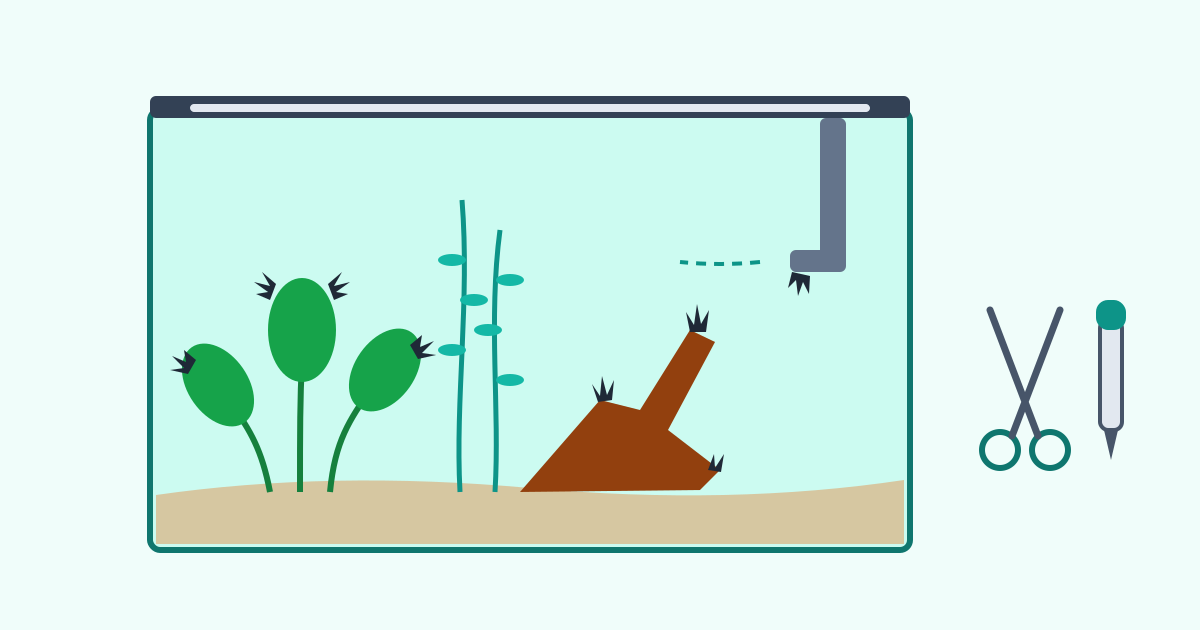
Black beard algae (BBA) is a red alga that grows as dark, brush-like tufts on leaf edges, driftwood, rocks and equipment. It turns up when plants are stressed, organic waste builds up and, in CO2-injected tanks, when CO2 levels swing. To get rid of it, trim the worst leaves, spot-treat what's worth saving, then fix the cause — steadier CO2, shorter lighting, big weekly water changes and less debris — or it comes straight back.
This guide covers how to recognise it, what causes it, a step-by-step removal plan, what liquid carbon and algae eaters can and can't do, and how to keep it from returning.
What black beard algae looks like
BBA forms dense tufts of very fine strands, like a small beard or brush. Aquasabi describes the colour as anything from dark green through grey to deep black; Aquarium Science adds that it can be blue-green or even purple. It clings tightly to whatever it grows on and doesn't wipe off by hand.
Where it grows is a clue too:
- Leaf edges, especially on slow-growing plants such as Anubias and Bucephalandra, and on older leaves.
- Hardscape — driftwood and rocks.
- Equipment in strong flow — filter outlets and CO2 diffusers.
To confirm it, Aquasabi and Aquarium Science both suggest putting a piece in rubbing alcohol: it turns reddish, because BBA is a red alga (Aquasabi names Audouinella and Rhodochorton species). Aquasabi groups staghorn algae in the same red-algae family.
Is black beard algae harmful?
Not to your fish. The 2Hr Aquarist says it doesn't poison or attack fish, shrimp or snails. The damage is to plants: a thick coat on a leaf blocks light and gas exchange, and adds stress to plants that are often already struggling. Left alone on slow growers, it can smother leaves until they die.
So it isn't an emergency, but it is a signal that something in the tank is off.
What causes black beard algae
The 2Hr Aquarist's point is that the causes work together — one trigger alone often isn't enough, but several at once create ideal conditions:
- Stressed plants. When plants adjust to a change in the tank, they leak metabolites from their leaf edges, and BBA spores attach there. Old leaves the plant is abandoning, crowded plants, compacted roots and plants battered by strong current are all vulnerable.
- Organic waste. Decaying leaves, uneaten food and debris on the substrate or packed into the filter. Aquasabi sees the black form most often in heavily stocked tanks with few plants, overfeeding and too few water changes.
- Unstable CO2. In CO2-injected tanks, CO2 that rises and falls through the day stresses plants, and the 2Hr Aquarist says there's evidence the swings themselves can trigger BBA. Aquasabi adds that when CO2 is short, red algae such as BBA can take carbon from bicarbonate in the water more easily than plants can.
- Too much light. Light isn't the root cause, but the 2Hr Aquarist calls it an accelerant once the other triggers are present.
- Strong, narrow flow. BBA favours high-flow spots, and a jet hitting the same plants stresses them.
- Nutrient imbalance. Aquasabi links BBA in planted tanks to too much iron and other trace elements; Aquarium Science links it to high nitrate, phosphate or iron. The 2Hr Aquarist disagrees that nutrients alone cause it, pointing to a clean, healthy tank that holds high nitrate and phosphate without BBA — so treat nutrients as a factor to check, not the whole story.
How to get rid of black beard algae
Scrubbing it off without changing anything else rarely works for long. The 2Hr Aquarist's approach is to remove what's too far gone, treat what's worth saving, and fix the conditions that let it in. In order:
- Trim the worst leaves. Cut off older leaves that are heavily covered — they're often on their way out anyway.
- Scrub hardscape and equipment. A stiff toothbrush on wood, rocks and filter outlets, outside the tank if you can.
- Spot-treat healthy leaves. For a leaf that's still worth keeping, the 2Hr Aquarist spot-treats with an algicide: flow off briefly, applied with a syringe or dropper, then flow back on. Treated tufts often turn reddish or pale as they die. Follow the label of whatever product you use, and keep spot treatment for mild to moderate cases — the same source says a tank that's overrun needs a reset rather than an algicide.
- Clean up the organic waste. Siphon debris off the substrate, service a clogged filter (it needs to work well, not be spotless), and do large water changes every week. Aquasabi recommends at least 50% weekly. Aquarium Science says heavy water changes alone can often control BBA.
- Steady the CO2 and soften the flow. If you inject CO2, keep it stable across the whole photoperiod — the aquarium CO2 system guide covers timing and measuring it. If the algae sits mainly in the path of the filter outlet, redirect or spread the flow.
- Cut the light back. The 2Hr Aquarist suggests 6–8 hours a day while you deal with BBA. The planted aquarium lighting guide covers hours and brightness in more detail.
- Grow more healthy plants. Clear out old, crowded growth and compacted root zones, replant fresh portions, and add fast-growing or floating plants if the tank is sparse. Healthy, growing plants are the long-term defence.
Does liquid carbon kill black beard algae?
This is the most common advice online, so it's worth being precise about what the manufacturer says.
Seachem Flourish Excel is a liquid carbon supplement for planted tanks. In its FAQ, Seachem says hobbyists report that some algae lessens when Excel is dosed, and that black beard algae seems to be particularly affected. But Seachem also says it doesn't produce or market Excel as an algicide, and that using it as a spot treatment — overdosing it or applying it directly to a plant — can cause damage. The 2Hr Aquarist likewise treats liquid carbon and hydrogen peroxide as support work, not the fix.
If you use it, use it as the label directs. Seachem's directions, word for word: "On initial use or after a major (> 40%) water change, use 1 capful (5 mL) for every 40 L (10 US gallons). Thereafter use 1 capful for every 200 L (50 US gallons) daily or every other day." Seachem recommends dosing every other day rather than daily if you keep Anacharis, and says that in its own preliminary lab test, Vallisneria showed some leaf melt at double the recommended dose but no issues at the recommended dose.
Free tool
Liquid carbon is dosed by litres of water, not the size printed on the tank. Work out your tank's real volume before you measure a dose.
Aquarium volume calculator →On my own tanks I've used Seachem Flourish Excel only occasionally, when a tank is first being set up, so the guidance above comes from Seachem and the sources cited rather than from my own BBA treatment.
Algae eaters: help, not a cure
The 2Hr Aquarist names Siamese algae eaters, American flagfish, mollies and Amano shrimp as animals that pick at BBA, and says none of them is a lasting solution on its own. Aquasabi adds that once a treatment has killed the algae, Amano shrimp and even ramshorn snails will graze the dead tufts.
Check that any algae eater suits your tank's size and community before you add it. I keep Amano shrimp in my 90-litre planted community tank, but the honest rule from the sources is the same either way: if the cause is still there, the algae grows faster than anything eats it.
Low-tech tanks vs CO2 tanks
The causes weigh differently depending on how your tank is run:
- Low-tech tanks (no CO2 injection): the 2Hr Aquarist ties BBA mostly to organic waste, poor water quality, old leaves and too much light for the amount of plants. Weekly water changes, moderate light, more plants and regular trimming do most of the work.
- CO2-injected tanks: unstable CO2 is the big one, often alongside strong light and ageing leaves. Steadying the CO2 matters more than any treatment.
My 90-litre planted community tank is a low-tech tank: I don't run pressurised or DIY CO2 on it. I did change its lighting hours because of algae, and that change helped — the lighting guide has the schedule.
Keeping it from coming back
BBA spores are everywhere, so the 2Hr Aquarist argues you can't keep them out of a tank — the aim is a tank where they can't get a foothold:
- Keep plants healthy and growing. Trim and replant old growth instead of letting it decline.
- Keep maintenance boringly regular. Large weekly water changes, debris siphoned off the substrate, a filter that flows freely.
- Keep CO2 steady — or don't inject at all. Swinging CO2 is worse than a steady, modest level.
- Match light to plants. Slow growers such as Anubias and Java fern don't need a powerful light; see the best planted aquarium light shortlist for lights by tank type.
- Spread the flow. A filter that circulates the whole tank gently is better than one jet; the best aquarium filter page covers filter types and sizing.