
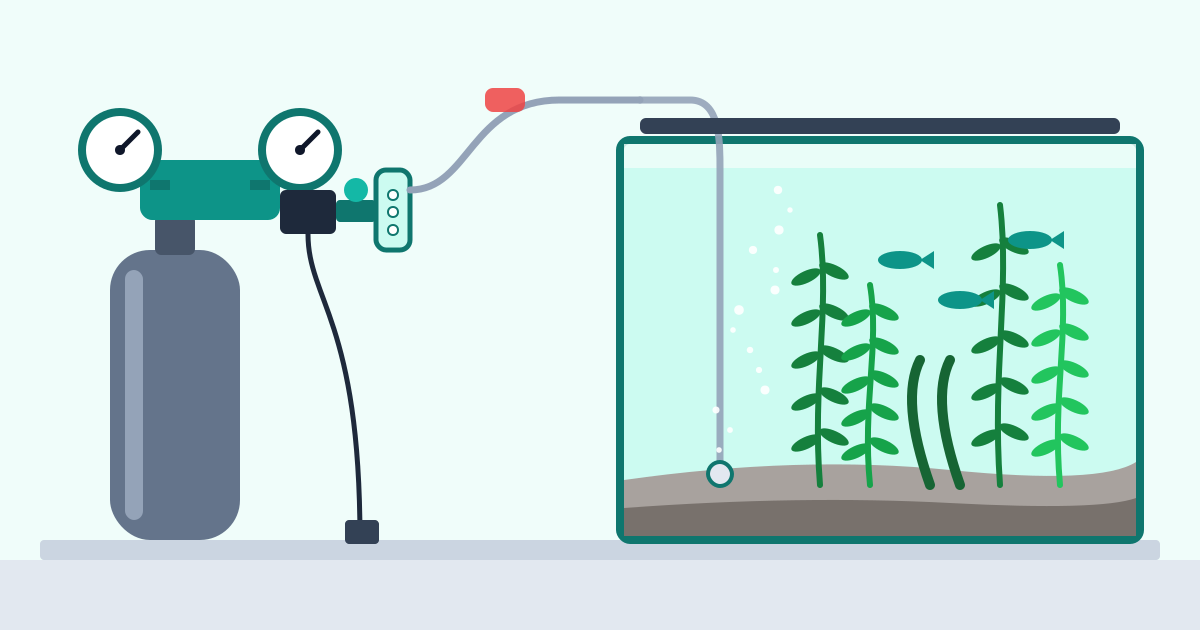
The right aquarium CO2 regulator is one with a solenoid that fits the cylinder you can get refilled locally. If you can afford it, choose a dual-stage regulator: it holds the flow steadier as the cylinder empties and helps prevent end-of-tank dump. A compact single-gauge regulator costs much less and works if you watch the gauge. Add a manifold to run several tanks, an adapter for SodaStream or paintball bottles, or skip the cylinder with a citric acid kit.
This is a short list of five regulator types, numbered and kept in the same order, each with what it's best for and a real drawback. None of the slots is sponsored.
How to read this page
The picks are regulator types, not products I've tested side by side. I haven't run pressurised or DIY CO2 on any of my tanks — my 90-litre planted community tank is low-tech — so everything here comes from the sources cited at the end. Where a product is named, it's an example a cited source or retailer gives.
The short answer
Start with your cylinder, then pick by budget and how many tanks you run:
- You'll use a refillable cylinder and want the safest option: a dual-stage regulator with a solenoid — pick 1.
- You're on a budget with one small or medium tank: a compact regulator with a solenoid, and refill before the gauge drops — pick 2.
- You want CO2 on more than one tank: a regulator that takes manifold blocks, one per tank — pick 3.
- You want to start with small SodaStream or paintball bottles: an adapter that lets a standard regulator fit them — pick 4.
- You can't get a cylinder filled nearby: a citric acid generator kit, which comes with its own regulator and solenoid — pick 5.
Not sure you need CO2 at all? Plenty of planted tanks grow well without it. In my 90-litre tank, the stem plants grow up to the surface with no CO2, under the light that came with the tank. See low-tech planted tanks before you spend anything.
The picks
Quick comparison
| # | Type | Best for | Helps prevent end-of-tank dump? | Cylinder | Relative cost |
|---|---|---|---|---|---|
| 1 | Dual-stage regulator with solenoid | Any tank on a refillable cylinder | Yes | Full-size refillable (CGA320 or W21.8x14) | High |
| 2 | Compact regulator with solenoid | One small or medium tank on a budget | Only if it says dual-stage | Full-size refillable — check the thread (hygger's fits CGA320) | Low |
| 3 | Manifold block | Two or more tanks | Depends on the regulator | Same as the regulator | Add-on to a regulator |
| 4 | SodaStream or paintball adapter | Starting with small bottles | Depends on the regulator | SodaStream or paintball bottle | Add-on to a regulator |
| 5 | Citric acid generator kit | No cylinder refills nearby | Not applicable — no cylinder | Its own steel bottle, refilled at home | Cheaper than a cylinder system |
"Relative cost" is a rough guide. On 17 November 2026, hygger listed its compact CO2 Mini Regulator at $35.99–$42.99, and Planted Aquaria listed the CO2Art PRO-SE dual-stage regulator with integrated solenoid at CA$199.99. Green Aqua says cylinder systems cost double, sometimes triple, the price of citric acid kits. Prices change, so check the retailer's page.
How I chose
Five questions sort any CO2 regulator for aquarium use. Work through them in this order.
What cylinder will you use? The regulator's thread has to match it, so choose the cylinder you can actually get filled first. CO2Art and UKAPS both say refillable cylinders in North America use the CGA320 connection, while most of Europe — the UK included — plus Oceania and Asia use the connection called BS341, DIN477 or W21.8x14. UKAPS lists refillable cylinders, CO2 fire extinguishers among them, from gas suppliers such as BOC and Energas, pub gas suppliers, hydroponics shops and aquatic shops. SodaStream bottles and small DIY welding bottles need a specially designed adapter, and disposable aquarium cartridges (20–95 g) use each maker's own fitting and are the most expensive way to buy CO2.
Does it have a solenoid? This is the non-negotiable one. The solenoid is an electric valve that lets a timer switch the gas on and off, and The 2Hr Aquarist says regulators without one can't be turned off by a power timer and should be avoided. Aquarium Co-Op suggests timing the CO2 to come on 1–2 hours before the lights and go off an hour before they do.
Single-stage or dual-stage? Aquarium Co-Op explains that a single-stage regulator drops the cylinder's pressure in one step and a two-stage regulator in two, which gives a steadier flow and helps prevent end-of-tank dump — a nearly empty cylinder releasing the rest of its gas in one go. Gensou Aquascaping describes why: liquid CO2 keeps the cylinder at a roughly constant 800–900 psi until the last of it evaporates, then the input pressure falls fast and a single-stage regulator can overcompensate and surge. Its advice is to treat the cylinder gauge as a fuel gauge and refill before it drops below 700 psi.
How good is the needle valve? The needle valve sets the flow you actually get. Buce Plant says a high-quality needle valve can drop the pressure to a fine flow rate and hold it — good ones don't "float" — so a cheap regulator with a valve that creeps can undo a careful setting.
How many tanks? If you might run CO2 on a second tank, buy a regulator that takes manifold blocks. The 2Hr Aquarist says one regulator and manifold on one cylinder can serve several tanks.
Free tool
Cylinder size follows tank size. Aquarium Co-Op suggests 2.5–5 lb for tanks up to 20 US gallons, 5 lb for 25–40 gallons and 10 lb for 55 gallons and up — work out your real volume first.
Aquarium volume calculator →Each pick in detail
1. Dual-stage CO2 regulator with solenoid — best overall. Two pressure-reducing stages in one body. The examples cited here also have a solenoid, a needle valve, a bubble counter and two gauges: one for the cylinder and one for the working pressure. For instance, Planted Aquaria lists the CO2Art PRO-SE (CGA320 thread) with a 12 V DC integrated solenoid, dual gauges and working pressure adjustable up to 40 psi (3 bar). Because the second stage always sees a steady input, Gensou Aquascaping says the working pressure doesn't spike as the cylinder empties — the main reason to pay more. Drawback: price. It costs far more than a basic compact regulator (see the prices under the comparison table), and a dual-stage body doesn't fix a poor needle valve, so check reviews of the valve too.
2. Compact CO2 regulator with solenoid — best budget pick. A small regulator with a solenoid, needle valve and bubble counter, for much less money. The hygger CO2 Mini Regulator (HC021) is a typical example: hygger says it fits side-open CGA320 cylinders, comes with or without a 12 V DC solenoid (a timer isn't included), and has a bubble counter with a built-in check valve and a single gauge for the cylinder's pressure. Drawbacks: hygger doesn't say whether it's single- or dual-stage, and if a listing doesn't say dual-stage, plan as if it's single-stage: watch the cylinder gauge and refill early. With one gauge you also can't read the working pressure.
3. CO2 manifold block — best for several tanks. A block that bolts onto the regulator and adds another outlet. Aquarium Co-Op's own dual-stage regulator, now discontinued, could be expanded to run up to six aquariums, each block with its own bubble counter so the gas to each tank is set separately. The 2Hr Aquarist describes the same idea: several tanks, one manifold, one cylinder. Drawback: a block has to fit your regulator body — Aquarium Co-Op's were add-ons for its own regulator — so check compatibility before you buy. And all the tanks share one cylinder, so when it runs out, they all lose CO2 at once.
4. SodaStream or paintball cylinder adapter — best for small bottles. An adapter that lets a standard regulator screw onto a smaller bottle. Buce Plant says paintball and SodaStream cylinders need extra adapters to connect to a regulator, and CO2Art says the same for SodaStream bottles of about 500 g, adding that New Zealand and Australian SodaStream cylinders differ from those elsewhere. CO2Art notes their big advantage: you can buy them in most supermarkets around the world. Drawbacks: a small bottle runs out much sooner — Buce Plant's tip is to buy the largest cylinder you can so you change it less often — and some regulators aren't meant for these bottles at all; Aquarium Co-Op's regulator was for CGA320 cylinders and not intended for paintball tanks. The adapter is also one more joint that has to seal.
5. Citric acid CO2 generator kit — best when you can't get a cylinder filled. Citric acid, baking soda and water react in a steel bottle that has its own regulator, needle valve, solenoid and bubble counter, so from the bottle onwards it works like a cylinder system and can run on a timer. It's the cheaper route — see the prices under the comparison table — and Green Aqua says the refill is done at home, with no trip to get a cylinder filled. Drawbacks: Green Aqua estimates a refill every three weeks to one or two months, against three to six months or longer for a high-pressure cylinder, and pitches these kits at small and medium tanks. The CO2 system guide covers how to refill one safely.
Fitting it and running it safely
The CO2 system guide has the full setup. The regulator-specific points:
- Seal with the O-ring, not tape. The 2Hr Aquarist says to make sure there's a working O-ring between the regulator and the cylinder and not to use thread-seal tape there, because the O-ring makes the seal. If you hear gas escaping with the regulator turned off, close the cylinder valve and tighten the joint.
- Fit a check valve. Buce Plant warns that any water that gets into a needle valve or regulator will damage it. Aquarium Co-Op says a check valve stops tank water flowing back up the line, and you can add a second one as a backup.
- Start low. Aquarium Co-Op suggests about one bubble per second to start. The bubble count only shows roughly how fast gas leaves, so check the result in the water with a CO2 drop checker.
- Put it on a timer. Switch the solenoid with a timer so CO2 stops at night. Gensou Aquascaping adds that a pH controller can shut the solenoid if pH drops below a level you set — a second line of defence against a dump.
- Watch your fish. If fish start gasping at the surface after you turn the gas up, turn the CO2 down; that guide covers what else to check.
What you can skip
- A regulator without a solenoid. It can't run on a timer, so CO2 keeps flowing all night.
- Disposable aquarium cartridges for anything but a trial. CO2Art calls them the most expensive option, they aren't refillable, and each maker uses its own fitting.
- Thread-seal tape on the cylinder joint. The O-ring does the sealing.
- Buying the regulator before the cylinder. Find out which cylinders you can get filled locally, then buy a regulator with the matching thread, not the other way round.
- A small cylinder to save money. Bigger cylinders cost less per kilogram of CO2, The 2Hr Aquarist says, and Aquarium Co-Op notes that the bigger the cylinder, the less often you refill it.
Put it to work
A regulator is the heart of a pressurised system, but it isn't the whole thing. The aquarium CO2 system guide walks through every part and the CO2 levels fish tolerate. The CO2 diffuser shortlist covers the other end of the line, and a CO2 drop checker tells you whether the gas is actually reaching the water.