
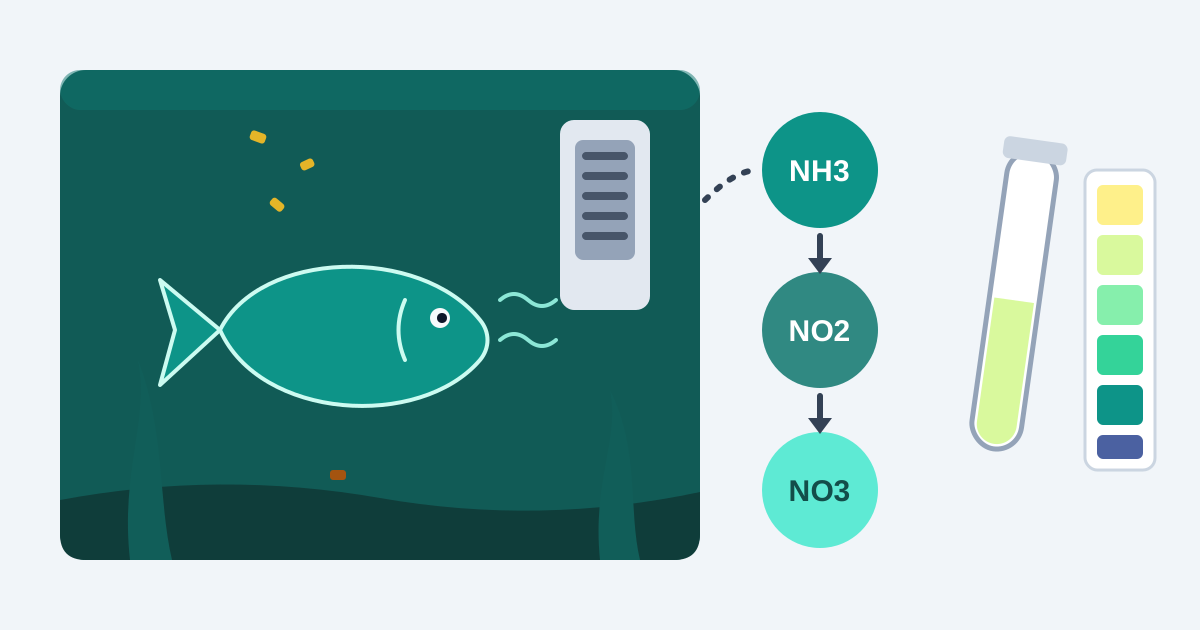
Aquarium ammonia is the waste your fish give off, and in a healthy, cycled tank you should never be able to measure it: the target is 0 ppm. If your test shows any, the short version is to cut feeding, do a 25–50% dechlorinated water change and retest — then work out why the filter isn't keeping up.
This page explains where ammonia in fish tank water comes from, what aquarium ammonia levels actually mean (the same reading can be harmless in one tank and dangerous in another), how to test it without being fooled, and how to bring it down. If your fish are already gasping, red-gilled or dying, go straight to ammonia poisoning in fish — that page is the emergency version.
Where aquarium ammonia comes from
Fish don't mainly produce ammonia through their droppings. According to the University of Florida's IFAS Extension, most of it leaves the fish through the gills, straight into the water, and the main source is simply the fish digesting their food. Uneaten food and other decaying matter add more.
That gives you the usual culprits when a reading appears:
- An uncycled or new tank — there aren't enough filter bacteria yet to process the waste. This is new tank syndrome.
- Overfeeding — more food digested, and more left over to rot.
- Too many fish for the filter, or a lot of fish added at once.
- Something dead or decaying — a fish or snail you haven't found, or melting plant leaves.
- Filter problems — Aqueon lists a biofilter that's "too dirty or too clean" as a cause, and Fritz Aquatics adds skipped water changes and medications that disrupt the biological filter.
- Your tap water. Many water suppliers disinfect with chloramine, which the US EPA says is most commonly made by adding ammonia to chlorine — and the EPA says more than one in five Americans use chloramine-treated drinking water. A dechlorinator deals with the chlorine; as Seachem puts it, chloramine minus chlorine leaves ammonia. Test a glass of tap water to see whether yours brings some in.
In an established tank you never see any of this, because the nitrifying bacteria in your filter turn ammonia into nitrite, and then nitrite into much less harmful nitrate, as fast as it's made. That chain is what cycling an aquarium builds.
What aquarium ammonia levels mean
Ammonia in water exists in two forms, and the difference explains why the same reading can matter more in one tank than another:
- Free ammonia (NH₃) — the toxic form. UF IFAS says it's roughly 100 times more toxic to fish than the other form, and that damage to fish starts above about 0.05 mg/L of it.
- Ammonium (NH₄⁺) — relatively harmless.
How much of your ammonia is in the toxic form depends on pH and temperature: the higher either one is, the bigger the toxic share (UF IFAS; Fritz). AquariumScience.org gives a useful rule of thumb — total ammonia is ten times more toxic at pH 8.0 than at pH 7.0.
Most hobby test kits, including the popular API one, measure both forms added together ("total ammonia"). So the number on your chart doesn't tell you on its own how dangerous the water is. A 0.5 ppm reading in soft, acidic water is much less of a threat than the same 0.5 ppm in a warm tank at pH 8 — but it's still a sign the tank isn't coping.
So what number should I aim for?
Zero. You don't need to calculate free ammonia to act — any reading that stays above 0 ppm means waste is building up faster than the filter can clear it. Treat the pH point as a reason to act faster in alkaline tanks, not as permission to ignore a reading in acidic ones.
How to test for ammonia
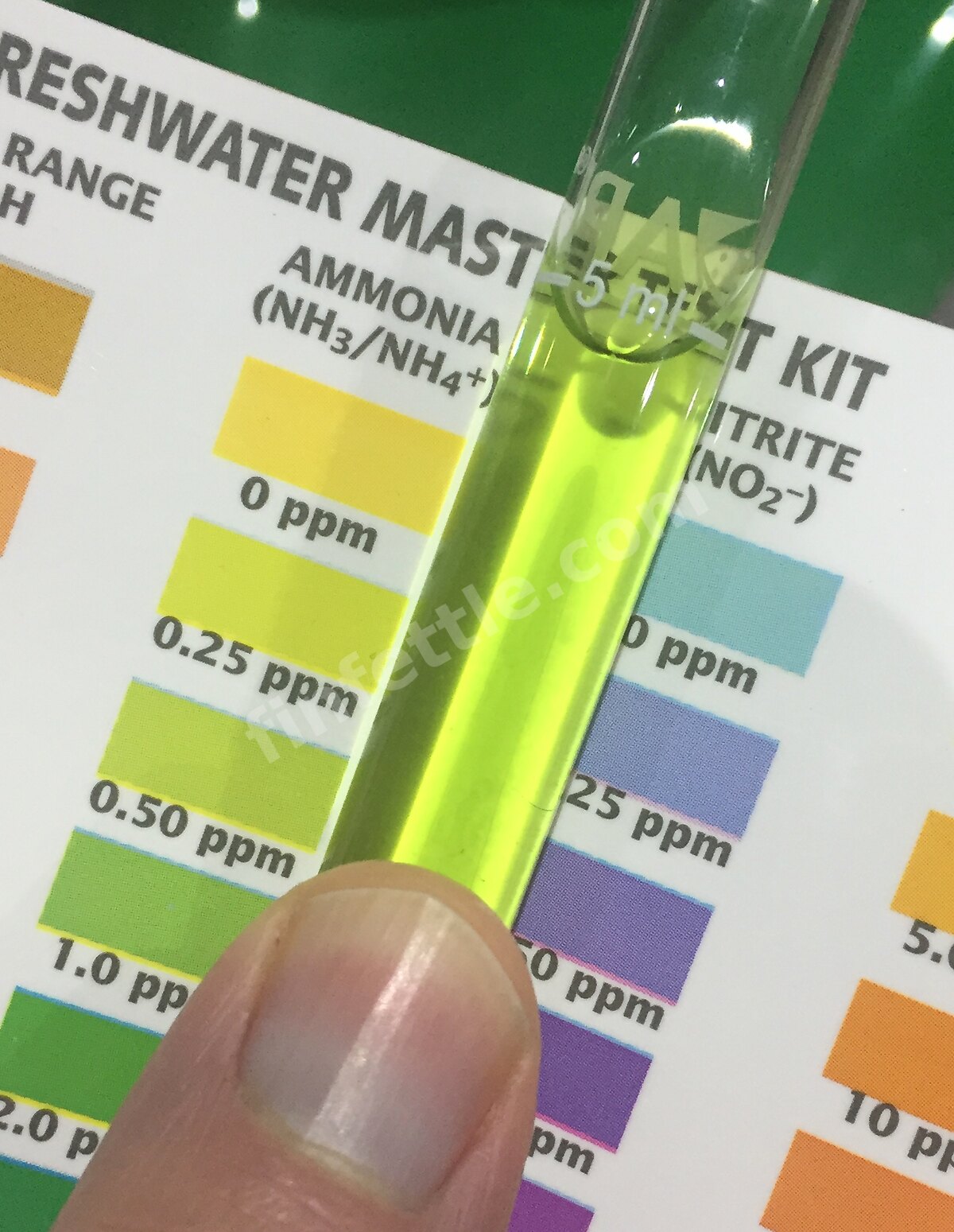
Ammonia is colourless and odourless, so a test kit is the only way to know it's there. A liquid kit is more precise than strips; follow its waiting time exactly and read the tube against the chart in good light.
More options, and how I chose them, are on my aquarium test kit page.
Two things that trip people up:
- A faint reading that won't go away. AquariumScience.org notes the API ammonia test can read 0.25 ppm even in distilled water. If you're stuck on a very light green, test tap water or bottled water side by side before you panic.
- Readings after a water conditioner. Some conditioners bind ammonia rather than remove it, and the test may still count it. Seachem says its Prime binds ammonia for up to 48 hours, that Nessler-type kits show a muddy, off-scale result after it, and that salicylate kits should be read promptly to avoid a false reading. Binding buys time; it doesn't replace water changes or a working filter.
High ammonia: what to do now
- Retest to confirm, and test your tap water too — you want to know whether the ammonia is coming from the tank or the tap.
- Stop or cut feeding for now (UF IFAS; Aqueon). Less food in means less ammonia out.
- Do a 25–50% water change with dechlorinated, temperature-matched water — the range both UF IFAS and Aqueon give. Fritz Aquatics scales it to the reading, going as high as 75% at 6–7 ppm. Retest afterwards and repeat if it's still above 0.
- Take out anything rotting — uneaten food, a dead fish or snail, melting leaves.
- Leave the filter media alone. Don't replace it or scrub it clean; it holds the bacteria that remove ammonia. If it's clogged, rinse it gently in a bucket of old tank water.
- Add aeration if the fish are breathing hard — UF IFAS advises raising oxygen if it falls below 5 mg/L, and ammonia damages gills. If they're gasping, see fish gasping at the surface.
- Test daily until ammonia stays at 0 ppm on its own.
Free tool
A water change works by dilution, so a '50%' change is only 50% if you know how much water is really in the tank. Substrate and rocks take a real share of the box rating — get your true volume here.
Aquarium volume calculator →When I cycled my first tank — a Juwel Trigon 190 — I did it fish-in, with a few hardy mollies and daily water changes. Testing and changing water, day after day until the bacteria caught up, is the same routine as the steps above.
When it's more than a water change
If fish are dying, gasping or showing red, inflamed gills even after the ammonia is back at 0, the gill damage or a secondary infection may need more than husbandry — UF IFAS notes ammonia-stressed fish are more prone to bacterial infections. Speak to an aquatic vet or an experienced fish shop. This page is educational and husbandry-first; it's not a substitute for a vet.
Why ammonia keeps coming back
A one-off reading after a missed water change is easy to fix. Ammonia that keeps returning means the tank's waste and its filter are out of balance:
- The tank isn't fully cycled yet. You'll usually see nitrite follow the ammonia. Keep the water changes going and give it time — the cycling guide explains how to tell when it's done.
- Too many fish or too much food for the filter. Feed less, and stock slowly.
- The filter keeps getting reset — replacing cartridges, cleaning all the media at once, or running a medication that affects filter bacteria.
- Chloramine in your tap water adding a little ammonia with every change. A cycled filter normally handles it; a new one may not.
Aqueon also suggests live plants, which take up ammonia, and testing weekly once things are stable. Cloudy water often turns up at the same time in a new tank — that's usually a bacterial bloom, which is a separate, mostly harmless thing.
Adding ammonia on purpose (fishless cycling)
A lot of people searching for aquarium ammonia actually want to add it. In a fishless cycle there are no fish producing waste, so you supply ammonia yourself to feed the bacteria while they grow — either a bottled ammonia product made for cycling, or a pinch of fish food left to rot. Once the tank can clear that ammonia to 0 within a day, with nitrite also at 0, it's ready for fish.
How much to add and how to track progress is covered step by step in how to cycle an aquarium.