
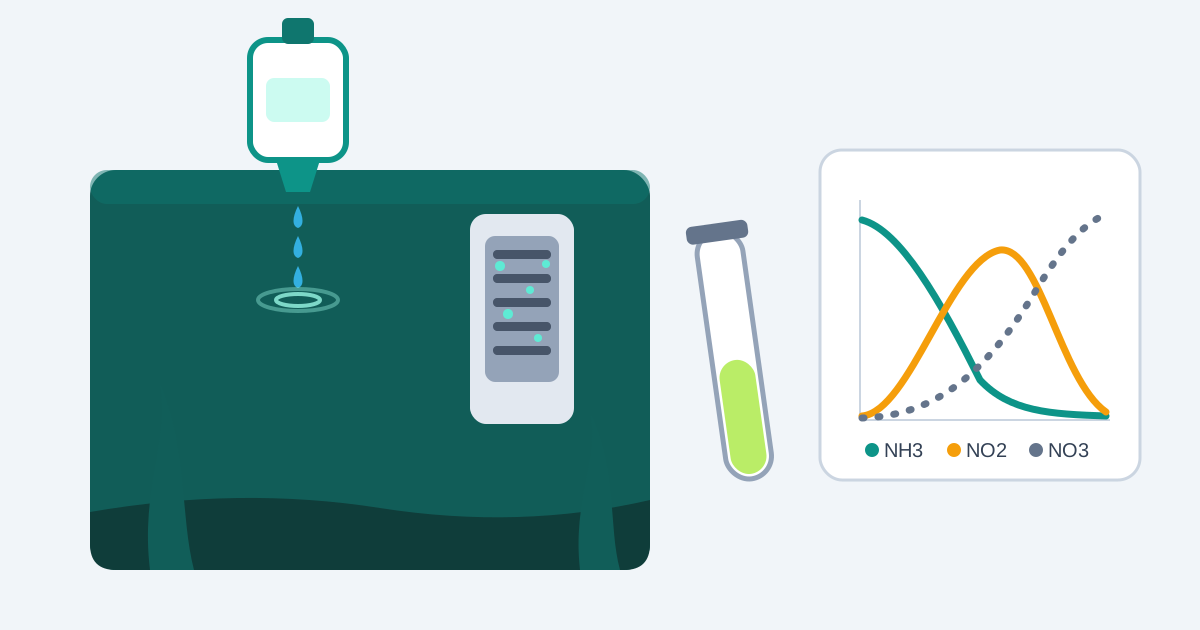
Dr Tim's ammonia is a bottled ammonium chloride solution for fishless cycling: it feeds the filter bacteria while there are no fish in the tank to do it. Dr Tim's says 4 drops per US gallon of aquarium water gives 2 ppm ammonia-nitrogen. After that first dose, let your test kit decide when to add more — and never let ammonia or nitrite climb above 5 ppm.
I haven't used Dr Tim's myself, and I've never done a fishless cycle — every tank I've cycled had fish in it — so this page isn't a hands-on review. It sets out exactly what Dr Tim's own label and guides say, in order, and the two things that trip people up — test readings that don't match, and cycles that stall. For the bigger picture of cycling, start with how to cycle an aquarium.
What Dr Tim's ammonia is
It's sold as Ammonium Chloride Solution for Fishless Cycling. Dr Tim's describes it as reagent-grade ammonium chloride with a stated concentration of 40 mg/ml of total ammonia-nitrogen. That stated strength is the whole point: in its fishless cycling guide, Dr Tim's warns that household ammonia cleaners often contain scents or other additives and rarely print their strength, so it can be hard to know how much you're adding.
Two details worth knowing before you dose:
- The dose changed in November 2016. Dr Tim's changed the solution, so current bottles take 4 drops per gallon instead of 1. If you've been handed an old bottle, read its own label and follow that.
- It's meant to be used a few times, not once. Dr Tim's says you generally add it to the tank 3 times during a fishless cycle, and on that basis a 2 oz bottle cycles 100 gallons, a 4 oz bottle 200 gallons and an 8 oz bottle 400 gallons.
How much Dr Tim's ammonia to add
The dose is per US gallon of water actually in the tank, not the tank's box size. Substrate, rocks and decor take up room, so measure or calculate the real volume first.
Free tool
Dr Tim's doses per US gallon. Work out your tank's real water volume — it shows gallons and litres side by side, so you can use it even if you think in litres.
Aquarium volume calculator →Then:
- Count the drops. 4 drops × your volume in gallons. If that's a lot of drops, Dr Tim's own conversion helps: 100 drops = 5 ml = 1 teaspoon, and 300 drops = 15 ml = 1 tablespoon.
- Don't chase the reading. Dr Tim's says not to expect your test kit to read exactly 2 ppm, and that getting exactly 2 ppm isn't critical — the key is not to add too much.
- Stay under 5 ppm. Its guide puts the starting target at 2 to 3 ppm and says not to go above 5. Too much ammonia, or nitrite above 5 ppm later on, holds back the very bacteria you're trying to grow.
If you're in the UK and think in litres: one US gallon is about 3.785 litres. Convert your real volume to gallons first, then use the 4-drops-per-gallon figure from the label rather than a rounded per-litre number.
Fishless cycling with Dr Tim's, step by step
This is the sequence in Dr Tim's quick guide. You need the ammonia, ammonia and nitrite tests (Dr Tim's says a pH test is a good idea too) and some patience. It works with or without Dr Tim's One & Only bacteria; the guide says adding the bacteria makes it shorter.
- Day 1 — dose to 2 ppm. 4 drops per gallon. If you're using One & Only bacteria, add it now too — Dr Tim's says to turn off any skimmer, UV and ozone and remove filter socks for 48 hours when you do.
- Day 2 — test ammonia and nitrite.
- Day 3 — re-dose only if both are below 1 ppm. If they are, add another 4 drops per gallon.
- Days 4 and 5 — test.
- Day 6 — same rule. If ammonia and nitrite are both below 1 ppm, add 4 drops per gallon again. Don't keep adding to make the test read 2 ppm.
- Days 7 and 8 — test. The first time ammonia and nitrite are both below 0.5 ppm, you're close. From here, test every day.
- Re-dose at below 0.2 ppm. When both ammonia and nitrite are below 0.2 ppm, add another full dose.
- Done. When you can add the full 2 ppm dose and both read below 0.2 ppm the next day, the tank is cycled. Do a partial water change and add some fish.
Before you start, test your tap water for ammonia too, so you know what you're starting from. When I tested mine straight from the tap, ammonia read 0 — but not every supply does.
Without bottled bacteria, it's slower. Dr Tim's longer guide describes the no-bacteria version: test every 2 or 3 days until nitrite shows up, then add half the first dose; around days 9 to 12 ammonia will probably be below 1 ppm with nitrite present, and nitrite doesn't spike until somewhere between days 14 and 20. After that, add only a quarter dose every few days, making sure nitrite stays under 5 ppm. Dr Tim's says a cycle without effective added bacteria takes about 30 days; the cycling guide has the same "test, wait, re-dose" logic with more on what each stage looks like.
More on choosing a kit is on my aquarium test kit page.
Why your test kit doesn't read 2 ppm
This comes up again and again on fishkeeping forums: people add 4 drops per gallon and the test shows more than 2 ppm, so they assume the bottle is too strong or the dose is wrong.
Dr Tim's answer is in its own guide: don't expect the kit to read exactly 2 ppm, and don't keep adding ammonia trying to make it. Separately, Dr Tim's writes its figures as ammonia-nitrogen (NH3-N). My own reading is that this is one likely reason for a mismatch: if your kit's colour chart isn't on that same basis, the numbers won't line up with the label. The guide also says that once you've added One & Only bacteria, your kit won't read 2 ppm after a dose — add the 4 drops per gallon and carry on.
What matters is the trend: ammonia falling, nitrite rising and then falling, nitrate appearing. If ammonia reads very high and isn't moving, that's the time to suspect too much, not to add more. Light green readings that never quite clear can also be the test itself — aquarium ammonia covers how to rule that out.
Fishless cycle stalled? Check these
Dr Tim's lists three big problems with fishless cycling; two of them apply when you use bottled ammonia, and there's one easy mistake on top.
- Too much ammonia or nitrite. High levels of either hold the bacteria back, which is why Dr Tim's says to keep both under 5 ppm. Do a water change to bring it down, then go back to dosing only when readings fall.
- pH has dropped below 7. The bacteria produce acid as they work, so a busy cycle can pull pH down until it stalls. Dr Tim's fix is a partial water change of around 20–25%, which brings the pH back up.
- Ammonia removers. Dr Tim's says not to add products that bind ammonia during a cycle — overdosing with them just makes it take longer.
Dr Tim's also notes that a bare-bottom tank (no substrate) cycles more slowly, because there's less surface for the bacteria. That matters for a quarantine tank: Dr Tim's suggests adding some inert glass rock or marbles to the bottom to help.
If your water turns milky partway through, that's usually a bacterial bloom rather than a problem with the cycle.
Pros and cons
Pros
- A stated strength, so a drop count turns into a known dose — no guessing like rotting food or unlabelled cleaner.
- No cloudy, smelly water from decaying food, which Dr Tim's lists as the downside of the food or shrimp method.
- Small bottles go a long way, by Dr Tim's own coverage figures.
Cons
- Easy to overdo: too much ammonia stalls the cycle you're trying to start.
- Readings rarely match the "2 ppm" on the label, which confuses a lot of first-timers.
- The dose is per US gallon only, so UK keepers have to convert first.
Fishless or fish-in?
I cycled my first tank, a Juwel Trigon 190, the other way — fish-in, with a few mollies, before I properly understood the nitrogen cycle — and it took around two months before ammonia stayed at 0. Every tank since has also been cycled fish-in, but with a different routine: I seed the new filter with media from an established tank and add a bottled starter (these days usually FritzZyme 7), and none of those cycles has caused me problems. With fish in, they're exposed to whatever ammonia and nitrite build up while the bacteria grow, and keeping that down is on you. A fishless cycle with a measured ammonia source puts no fish at risk, which is why it's the usual recommendation for a first tank. If you're already fish-in and seeing ammonia or nitrite, don't add Dr Tim's — read new tank syndrome instead.
If you're weighing a bottled bacteria starter as well, Fluval Cycle goes through the independent tests on those products.
Fish already in the tank and struggling?
If fish are gasping, red-gilled or dying, deal with the water first — test, and do a water change. Ammonia and nitrite damage can need more than husbandry; speak to an aquatic vet or an experienced fish shop. This page is educational; it's not a substitute for a vet.