
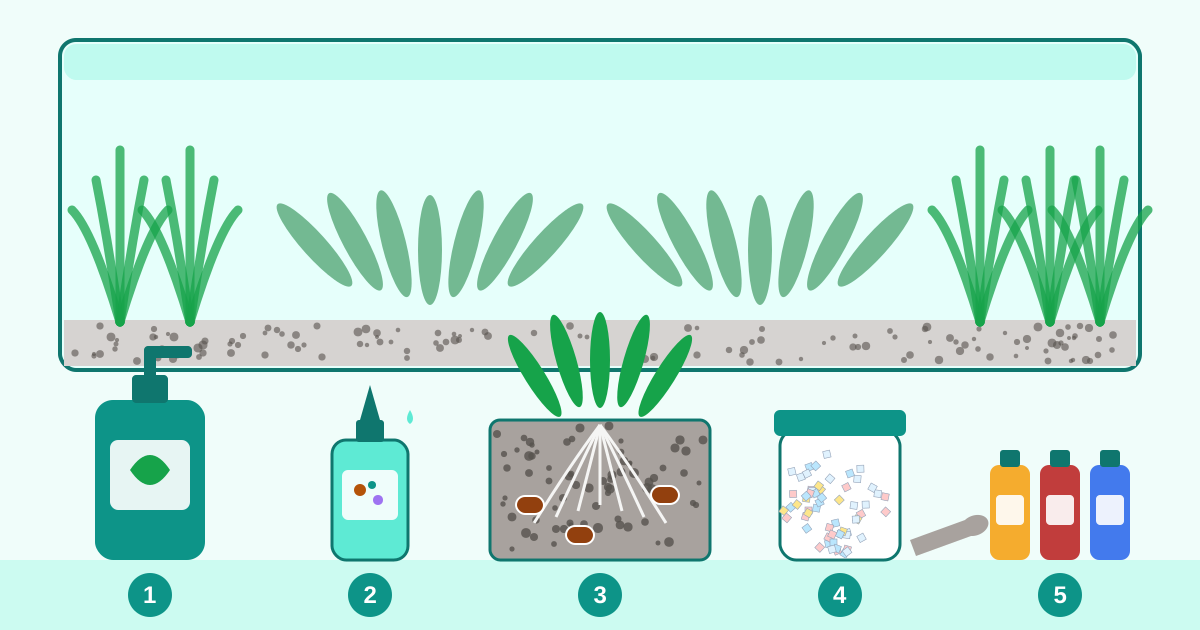
The right aquarium plant fertilizer depends on which plants you grow and how many fish you keep. For most planted tanks, an all-in-one liquid feeds the plants that take nutrients from the water, and root tabs feed the ones that take them through their roots. If you have only a few slow plants and plenty of fish, a micronutrient-only liquid without nitrogen or phosphate fits better. Dry fertiliser salts are the cheap route for heavily planted CO2 tanks.
This is a short list of five fertiliser types, numbered and kept in the same order, each with what it's best for and a real drawback. None of the slots is sponsored.
How to read this page
The picks are fertiliser types, not products I've tested side by side. Where I name a product, it's either an example from a cited manufacturer or one I've used myself — and I say which. My own routine is near the end, in "What I use in my own tanks". The page gives no doses: use the label of whatever you buy.
The short answer
Pick by your plants first, then by your fish and light:
- A normal planted tank with a mix of plants: an all-in-one liquid — pick 1 — plus root tabs for any swords or crypts (pick 3).
- A few slow growers (Anubias, Java fern, mosses) and plenty of fish: a micronutrient liquid without nitrogen or phosphate — pick 2.
- Swords, crypts or carpeting plants in plain gravel or sand: root tabs — pick 3.
- A heavily planted tank with CO2 and strong light: dry fertiliser salts — pick 4.
- You know exactly which nutrient is short: a single-nutrient supplement — pick 5.
Tropica draws the main line clearly: its fertiliser with nitrogen and phosphate is for tanks with many fast-growing plants, and its fertiliser without them is for tanks with few or slow-growing plants and many fish.
The picks
Quick comparison
| # | Type | Best for | Nitrogen & phosphate? | Feeds | Effort | Relative cost |
|---|---|---|---|---|---|---|
| 1 | All-in-one liquid | Most planted tanks | Yes | Water column | Low | Mid |
| 2 | Micronutrient liquid | Few plants, many fish | No (or very little) | Water column | Low | Low–mid |
| 3 | Root tabs | Swords, crypts, carpets | Depends on the tab | Roots | Low | Low |
| 4 | Dry fertiliser salts | Heavily planted CO2 tanks | Yes — you choose the mix | Water column | High | Lowest per dose |
| 5 | Single-nutrient supplements | One known shortfall | Only if that's the one you buy | Water column | Medium | Varies |
"Nitrogen & phosphate?" for picks 1 and 2 follows the manufacturer pages cited below; root tabs vary by brand, so check the pack. "Relative cost" is a rough ranking, not a price — check the retailer's page for current prices.
How I chose
Four questions sort fertilisers for a planted tank:
Where do your plants feed? Aquarium Co-Op says crypts, swords, bulb plants, carpeting plants and runner-producing plants feed through their roots and need a nutrient-rich substrate or root tabs. Stem plants can use either route but seem to prefer the water, and mosses, floating plants, Anubias and Java fern don't need substrate at all.
Do your fish already supply nitrogen and phosphate? This is the split between picks 1 and 2. Tropica sells one fertiliser with nitrogen and phosphate for tanks with many fast-growing plants, and one without them for tanks with few or slow-growing plants and many fish. Seachem's Flourish also leaves them out: Seachem says it contains no significant nitrogen or phosphorus, and sells those separately for when they're needed.
How hard are your plants growing? Light, CO2 and plant mass set the demand. The 2Hr Aquarist says heavy dosing in a sparsely planted tank "seeds instability", while heavily planted tanks benefit from higher nutrient levels; it recommends a leaner approach to beginners because it's easier to control.
How much work will you do? A liquid is a measured squirt. Dry salts mean mixing your own solutions and, with the EI method, a large water change every week.
Free tool
Every fertiliser label doses by water volume. Work out your tank's real volume — not just the number on the box — before you measure anything out.
Aquarium volume calculator →Each pick in detail
1. All-in-one liquid fertiliser — best overall for most planted tanks. One bottle that carries the main nutrients plants take from the water: nitrogen, phosphate and potassium plus trace elements such as iron. Aquarium Co-Op's Easy Green is a typical example: its published analysis lists nitrogen, phosphate, potash, magnesium, iron and other trace elements, and Aquarium Co-Op says it is safe for fish, shrimp and snails. It ties how often you dose to how bright your light is and how heavily planted the tank is, and aims for 20–50 ppm of nitrate in the tank from dosing. Drawbacks: the nitrogen and phosphate are only useful if the plants use them. Tropica warns that if algae starts, its fertiliser containing nitrogen and phosphate will promote it, and that the dose has to match how fast the plants take nutrients up. Seachem also argues that putting everything in one bottle risks overdosing trace elements in the effort to raise the main nutrients.
2. Micronutrient liquid without nitrogen or phosphate — best for few plants and lots of fish. In a tank with a handful of slow plants and a healthy fish load, the fish waste already supplies nitrogen and phosphate. What the plants are more likely to lack is iron, magnesium and other trace elements. Tropica describes its Premium Nutrition as containing iron, magnesium and micronutrients with no nitrogen or phosphorus, for aquariums with few or slow-growing plants and many fish. Seachem's Flourish works the same way and is labelled safe for invertebrates such as shrimp. Drawback: in a heavily planted, fast-growing tank the plants will outrun the fish's supply of nitrogen and phosphate, so you'd need pick 1 or separate nitrogen and phosphate on top. Seachem says Flourish is designed to be used alongside other macro- and micronutrient supplements.
3. Root tabs — best for root feeders. Tablets you push into the substrate near the roots. Aquarium Co-Op says root feeders — crypts, swords, bulb plants, carpeting plants and runner-producing plants — need a nutrient-rich substrate or root tabs, and that inert gravel and sand contain no nutrients themselves. Push them deep, near the roots, and top them up as the label says; Aquarium Co-Op notes a sword's needs grow as the plant does. Drawbacks: they do little for plants that feed from the water, so a tank with Anubias or Java fern on wood still needs a liquid. Aquarium Co-Op also warns against homemade tabs and houseplant fertilisers, which can cause dangerous ammonia spikes. If you're choosing a substrate too, the planted-tank substrate guide covers nutrient-rich options that reduce how much you need.
4. Dry fertiliser salts — best value for heavily planted CO2 tanks. Plain fertiliser salts — potassium nitrate, mono-potassium phosphate, potassium sulfate, plus an iron or trace-element mix — dissolved at home into your own macro and micro solutions. These are the salts in Aquarium Science's recipes for EI (Estimative Index), which it calls the most popular way of dosing high-tech, CO2-injected tanks. The 2Hr Aquarist describes EI as overdosing through the week, then resetting the levels with a 50% water change at the end of it. Aquarium Science says making your own is the cheap route, while ready-made liquids get very expensive for larger tanks. Drawbacks: you're measuring and mixing chemicals, the weekly big water change is real work, and EI is meant for high-light, well-planted tanks. The 2Hr Aquarist finds it too rich for tanks with less plant mass. If you're unsure about the CO2 side, start with the aquarium CO2 system guide.
5. Single-nutrient supplements — best for fixing one known shortfall. Bottles that add one nutrient: potassium, iron, nitrogen or phosphate. Seachem, for example, sells nitrogen, phosphorus and potassium separately to use with Flourish "as needed". They're useful when the leaves point clearly at one nutrient — the plant nutrient deficiency guide shows how to read the symptoms — or when you run pick 2 in a tank that has outgrown its fish's nitrogen supply. Drawback: guesswork costs money and can feed algae. Rule out melting, light and CO2 first, change one thing at a time, and give it a few weeks before adding the next bottle.
What I use in my own tanks
My 90-litre planted community tank is low-tech: no CO2 injection, two Amazon swords, an Anubias nana on a coconut shell and a Java fern on driftwood, in a layer of Seachem Flourite under fine white sand mixed with pebbles. I add Tetra InitialSticks, Tetra's substrate fertiliser, under the swords, and dose liquid carbon now and then. In both of my planted tanks — this one and the Juwel Trigon 190 during its planted phase — I've also dosed Seachem Flourish — a pick-2 fertiliser, with no significant nitrogen or phosphate — though only about once every three months, mainly to avoid algae. In the 90-litre tank I've also used root tabs under the stem plants, roughly once every six months. That's my habit, not a recommendation: dose whatever you use as its label says. None of the plants in the 90-litre tank has ever shown deficiency symptoms.
The Trigon's first planted setup shows what can happen when root feeders go unfed. The Amazon swords slowly faded under its thin sand cap, and because I rarely added root tabs or dosed liquid carbon, every other plant in that tank eventually died off too. That's the gap pick 3 is for. The Java moss was the exception: it thrived, growing into a thick bush on top of the rocks.
What you can skip
- Houseplant or garden fertiliser. Aquarium Co-Op warns it can cause dangerous ammonia spikes in a tank.
- A nitrogen-and-phosphate fertiliser in a lightly planted, well-stocked tank. Tropica's own split puts that tank on the fertiliser without them.
- EI in a sparsely planted tank. The 2Hr Aquarist says dosing heavy nutrients with low plant loads only causes instability and algae.
- Fertiliser as a cure for a dying plant. Tropica says its fertiliser is "not a medicine for dying plants" — pale leaves can also come from poor growth.
- Adding more because growth is slow. Aquarium Science, citing Tom Barr, says changing the fertiliser formula is rarely productive compared with fixing CO2 and lighting. And if algae appears, Tropica's advice is more frequent water changes and more fast-growing plants.
Put it to work
If you're setting up a tank without CO2, the low-tech planted tank guide covers the plants and light that go with a light fertiliser routine. If leaves are already yellowing, the nutrient deficiency guide helps you pick between picks 1, 3 and 5. And if an algae problem starts after you begin dosing, the black beard algae guide covers one of the most stubborn kinds and what to change.