
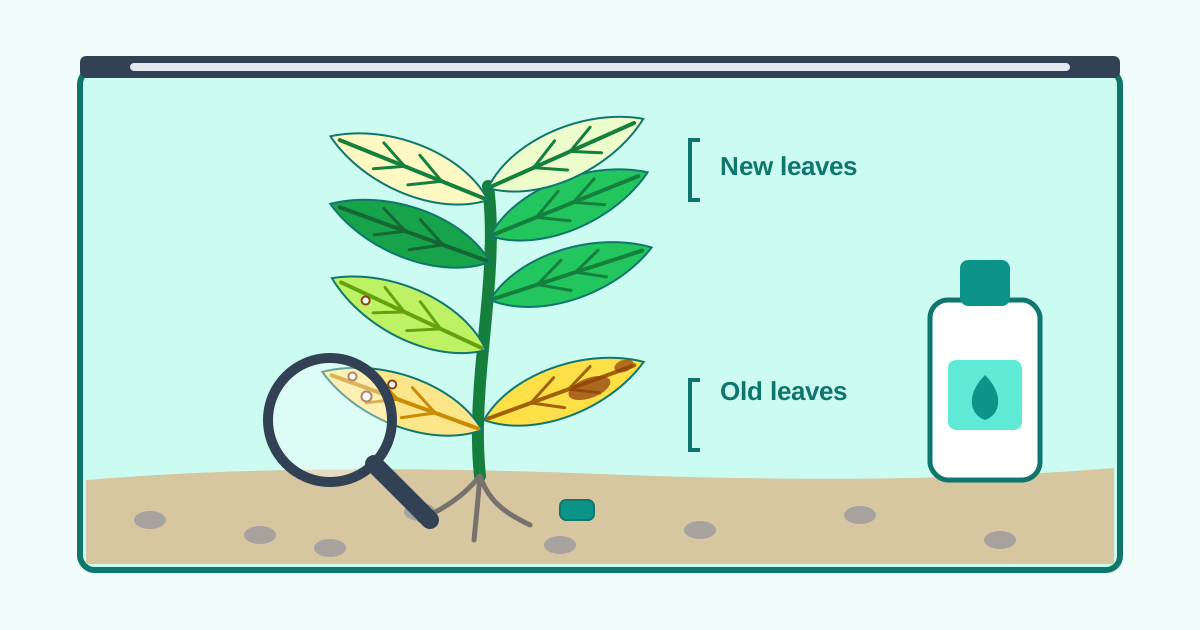
Aquarium plant deficiency shows up in the leaves, and which leaves matters most. Yellowing, pinholes or brown patches on older leaves usually point to nitrogen, potassium, phosphate or magnesium. Pale, yellow or twisted new growth points to iron or calcium. Before you add anything, rule out melting, CO2 and light — then start with a complete fertiliser, change one thing at a time, and give it two to three weeks.
This guide has a symptom chart, the things that look like a deficiency but aren't, a nutrient-by-nutrient breakdown, and how to fix it. It also covers where the three main sources disagree — including one, The 2Hr Aquarist, that calls deficiency charts "terribly inaccurate" for aquatic plants.
Old leaves or new leaves?
Start here, because it halves the list of suspects.
- Damage on older leaves first. Aquarium Co-Op explains that when a plant runs short of nitrogen, it moves what it has out of old leaves to feed new growth, so the old leaves yellow first. The same pattern holds for the other nutrients a plant can move around: The 2Hr Aquarist calls potassium "very mobile", and Aquarium Co-Op and Buce Plant both place potassium, phosphate and magnesium symptoms on older leaves.
- Damage on new growth. The 2Hr Aquarist describes iron, calcium and other trace elements as immobile — the plant can't pull them back out of old leaves — so a shortage shows on the newest leaves while older ones look normal.
Aquarium plant deficiency chart
| Where | What you see | Most likely shortage | Also check |
|---|---|---|---|
| Older leaves | Yellow and translucent, starting at the tips | Nitrogen | Melting on new plants; low CO2 |
| Older leaves | Small pinholes, mainly at edges and tips, sometimes rimmed yellow or brown | Potassium | Is the plant Anubias or Java fern (heavy potassium users)? |
| Older leaves | Yellow with soggy brown patches; algae on the dying leaves | Phosphate | Phosphate-absorbing filter pads |
| Older leaves | Lighter leaf with dark veins; edges may droop | Magnesium | Soft water (often comes with calcium shortage) |
| New leaves | Pale green, yellow or white, veins stay darker; old leaves normal | Iron | Low or unstable CO2; light |
| New leaves | Twisted, stunted or gnarled | Calcium | Very soft or RO water |
| Leaves | Yellow-to-white net-like patches | Manganese | Naturally patterned or variegated plants |
The table combines the descriptions from Aquarium Co-Op and Buce Plant. Treat it as a list of suspects, not a verdict — the next section explains why.
Rule these out first
The 2Hr Aquarist's main point is that deficiency charts come from farming, and that plenty of things that aren't nutrients produce the same symptoms in an aquarium. Matching a leaf to a chart, it says, often leads to the wrong fix — what it calls "nutrient tunnel vision". Check these before you buy anything:
- Melting. Yellow, translucent leaves on a newly added plant are most likely melting, not a deficiency. Aquarium Co-Op and Buce Plant both say new plants often shed their leaves and regrow underwater ones. Aquarium Co-Op names Amazon swords, crypts and stem plants as common melters and calls Anubias and Java fern hardier; Buce Plant lists Bucephalandra, crypts and stem plants.
- CO2. Buce Plant says a CO2 shortage looks similar to a nutrient deficiency and should be ruled out first. The 2Hr Aquarist calls CO2 the most important factor for new growth, and says low or unstable CO2 can cause yellowing, leaves dropping early, loss of colour and stunted tips. The CO2 guide covers what a system involves.
- Light. The 2Hr Aquarist lists a less-than-ideal light spectrum among the things that can make plants look poorly. If your light is weak, old or running very long, start with the planted lighting guide.
- Water hardness. Calcium, magnesium and manganese shortages often turn up together in soft water, according to Aquarium Co-Op. The 2Hr Aquarist suggests checking for extreme KH and GH values, and asking local aquarists on the same tap water what they see.
- Phosphate pads. Both Aquarium Co-Op and Buce Plant warn that phosphate-absorbing filter pads can starve plants of phosphate.
- Too much, not too little. The 2Hr Aquarist notes that excess trace elements can stunt plants through toxicity rather than a lack of nutrients, and that many tanks do better with less fertiliser.
- Natural patterns. Buce Plant points out that some plants — Anubias 'Pinto' and variegated varieties, for example — have pale or white patches by design.
Read the new leaves, not the old ones
To judge whether a change is working, watch the leaves that grow after it. The 2Hr Aquarist says fast-growing stem plants are good indicators of recent conditions, while slow growers like Anubias and Bucephalandra are not.
Nutrient by nutrient
Nitrogen. Older leaves go yellow and translucent from the tips. Aquarium Co-Op says low nitrogen is common in tanks that get weekly water changes without anyone testing the actual nitrate level. Buce Plant notes that a cycled tank with fish or shrimp usually has enough. Aquarium Co-Op warns against fixing it with a nitrogen-only supplement, because that can tip the plant into a different shortage.
Phosphate. Older leaves yellow with soggy brown patches, and algae often settles on the dying leaves. Buce Plant adds that older leaves may look darker with brown undersides first, new leaves come in shorter and stems thinner. Check for a phosphate-removing pad in the filter before dosing anything.
Potassium. Small pinholes in older leaves, mainly at the edges and tips, sometimes with a yellow or brown rim. Buce Plant says edges can also go pale and curl inwards. Aquarium Co-Op and Buce Plant both single out Anubias and Java fern as plants that need plenty of potassium. The 2Hr Aquarist cautions that if the tank already has plenty of potassium and the holes persist, potassium is unlikely to be the cause.
Iron. The newest leaves come in pale green, yellow or white, the veins stay darker, and older leaves look normal. Buce Plant lists iron among the most common deficiencies, alongside potassium and phosphorus. Buce Plant says all-in-one fertilisers don't carry enough iron, and Aquarium Co-Op says high iron is hard to fit into typical fertilisers and suggests an iron-specific supplement; Aquarium Co-Op also notes that extra iron can bring out red in red plants.
Magnesium. Leaves go lighter while the veins stay dark — similar to iron, but on older leaves — and edges may droop. Buce Plant says most aquarium fertilisers already contain magnesium, so a regular fertiliser routine usually covers it.
Calcium. New leaves grow twisted, stunted or gnarled. Aquarium Co-Op and Buce Plant both tie it to soft or RO water, and Buce Plant adds that calcium deficiency is rarely an issue in freshwater aquariums. The fix is raising hardness gradually — Aquarium Co-Op and Buce Plant both mention crushed coral in the filter or on the substrate.
Manganese. Buce Plant describes yellow-to-white, net-like patches on leaves. It's easy to confuse with natural patterning, so rule that out first.
How to fix it
- Confirm the pattern. Old leaves, new leaves, or a new plant melting? Use the chart above.
- Rule out CO2, light, hardness and phosphate pads. See "Rule these out first".
- Start with a complete fertiliser. Aquarium Co-Op says most deficiencies can be solved by increasing the dose of an all-in-one fertiliser, and warns that dosing a single nutrient on its own can leave plants short of others. Follow the product's label — this page doesn't set doses.
- Feed root feeders through the substrate. Aquarium Co-Op says liquid fertiliser suits plants that take nutrients from the water, and root tabs suit plants that feed through their roots.
- Add a single nutrient only for a clear case. An iron supplement for pale new leaves with dark veins; crushed coral for twisted new growth in soft water.
- Change one thing, then wait. The 2Hr Aquarist says to keep a regular routine and adjust one nutrient at a time, otherwise you can't tell what worked. Give it two to three weeks.
- Revisit as the tank changes. Aquarium Co-Op says fertiliser needs change as plants grow, get trimmed, or are added or removed.
Free tool
Fertiliser labels dose per litre or gallon of water. Work out your tank's real volume first, so you're following the label for the water that's actually in the tank.
Aquarium volume calculator →Liquid fertiliser or root tabs?
It depends on how the plant feeds. Aquarium Co-Op's split is simple: liquid fertiliser for plants that feed from the water column, root tabs for plants that feed through their roots. Many planted tanks use both. Plants tied to wood or rock, like Anubias and Java fern, have no roots in the substrate and mostly take nutrients from the water — and they're the two Aquarium Co-Op and Buce Plant single out as heavy potassium users.
How long until you see a difference?
Aquarium Co-Op and Buce Plant both say to allow two to three weeks before judging a change. The 2Hr Aquarist says it takes about a week to see changes for sure, and slower-growing or previously stunted plants can take weeks. Judge the result by the leaves that grow after the change, not the ones that were already damaged.
Where the sources disagree
- How much to trust a chart. Aquarium Co-Op and Buce Plant both organise their advice as symptom-to-nutrient guides. The 2Hr Aquarist argues these charts are inaccurate for aquarium plants and that CO2, water parameters and routine should come first. Our take: use the chart to narrow the suspects, then work through the rule-outs before buying anything.
- More or less. Charts push you towards adding something. The 2Hr Aquarist says many tanks do better with less fertiliser, and that extreme nutrient ratios tend to be ineffective.
My own tank
My 90-litre planted community tank is low-tech, with no pressurised or DIY CO2. It grows two Amazon swords, an Anubias nana on a coconut shell and a Java fern on driftwood, in Seachem Flourite under a top layer of fine white sand and pebbles, and I've added Tetra InitialSticks to the substrate for the Amazon swords. That mix is a good example of the split above: the swords feed through their roots, while the Anubias and Java fern — the two plants Aquarium Co-Op and Buce Plant flag as heavy potassium users — feed from the water. None of the plants in the 90 L has ever shown deficiency symptoms. Besides the root tabs for the swords, I dose liquid carbon now and then. In my planted tanks I've also dosed Seachem Flourish, a liquid fertiliser, though only about once every three months. The water runs at pH 7.0–7.4, and the substrate sits on a plenum for anoxic filtration. The symptoms and fixes on this page come from the sources cited, not from a deficiency I've diagnosed in my own tank.