
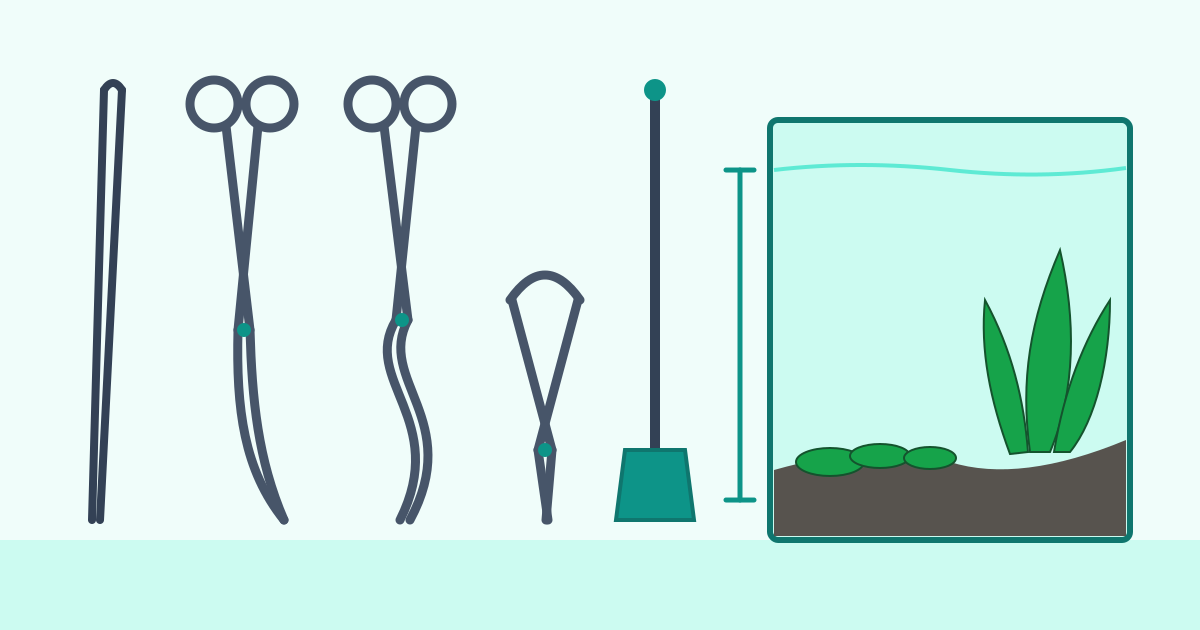
The aquascaping tools most planted tanks need are long tweezers and long scissors. Everything else depends on the job: wave scissors for carpets, spring scissors for moss and nano tanks, and a spatula for shaping substrate.
Buy by length as well as type. The kits we checked are 25–32 cm, which is short for a deep tank.
How to read this page
These picks are tool types, not products I've tested side by side, and the comparison comes from the sources cited. The models named are examples with published sizes. Prices are what each retailer showed on 6 November 2026, and they'll change.
The short answer
- Most planted tanks: long tweezers and curved scissors — pick 1.
- A first full scape, with substrate to shape: a 4–6 piece kit — pick 2.
- A carpet in a larger tank: wave scissors — pick 3.
- Moss, or a nano tank: spring scissors — pick 4.
- Slopes and sand paths: a substrate spatula — pick 5.
The picks
Quick comparison
| # | Tool | Best for | Typical length | Examples and prices seen |
|---|---|---|---|---|
| 1 | Long tweezers and curved scissors | Most planted tanks | 25 cm and up | UNS tweezers + UNS curved scissors, $45.98 for both (Glass Aqua); Tropica Tweezers + Tropica Scissors 25 cm, blade shape not listed, from £34.88 for both (Swell UK) |
| 2 | 4–6 piece kit | A first full scape | 25–32 cm | hygger 6-in-1, $15.99 (hygger); Dennerle set of 3 tools, £29.99 (Real Aquatics) |
| 3 | Wave scissors | Carpets | 20–25 cm | UNS Pro Black, 25 cm, $29.99 (Buce Plant); Aqua Rebell, 20 cm, from €19.90 (Aquasabi) |
| 4 | Spring scissors | Moss and nano tanks | About 15 cm | UNS Spring, 15 cm, $29.99 (Buce Plant); Tropica Spring, 15 cm, from £18.69 (Swell UK) |
| 5 | Substrate spatula | Slopes and sand paths | 12–32 cm | Glass Aqua 4-Way, 12 × 6 cm, $24.99 (Glass Aqua); Chihiros Sand Flattener, from €14.90 (Aquasabi) |
How I chose
Four things matter more than the brand on the handle:
The job it does. Each of these five does something the others do badly, which is why the list stops at five.
Reach. A tool has to get to the substrate. Many listings leave this spec out, and the section below covers it.
Steel and finish. Stainless steel is the standard, but Gensou says grades differ, and cheap tools are where sources warn about rust.
Fit. Tweezer tips should meet with no gap, and scissor hinges should move smoothly without wobble. Gensou treats both as signs of quality, and Portland Aquarium looks for a firm grip and a comfortable handle.
Each pick, honestly
1. Long tweezers and curved scissors — best for most planted tanks. FishyHub ranks straight tweezers first and straight scissors second, and says both get used constantly. One long-time Planted Tank forum member says these two are all you need and everything else is optional. I've gone with curved scissors because Aquasabi says curved blades make cutting from above easier, and they also work near the substrate, though straight ones are fine if that's what you have. Drawback: neither tool moves substrate, and good single tools aren't cheap. Glass Aqua's UNS tweezers and curved scissors come to $45.98, about three times the price of hygger's whole kit.
2. A 4–6 piece kit — best for a first full scape. Gensou says most beginners start with a basic four-piece set and add tools as their tanks grow. Check what's in it, because the numbers on the box can flatter it. hygger's 6-in-1 is curved scissors, straight and curved tweezers and a sand spatula, plus a holder and a cleaning cloth. Bulk Reef Supply's 8-piece kit, at $74.88, has four pairs of scissors, two tweezers, a shovel and a scraper with no blades included. Drawback: quality varies. FishyHub warns that cheap generic tools can have poor spring tension and blunt tips, and rust within months.
3. Wave scissors — best for carpets. The S-shaped blades lie flat along the substrate while your hand stays raised, says Buce Plant, which names Monte Carlo, Hairgrass and Glossostigma. They can shape dense stem plants too, and Horizon Aquatics says to flip them over for domed shapes. Drawback: you don't need them without a carpet. Aquasabi recommends them for tanks with edges of 60 cm or more, and says curved models like these are harder to sharpen than straight ones.
4. Spring scissors — best for moss and nano tanks. The spring reopens the blades, which Aquasabi says reduces fatigue on long sessions. It recommends them for mosses, ground covers and nano tanks. Moss is a routine job, too: in my Juwel Trigon 190, a Java moss bush needed trimming back about once a month. Drawback: they're short, at about 15 cm, so your hand goes in the water in anything but a small tank. For thick woody stems, heavy rhizomes and plastic ties, Buce Plant recommends heavier scissors.
5. Substrate spatula — best for slopes and sand paths. Aquasabi says it shapes and smooths sand, soil or gravel, and it's handy when shrimp flatten a slope while foraging or when soil drifts into a sand path. Many have two ends, a wide one for moving material and a narrow one for detail. Drawback: compact models keep your hand close to the substrate. Glass Aqua's 4-Way Flattener is about 12 cm, while the spatula in Dennerle's set is 32 cm. If your substrate is flat, skip it.
What length do you need?
Length decides whether you can work without soaking your arm or knocking the layout. Gensou's two guides are the most useful sizing we found, though they don't quite agree in the middle:
| Tank | Suggested length | Source |
|---|---|---|
| Up to 40 cm deep | 25–30 cm | Gensou tool sets guide |
| Nano, under 30 cm tall | About 25 cm (tweezers) | Gensou tweezers guide |
| Standard and tall tanks | 30–35 cm (tweezers) | Gensou tweezers guide |
| 45–60 cm deep | 35–45 cm | Gensou tool sets guide |
| Deep tanks generally | 25–40 cm | Horizon Aquatics |
Here's how that compares with what kits offer:
| Set | Lengths listed |
|---|---|
| hygger 6-in-1 | Scissors 9.8 in (25 cm), tweezers 10.5–10.6 in (27 cm), spatula 12.5 in (32 cm) |
| Dennerle set | Scissors 25 cm, tweezers 27 cm, spatula 32 cm |
| Fluval 3-piece | Scissors 9.8 in (25 cm), forceps 10.6 in (27 cm), shovel 12.6 in (32 cm) |
| Bulk Reef Supply 8-piece | About 10 in (25 cm), per Bulk Reef Supply staff |
So typical kit tools cover tanks up to about 40 cm deep by one Gensou guide, while the other would want a little more reach in a standard or tall tank. Neither is enough at 45 cm and deeper. Gensou also gives a stricter rule: buy tools at least 10 cm longer than the water level. That would mean 55 cm tools for 45 cm of water, longer than any size above, so treat it as the ideal and the table as the practical answer.
If your tank is deeper than about 40 cm, check the listed length before you buy. Single tools go much further than kits: Swell UK lists Eheim plant tongs at 400 mm and 600 mm.
Free tool
Measure your tank's depth before you buy tools. While you've got the tape out, work out its real volume too.
Aquarium volume calculator →Straight or curved?
Tweezers. Straight are the most versatile, says Gensou, and Portland Aquarium uses them for grasses such as Vallisneria, held nearly vertical. Curved tips let you plant at an angle without your hand blocking the view, says Gensou, and Horizon Aquatics suggests them for tight corners and around hardscape. Fine tips help with fiddly jobs: Gensou names attaching moss to tiny crevices in hardscape. If you only buy one, make it straight.
Scissors. Sources split here. Straight is the usual choice for general trimming and tall stems (Horizon Aquatics, Portland Aquarium). Aquasabi's Oliver Knott piece uses long curved scissors on stems, because the blades make cutting from above easier. Either works, so don't buy both on day one.
Kit or single tools?
The sources disagree, and both have a point. Gensou says most beginners start with a four-piece set, then upgrade single tools, with curved tweezers and wave scissors the logical first additions. The Planted Tank forum member says you don't need a set at all.
- Buy a kit if you're starting from a bare tank and want to shape the substrate.
- Buy singles if your tank is deep, because you can pick the length of each tool, or if you're only planting and trimming.
- Count the tools, not the pieces. Holders, cloths and cases all get counted.
Steel, finishes and rust
Stainless steel doesn't mean rustproof. Gensou says lower-grade 400-series steel resists corrosion well enough if it's dried promptly, while 304 and 316 cope better with long contact with water. Its other guide calls 420 and 440 series premium, though, so don't judge a tool on the number alone. Few listings name a grade anyway. Glass Aqua's flattener is one that does: 304.
Black and coloured tools have a coating or finish on the steel. Buce Plant calls its matte black a corrosion-resistant coating, and hygger says its colour oxidation finish resists rust. None of the sources we read tested how long these finishes last, so I can't tell you whether they're worth paying for.
How to look after them
- Rinse in fresh water after each use. Buce Plant stresses this after water changes and liquid fertiliser dosing.
- Dry with a towel. Aquasabi says flash rust starts where steel meets screws, so dry those contact points carefully.
- Store them dry. Gensou calls storing tools damp the fastest route to rust.
- Oil the pivots if they stiffen. Gensou suggests a light coat of camellia oil.
- Deal with mild rust early. Aquasabi uses a three-grit polishing tool, in small motions in one direction, taking care near the blades.
- Sharpen gently. Aquasabi says straight scissors can go through a household scissor grinder, taking care not to remove too much metal. For curved and wave blades, it suggests a hone or small whetstone.
If you've used them in saltwater, rinse them straight away. Aquasabi says rust from marine use eats much deeper into the steel and can cause irreparable damage.
Trimming without making a mess
Aquasabi's Oliver Knott piece has two tips worth stealing. Turn the flow off before you trim moss or ground cover, or the fragments spread and take root where you don't want them. Then remove clippings as you go, with a net or a hose. Portland Aquarium says a fine mesh matters, or the clippings pass through.
What you can skip
- A full premium set for a first tank. Aquasabi showed ADA Pro-Scissors at €76.50–€116, and Gensou says premium tools aren't necessary.
- Four pairs of scissors. You need one long pair, plus one for a carpet or moss if you have them.
- A short kit for a deep tank. Measure first. Long single tools are a better buy than a set you'll have to replace.
Two useful extras
A glass scraper isn't an aquascaping tool as such, but many tool lists include one. Some algae won't wipe off with a sponge, and you'll need a blade for it. Aquasabi says scraper blades usually aren't stainless, so take them out after use and dry them. Horizon Aquatics says to check that any scraper is safe for your tank's material, and warns that sand trapped under a magnetic scraper can scratch glass.
A fine net catches floating clippings, as above.
For planting technique, the beginner plants guide covers each plant type. For small tanks, see the nano planted tank guide, and for the wider setup, the low-tech planted tank guide. If you're shaping a slope, choose from the substrate comparison first, and if you're tying moss to driftwood, expect to trim it.