
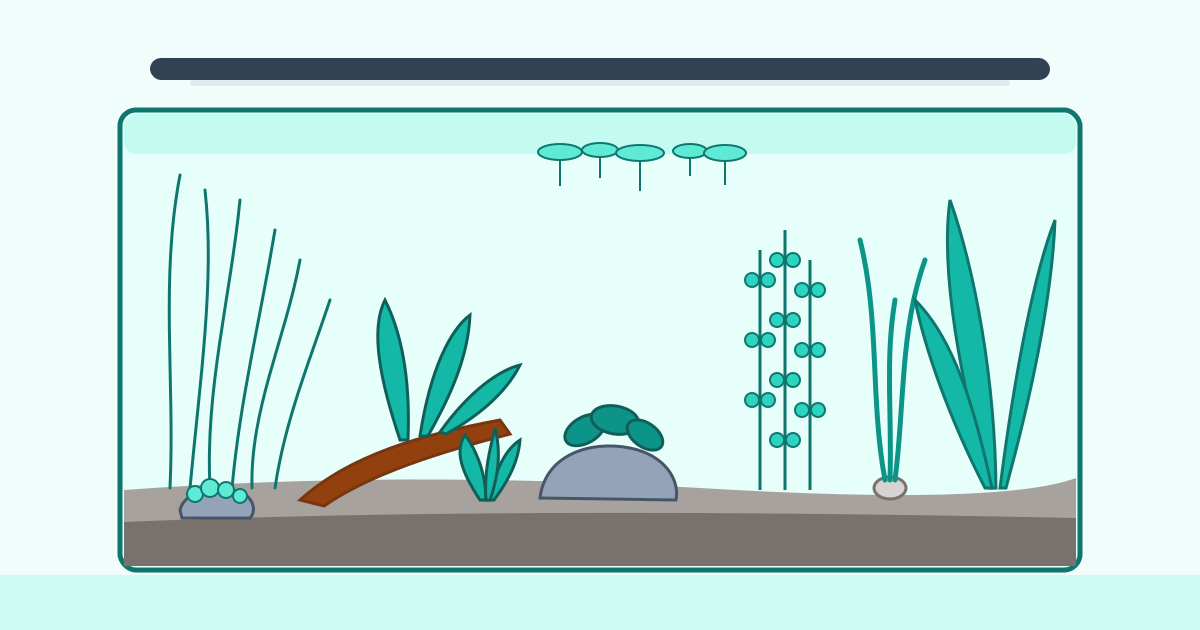
The easiest aquarium plants for beginners are Java fern and Anubias, which grow on wood or rock with no substrate, followed by Cryptocoryne, Amazon sword, Vallisneria, Java moss and floating plants such as Amazon frogbit. None of them needs CO2 injection. What changes from plant to plant is how it goes in and how it feeds — a rhizome tied to wood, a root feeder given root tabs, a melting crypt left alone — so this guide groups the easy plants by how you plant them.
If you only want a short list of the most forgiving plants, see our five low-light plant picks. This page covers the wider beginner set and how to get each one established.
Easy plants, grouped by how you plant them
| Type | Easy examples | How it goes in | Feeds mainly from |
|---|---|---|---|
| Rhizome | Java fern, Anubias | Tied or glued to wood or rock; rhizome never buried | Water (liquid fertiliser) |
| Moss | Java moss, Christmas moss | Tied or glued to wood or rock, or left loose | Water |
| Rosette (rooted) | Amazon sword, Cryptocoryne wendtii and lutea | Roots buried, crown above the substrate | Roots (root tabs) |
| Grass-like | Vallisneria, dwarf sagittaria | Roots buried, plantlets spaced apart | Roots and water |
| Bulb | Aponogeton crispus ("betta bulb") | Placed on top of the substrate | Roots and water |
| Stem | Bacopa caroliniana | Each stem pushed 2–3 inches in, spaced apart | Water |
| Floating | Amazon frogbit, water sprite, hornwort | Placed on the surface | Water |
The planting methods and "feeds from" column follow Aquarium Co-Op's planting guide; the plant lists come from Aquarium Co-Op's top-10 beginner plants and Aquarium Science's list of easy low-tech plants.
Aquarium Science singles out four plants that "just cannot be killed, even by rank amateurs": Anubias, Amazon sword, Java fern and Java moss. If you're nervous, start there.
How to plant each type
Rhizome plants — Java fern, Anubias. The rhizome is the thick, horizontal stem that the leaves grow up from and the roots grow down from. Aquarium Co-Op says these plants don't need substrate at all: wedge them into cracks in rock, or fix them to driftwood with super glue gel or sewing thread, and the roots will eventually grip the hardscape. The roots can go into the substrate, but never cover the rhizome — Aquarium Science warns that a Java fern with its crown buried in sand will die.
Mosses. Java moss and Christmas moss attach the same way: tied or glued to wood or rock. They're usually sold already fixed to a mesh, a piece of wood or a decoration. Aquarium Co-Op says Christmas moss gives excellent cover for baby fish and shrimp.
Swords and crypts. Both are rosette plants: the leaves grow out of one base, the crown. Dig a hole with your fingers or planting tweezers, bury the roots and keep the crown above the substrate. Amazon swords grow tall, so Aquarium Co-Op puts them in the midground or background. Aquarium Co-Op calls swords heavy root feeders, and crypts also need root tabs in a plain substrate — see "Feeding them" below.
Vallisneria and other grass-like plants. These spread by side shoots in the substrate that grow into new plants. A pot often holds several plants: Aquarium Co-Op says to plant them separately with a little space between, roots buried and leaf bases uncovered. Given root tabs and liquid fertiliser, it says Vallisneria grows all the way to the surface and spreads on its own.
Bulbs — Aponogeton. Rinse the bulb and set it on top of the substrate. If no new leaves or roots appear after one to three weeks, Aquarium Co-Op says to turn the bulb over — it may be upside down. It also notes that Aponogeton crispus, sold in chain pet stores as a "betta bulb", can go dormant for a couple of months and drop its large leaves. Leave it in the tank; new growth comes back.
Stem plants — Bacopa. Remove the band or ring around the bunch, then push each stem at least 2 to 3 inches into the substrate, one at a time with space between, according to Aquarium Co-Op. Plant weights help if they keep floating up, and Aquarium Co-Op says stems feed mainly from the water. Its tip for Bacopa: as it grows taller, cut off the tops and replant them. Aquarium Science adds that Bacopa caroliniana becomes "leggy" without plenty of light.
Floating plants — frogbit, water sprite. Aquarium Co-Op calls these the easiest of all: put them on the surface, give them light and liquid fertiliser, slow the current and keep their leaves dry. Don't let them cover the whole surface, it warns, or fish can run short of oxygen and plants below lose light.
Buying your first plants
Potted or tissue culture? Most plants come in a plastic pot packed with rock wool. Aquarium Co-Op compares them with lab-grown tissue culture cups:
- Tissue culture: free of algae, snails and pests, and easy to prepare (rinse off the gel or liquid). But the plants are small, so they take time to fill out, and they may melt back a bit as they adjust.
- Potted: bigger and hardier, with established roots, so you may see less melting. But they can carry snails, snail eggs, algae or duckweed.
Aquarium Co-Op suggests potted plants may adapt more readily to a low-light tank without CO2, while tissue culture suits a new, high-tech tank. It also suggests choosing tissue culture Bucephalandra where you can, because wild harvesting may harm the local ecosystem.
Unpacking. Squeeze the plant and rock wool out of the pot, split the rock wool, strip off as much as you can, and pick out the small yellow fertiliser balls so they don't cause a nutrient spike, per Aquarium Co-Op. Rinse off what's left.
What to skip as a beginner:
- Plants that aren't really aquatic. Aquarium Science's typical first tank includes "terrestrial plants" that simply die. If a plant's care notes don't describe it growing fully underwater, leave it.
- Duckweed, unless you want it for good. Aquarium Science says it grows so fast that some consider it a noxious weed.
- Carpeting plants such as Monte Carlo, at least at first. Aquarium Co-Op says these short, dense carpets typically enjoy lots of light, pressurised CO2, and both liquid fertiliser and root tabs; it lists grass-like dwarf sagittaria among its ten easy plants instead. The sources disagree here: Aquarium Science lists pygmy chain sword, pearlweed and dwarf baby tears as undemanding carpets. If you try one, Aquarium Co-Op's tip is to plant it still in its rock wool plug, with a root tab in the middle.
The first few weeks: melt is normal
Most aquarium plants are grown out of water on plant farms, Aquarium Co-Op explains, so they arrive with leaves that were never underwater. Once submerged, many shed those leaves and grow new ones. Swords drop their big, round leaves for longer, narrower ones; crypts are, in its words, "known for melting back when they're first added to a new tank"; and Bacopa loses its lower leaves while new ones grow at the top.
What to do: leave the plant in place. Aquarium Co-Op's advice for melting swords and crypts is not to throw the "dead" plant away; once it adjusts, new leaves follow. Aquarium Science says the same of crypts — they die back when planted, then come back — and notes that Amazon swords die back at first too.
If the tank itself is brand new, see how to cycle an aquarium before adding fish.
Feeding them
Easy plants still need food; they just need less of it, and different plants eat in different places:
- Root feeders — swords, crypts, Vallisneria. In a plain sand or gravel substrate, add root tabs. Aquarium Co-Op says Amazon swords need "lots and lots of root tabs" and that yellowing new leaves mean it needs more; it suggests root tabs about every three months for Cryptocoryne wendtii in an inert substrate. The planted tank substrate guide explains when a nutrient-rich substrate is worth it instead.
- Water-column feeders — rhizome plants, moss, stems, floaters. These take most of their food from the water, so they need a liquid fertiliser. See aquarium plant fertilizer picks. Whatever you use, follow the product's label; this page doesn't set doses.
- Light. These plants were chosen because they cope with a basic light, but light hours still matter. The planted aquarium lighting guide covers how long to run it.
Free tool
Fertiliser and root-tab labels are dosed by tank volume. Work out the real number first.
Aquarium volume calculator →If leaves start yellowing, getting holes or coming in pale, the nutrient deficiency guide helps you tell a root-feeding problem from a water-column one.
My own beginner plants
My 90-litre planted community tank grows three of the plants on this page: two Amazon swords, an Anubias nana on a coconut shell and a Java fern on driftwood. It also has stem plants, which I've given root tabs roughly once every six months. It has never had CO2 injection and still runs the light it came with. For the swords I've added Tetra InitialSticks, Tetra's substrate fertiliser, and I dose Seachem Flourish only about once every three months. No plant has died out in that tank.
The counter-example is my Juwel Trigon 190's early planted phase. The Amazon swords there slowly faded, and because I rarely dosed liquid carbon or added root tabs, every other plant in that tank eventually died off too. The sources make the same point: easy plants forgive a basic light, but root feeders such as swords still need feeding. The one plant that did well in that tank was the Java moss, which thrived and grew into a thick bush on top of the rocks.
The plant lists, planting methods and buying advice on this page come from the sources cited, not from tests on my tanks.