
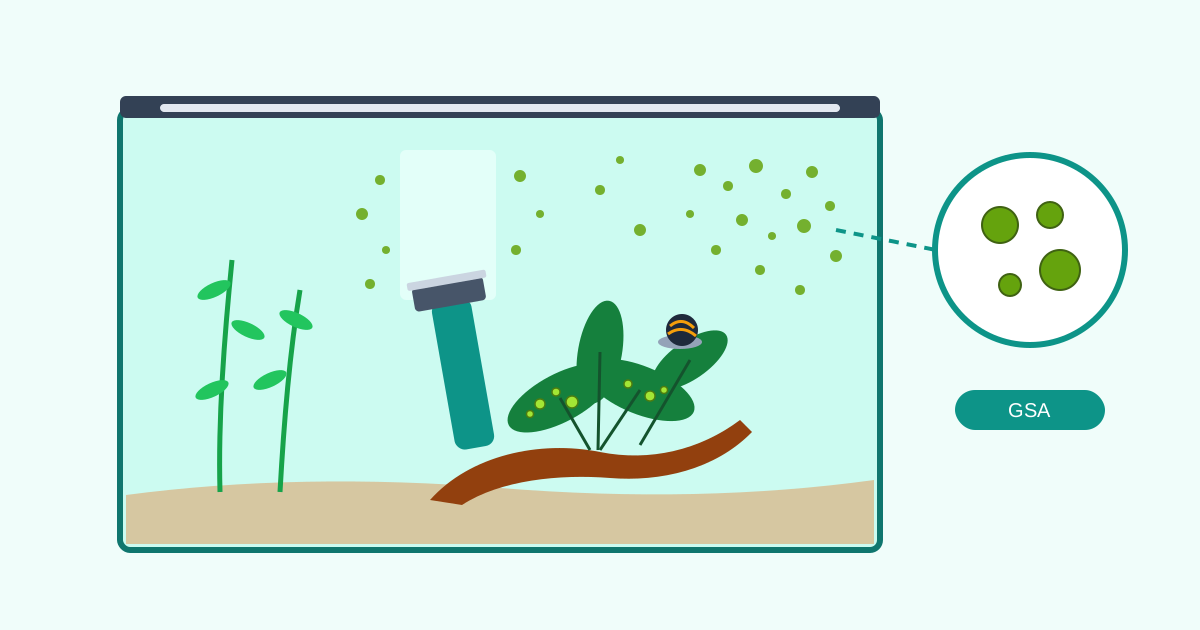
Green spot algae (GSA) is a hard, flat green alga that grows as small round dots on aquarium glass, equipment and the older leaves of slow-growing plants such as Anubias, Java fern and Bucephalandra. A sponge won't shift it: scrape the glass with a blade, cut badly spotted old leaves, then fix the cause — usually weak or stressed plants (often short of phosphate or CO2), strong light on slow growers, and detritus or poor flow.
This guide covers how to recognise it, what causes it, how to remove it, the phosphate question, what eats it, and how to keep it to a few spots you scrape off with routine maintenance. It's written for freshwater planted tanks.
What green spot algae looks like
Aquasabi describes it as green, flat, tiny spots, like polka dots, that are attached very strongly to whatever they grow on. If conditions suit it, the spots widen bit by bit until they join into a coat. You'll mostly see it on the glass — often the brightest patch — but also on equipment, decoration and plant leaves, especially the tough, long-lived leaves of Anubias. Aquasabi says the spots probably mostly belong to green algae of the genus Coleochaete.
It's easy to confuse with other green films. The 2Hr Aquarist's way to tell them apart:
| Green spot algae (GSA) | Green dust algae (GDA) | |
|---|---|---|
| What you see | Small, distinct, round dots that can merge | A soft green film over the glass |
| Speed | Develops slowly | Can appear within a day or two under strong light |
| Removal | Hard to scrape; needs a blade | Wipes off easily, but often comes back quickly |
| Usually linked to | Weak or stressed plants, detritus, strong light on slow growers | A young tank, nitrogen waste or nitrate spikes, poor oxygenation, few plants |
If a sponge clears it, it probably isn't GSA. If you need a razor blade, it probably is.
One source disagrees on how stubborn it is: Aquarium Science calls it "green coat algae" and says it is relatively easy to clean because it doesn't cling to surfaces the way red algae do. Both Aquasabi and the 2Hr Aquarist say true spot algae is hard to remove — and Aquasabi notes that other flat green coats look similar, some of which wipe off easily. So the sources may be describing different algae under one name.
Is green spot algae harmful?
Not to your fish. Aquarium Science treats it as a normal part of every aquarium that doesn't usually cause a big problem. The cost is to your plants and your view: the 2Hr Aquarist says older leaves have little ability to heal, so plants tend to abandon spotted ones and grow new leaves instead.
It's also a useful signal. On leaves, it points to plants that are weak or adapting to a change. On glass and hardscape, the 2Hr Aquarist links it to a build-up of detritus and organic waste with too little plant competition.
What causes green spot algae
- Weak plants. The 2Hr Aquarist says GSA most often takes hold on plants whose growth has slowed because nutrients or carbon are too lean. Healthy leaves produce chemicals that stop algae attaching; when a plant is short of energy, those defences weaken, and older leaves go first.
- Plants adapting to a change. A move to a new tank or a big shift in nutrient levels makes a plant put its energy into new growth and leave older leaves undefended, per the same source. The tell: spotted old leaves, clean new ones.
- Phosphate that's off. Aquasabi says spot algae usually appear when phosphate is too low or too high. The 2Hr Aquarist focuses on the low end — more on that below.
- Not enough CO2 or macronutrients. Aquasabi names carbon (CO2) and macronutrient (nitrogen, phosphorus, potassium) shortages as frequent causes.
- Strong light on slow growers. Spot algae are common in strongly lit tanks, according to Aquasabi. The 2Hr Aquarist adds that high light alone isn't the cause — it exposes weak plant health faster.
- Detritus and slowing flow. When GSA grows on glass and hardscape rather than plants, the 2Hr Aquarist points to organic waste and a clogging filter, which leave stale pockets of water long before the tank looks dirty.
How to get rid of green spot algae
Removing the spots is the easy half; the 2Hr Aquarist's point is that new, healthy growth is what keeps them from coming back. In order:
- Scrape the glass with a blade. GSA clings too hard for a sponge. Use a razor-blade scraper on glass or a plastic blade on acrylic — the 2Hr Aquarist says an old credit card also works on flat surfaces.
- Cut badly spotted old leaves. Older leaves rarely recover even when conditions improve. Trimming them lets the plant put its energy into clean new leaves.
- Clear detritus and restore flow. Do a large water change and stir up debris with a turkey baster as you siphon. The 2Hr Aquarist gives about 50% a week as a baseline and says many aquarists change 50–85% during an active clean-up. Clean the filter if its flow has dropped.
- Test phosphate before you touch the fertiliser. Aquasabi says a phosphate test is the way to tell whether it is too low or too high (see the next section).
- Shorten or soften the light. If the tank is mostly slow growers that don't need strong light, turn it down. The 2Hr Aquarist says cutting the photoperiod to about 6 to 7 hours a day is often very effective against GSA.
- Check CO2 if you inject it. The 2Hr Aquarist recommends aiming for a 1 pH drop and warns not to assume a green drop checker means there's enough CO2 — the CO2 system guide explains the method.
- Add nerite snails, if they suit your tank. They rasp hard spots off glass and leaves (see "What eats green spot algae" below).
Aquasabi suggests scraping the glass clean once you've corrected phosphate, so any new spots show you whether the fix is working.
Free tool
A 50–85% water change, and any fertiliser label, is measured against the water actually in the tank. Work out your tank's real volume first.
Aquarium volume calculator →Phosphate: too low or too high?
This is where the advice online splits.
The 2Hr Aquarist calls "phosphate causes algae, so keep it at zero" bad advice. In planted tanks, it says, phosphate-starved plants become more vulnerable, and tanks run on very lean phosphate regimes often get GSA in the long run. If GSA is the only algae in your tank and you don't dose phosphate at all, that's a hint your plants aren't getting enough. But it adds that low phosphate isn't the only cause: if you already measure and dose phosphate, look at other things holding plants back, such as compacted roots or a build-up of old growth.
Aquasabi says spot algae usually appear when phosphate is either too low or too high, and gives these target ranges for a planted tank:
| Nutrient | Aquasabi's favourable range |
|---|---|
| CO2 | about 20–30 mg/l |
| Nitrate (NO3) | 10–25 mg/l |
| Potassium (K) | 5–10 mg/l |
| Phosphate (PO4) | 0.1–1 mg/l |
| Magnesium (Mg) | above 10 mg/l |
If your phosphate reads at the bottom of the test's range, Aquasabi says to add it with a fertiliser that contains it. If it reads much too high — around 3 mg/l or more — it suggests large water changes or a phosphate-binding filter medium for a while, and cutting back any phosphate you dose. Aquarium Science, meanwhile, says to look at phosphorus and nitrate only if GSA becomes a big problem.
The common thread: test before you change anything. Follow any fertiliser's label for the amount — this page doesn't set doses.
What eats green spot algae
- Nerite snails (Neritina) and sun snails (Clithon) — Aquasabi rates them the most efficient GSA eaters because they rasp hard coats off thoroughly. The 2Hr Aquarist also calls nerites an effective clean-up method, but "support staff, not management".
- Amano shrimp — mostly ignore GSA, according to the 2Hr Aquarist.
- Other dwarf shrimp and otocinclus — help with softer algae and general upkeep but don't make a significant dent in GSA, per the same source.
Check any grazer suits your tank's size and community before adding it. Like every algae eater, snails keep regrowth down while you fix the cause; they don't replace the fix.
Low-tech tanks vs CO2 tanks
- Low-tech tanks (no CO2 injection): the 2Hr Aquarist says carbon is the main limit on plant growth, and slow growth is part of the deal. Don't raise the light to speed things up — Anubias and Bucephalandra in a low-tech tank don't have the vigour to fend off algae under strong light, so grow them in lower light or in shaded spots. A nutrient-rich soil substrate and plants that cope with low CO2 also help.
- CO2-injected tanks: low CO2 can stall growth and let GSA in, but the same source says the more common problem is maintenance slipping under strong light — clogged filters, weaker flow, old growth left too long. Strong light can work even for Anubias and Bucephalandra if the tank stays clean and circulation stays strong.
I've had green spot algae myself, though never green hair algae. In my 90-litre planted community tank it grew mostly on the glass, but it also formed hard spots on the Java fern leaves; in my Juwel Trigon 190 it was mainly on the glass. I bought two nerite snails, which grazed it off the glass; I also scrubbed the glass with a sponge, but it was the snails that kept it under control. Alongside that, I made sure to clean the filter sponges every week. My 90-litre planted community tank is low-tech, with no pressurised or DIY CO2, and grows two Amazon swords, an Anubias nana and a Java fern — and Anubias and Java fern are exactly the slow growers the 2Hr Aquarist says GSA targets. Its light runs longer than the 6–7 hours the 2Hr Aquarist suggests for GSA; the lighting guide has my schedule and why I changed it.
If what you're seeing is dark, brush-like tufts rather than flat green dots, that's black beard algae; soft green strands are hair algae; a soft brown film that wipes off is brown algae (diatoms).
Keeping it away
You won't get rid of it for good. Aquarium Science says GSA grows slowly even with almost no nutrients, so the only way to keep it out completely is to leave the lights off. The realistic goal is a few spots you scrape off during routine maintenance:
- Keep plants growing well. Cut old, declining leaves and replant fresh growth; the 2Hr Aquarist says uprooting old growth and replanting into a cleared, root-fed patch of substrate makes a big difference.
- Keep up the water changes. Aquasabi recommends around 50% a week to stop nutrients building up, and a blade clean of the glass as part of weekly maintenance.
- Keep the filter clean before its flow drops far enough for waste to settle.
- Match the light to the plants. Slow growers don't need a strong light; the best planted aquarium light shortlist sorts lights by tank type.
- Change one thing at a time and give plants time to adapt — adaptation stress is one of the main triggers.