
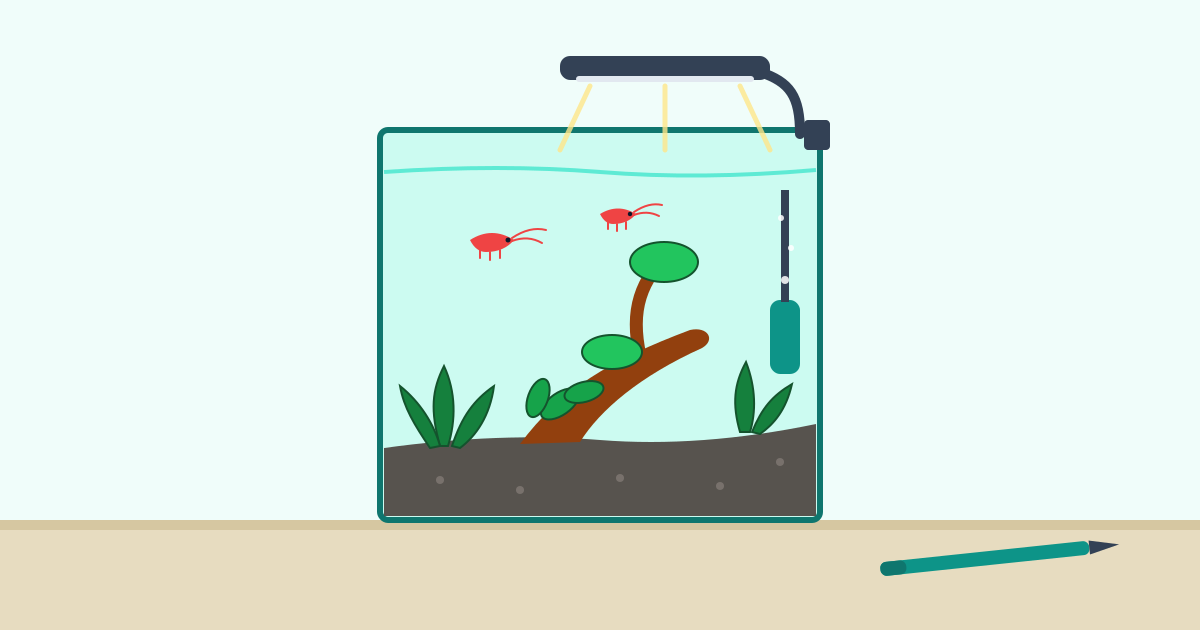
A nano planted tank is a small planted aquarium, usually 10 US gallons (38 litres) or less. Choose the biggest tank that fits your space, a small light on a timer, a gentle filter and slow, small-leaved plants. Cycle it before adding animals, stock it by size, and change water every week.
This guide covers what counts as nano, each piece of gear, plants that stay in scale, what can live in each size, and the points where the sources disagree, including whether a nano suits a beginner at all.
What counts as a nano tank?
Nobody has fixed the term. TFH Magazine calls it "not precisely defined", and Seriously Fish calls it a tank "of arguable definition". These are the lines the sources draw:
| Source | Counts as nano |
|---|---|
| TFH Magazine | 10 gallons or less (about 38 litres) |
| Seriously Fish | 5–10 US gallons for freshwater (about 19–38 litres) |
| Aquasabi | Under the standard 54-litre tank (about 14 US gallons); under 10 litres is a "pico" |
| BRS Fresh | Under 20 gallons (about 76 litres); some say under 30 |
This page uses TFH's line of 10 gallons or less. Above that it's simply a small planted tank, and our guides to low-tech planted tanks and 20-gallon tanks apply directly.
Is a nano a good first planted tank?
A planted nano tank can be a good start, but the sources split. The 2Hr Aquarist says smaller tanks change water parameters faster and can be less forgiving of mistakes. It calls 10–15 gallon tanks great for experienced aquarists and as shrimp tanks, "but not necessarily easier", and suggests 20–40 gallons for a first planted tank.
TFH Magazine says that, appropriately stocked and managed, tiny planted tanks are "quite stable habitats", and Aquasabi recommends nanos to beginners outright. If you want the lowest risk, go a bit bigger within the nano range, as Buce Plant advises, and keep the animal list short.
How to set up a nano planted tank
1. Choose the tank and the spot. Buce Plant says the smaller the tank, the faster it reacts, so go a bit bigger within the nano range if you can. Long tanks suit depth and layout, while taller ones need more attention to lighting and circulation. Keep it out of direct sun and away from heating or cooling vents, and put it where it's easy to reach, because you'll be in it every week. BRS Fresh calls an all-in-one kit a great choice for beginners. Check that its light is meant for plants: TFH Magazine, writing in the compact-fluorescent era, warned that most hoods for tanks this small fell short, and told buyers to pick a system built with enough light.
2. Add the substrate. For a heavily planted tank, use a nutrient-rich aquarium soil. For plants tied to wood or rock, Buce Plant says a simpler substrate works. BRS Fresh suggests gravel or sand with root tabs if you're only keeping a few plants, and keeping sand to no more than an inch deep. A nutrient-rich soil can release ammonia and nutrients early on, so TFH Magazine suggests using it as a base under a layer of fine, rinsed quartz gravel, which saves early water changes. A small bag goes a long way in a tank this size. The types are compared in substrate for a planted tank.
3. Fit a filter made for the size. Aquasabi says nano tanks use internal or external filters developed for their size, and our filter comparison covers the types. Buce Plant says to aim for a gentle sway in the leaves, without flattening the plants. The 2Hr Aquarist's general target of 6–10 times the tank volume per hour works out like this:
| Tank | 6–10× volume per hour |
|---|---|
| 5 US gallons (19 litres) | 30–50 gallons per hour (about 115–190 L/h) |
| 10 US gallons (38 litres) | 60–100 gallons per hour (about 230–380 L/h) |
Watch the rating on anything sold as a nano filter. BRS Fresh calls 140–160 gallons-per-hour canisters ideal for nano tanks, and that's 7–8 turnovers on a 20-gallon tank but around 30 on a 5-gallon one. For a betta, Aquarium Co-Op suggests a gentle sponge filter.
4. Add a heater if the animals need one. TFH Magazine says most nano tanks with fish or shrimp will need one, and prefers small thermostatic heaters. At the time it wrote, they went down to tanks of 2 gallons, with no good option below that. Aquarium Co-Op is more relaxed about some species: Neocaridina shrimp can live at room temperature, and white cloud mountain minnows don't need a heater at all. A betta does.
5. Fit a small light on a timer. Buce Plant says a new tank doesn't need maximum light, just a consistent schedule, and that a timer keeps it steady. BRS Fresh starts at 6–8 hours a day. The 2Hr Aquarist starts a new tank at 5–6 hours and moves to 7–8 only once plants are clearly growing. It rates 20–40 PAR at the substrate as low light and about 40–60 PAR as medium. A rimless nano has nothing for a light bar to sit on, so a clip-on is the usual fix (pick 3 in our planted light picks). The planted lighting guide covers hours and PAR in depth.
6. Decide on CO2. You can skip it: The 2Hr Aquarist says hardy plants such as Java fern, Anubias, Cryptocoryne and mosses don't need it. TFH Magazine says most slow nano plants do well without CO2 given some organic material in the substrate, and that delicate plants are where it makes a big difference. BRS Fresh ties lush carpets to CO2 plus strong light. If you add it, TFH says a yeast reactor is more than enough for a tank this small, fed into the filter or through a glass diffuser sized for nanos. Be careful with gas in very small tanks: Practical Fishkeeping warns that the dose from some pressurised kits varies with room temperature, and that in volumes under 12 litres the consequences can prove deadly. For its 8-litre tank it suggests sticking to liquid fertiliser and a liquid carbon additive instead, though it warns that overdosed liquid carbon can be toxic to livestock and plants. The aquarium CO2 guide covers the options, and the nano diffuser is pick 2 on our diffuser page.
7. Build the layout and plant it. BRS Fresh suggests one type of wood, at least two pieces, and slightly more rock than you think you need. Aquarium Co-Op's rule is small plants at the front and tall plants at the back. TFH Magazine calls planting tools an absolute necessity here, because fingers are too big, and suggests taking out enough water to allow for your hand before you start, or your desk gets wet. The main wood types are compared in driftwood for an aquarium.
8. Cycle it before adding animals. BRS Fresh adds fish only once the cycle is complete and tests show no ammonia or nitrite. Buce Plant says to test instead of guessing, and to keep up water changes in the first few weeks, especially over a nutrient-rich substrate. On a new soil tank, The 2Hr Aquarist does a dark start, seeding the filter with bottled bacteria or established media, and then waits at least another 3 weeks after planting before adding fish. Our cycling guide explains the process.
Free tool
Filter turnover and fertiliser labels both work from your tank's volume, and in a tank this small a rough guess is a big percentage error. Work out the real number first.
Aquarium volume calculator →Plants that stay in scale
TFH Magazine's two rules for choosing are that leaf size should suit the tank, and that you should avoid anything that needs trimming every few days. That rules out a few plants beginners usually start with: regular Java moss, TFH says, grows too quickly and tends to overrun a tiny tank. Slower plants from our low-light plant picks are a better fit.
| Plant | Type | Notes from the sources |
|---|---|---|
| Anubias nana and nana petite | Attach to wood or rock | TFH's slow, lower-light choice; Glass Aqua used nana petite in its 2-gallon cube |
| Small Java fern varieties | Attach to wood or rock | TFH lists small Microsorum; Glass Aqua used narrow leaf trimmings |
| Bucephalandra | Attach to wood or rock | Aquasabi calls these epiphytes slow-growing, undemanding and small-scale |
| Christmas, flame and weeping moss | Attach | TFH says these grow more slowly than Java moss |
| Fissidens | Attach | TFH calls it a wonderful accent; Aquasabi lists it for nano tanks |
| Small Cryptocoryne, including C. parva | Rooted | Aquasabi says C. parva grows better with enough light and a nutrient-rich soil |
| Dwarf hairgrass | Carpet | TFH says it makes a dense carpet without growing too tall, in all but the smallest tanks |
| Hemianthus callitrichoides | Carpet | TFH's pick for small CO2 tanks; Aquasabi calls it one of the smallest aquarium plants |
If you want a few stems, TFH suggests avoiding those with large leaves or very fast growth. Practical Fishkeeping adds that in a small tank pruning matters, and that some species may need frequent trimming. For how to plant each type, see aquarium plants for beginners.
What can live in a nano tank, by size
The size bands below are TFH Magazine's, with other sources added. Buce Plant's advice covers all of them: keep the bioload light.
| Tank | What the sources suggest |
|---|---|
| Under 2 gallons (about 8 litres) | Plants only (TFH). Aquasabi says pico tanks are usually run without animals. Practical Fishkeeping says its 8-litre tank is unsuitable for fish but suggests a small group of shrimp or snails |
| 2.5–5 gallons (about 9.5–19 litres) | Too small for most fish (TFH). A colony of cherry, crystal or bee shrimp |
| 5 gallons or more (19 litres+) | A school of 8–12 ember tetras or a group of six celestial pearl danios (TFH). A school of six green neon tetras, six or more rosy loaches, one scarlet badis, or one pea puffer on its own (Aquarium Co-Op). One betta (Aquarium Co-Op, Buce Plant) |
Three things to check before you buy:
- Shrimp and fish rarely mix. Aquarium Co-Op says most fish treat shrimp as snacks, and that pea puffers will go after live snails too.
- Shrimp want a mature tank. Aquarium Co-Op says newly set-up tanks are usually quite sterile, so wait for healthy plants, mulm and signs of algae.
- Fish need swimming room too. Buce Plant says chili rasboras can work if the tank has enough horizontal space and cover.
Looking after a nano tank
TFH Magazine says maintenance isn't much different from any planted tank; you just think in scale.
- Water changes. TFH Magazine suggests 50% weekly. You can siphon with small tubing or dip it out with a cup. Practical Fishkeeping says to dechlorinate the new water and match its temperature, because in such small volumes any change in water chemistry can affect the livestock.
- Topping up. TFH says an open-top tank loses quite a bit to evaporation, so it needs topping up between changes.
- Algae. TFH suggests a single-edge razor blade as a scraper. Buce Plant says to reduce the light duration slightly first, then wait a week or two before changing anything else. If it's black tufts, see black beard algae.
- Fertiliser. Err on the side of caution. TFH says that with a good nutritious substrate you may not need to supplement much for many months, and that fish food helps feed the plants too. When you do dose, it suggests learning to use an eyedropper or making diluted solutions, and Buce Plant says to dose lightly and only when plants show a need. Follow the product's label; this page doesn't set doses. Our fertiliser comparison covers the types.
- Resetting. One upside of a tiny tank, TFH points out, is that starting again is easy if things go wrong.
Where the sources disagree
- Is a nano harder? The 2Hr Aquarist says small tanks are less forgiving. TFH Magazine says they're quite stable when properly stocked. Buce Plant says small water volumes can swing fast, while Aquasabi calls the bigger-is-more-stable idea "really obsolete". Our take: a bigger tank gives you more time to catch a mistake, which is The 2Hr Aquarist's argument too, so a nano leaves less margin if you overfeed, overstock or miss water changes.
- How much water to change. TFH suggests 50% weekly and Practical Fishkeeping at least 50% weekly on an 8-litre tank. The 2-gallon Glass Aqua tank got 40%, The 2Hr Aquarist's general range is about 30–70%, and Buce Plant's low-tech nanos get about 20% a week. Our take: a lightly stocked plant tank can sit at the low end, and a tank with fish or new soil belongs at the high end.
- The smallest tank for a betta. Aquarium Co-Op says 5 gallons or larger. Glass Aqua describes a betta in a cube of just over 2 gallons, and Aquasabi names the betta as the exception among small tanks that suit fish poorly. We'd go by the 5-gallon figure.
- Under 2 gallons. TFH keeps these for plants only, since they're very hard to keep at a comfortable temperature. Practical Fishkeeping suggests shrimp or snails at about that size, with at least 50% changed weekly.
- The smallest tank for shrimp. TFH Magazine suggests a shrimp colony from about 2.5 gallons. Aquarium Co-Op prepares a mature tank of 10–20 gallons for them. Aquasabi notes there are no formal minimum-size guidelines for shrimp.
My own tanks are bigger than this
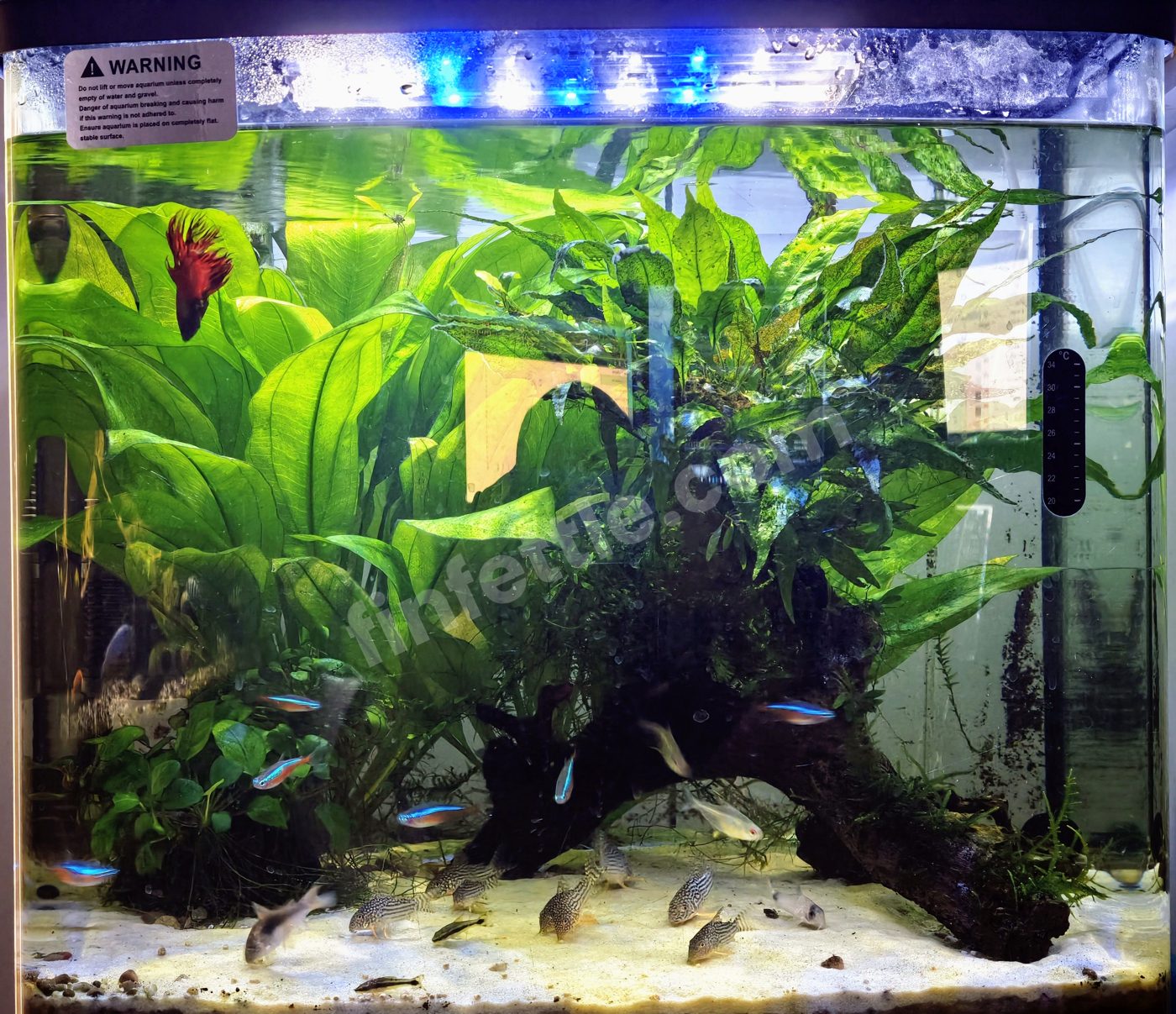
I've never run a tank under about 40 litres. My planted tanks have been the 90-litre community tank and the Juwel Trigon 190 in its early planted phase, and both are well above nano size. So the size bands, stocking lists and water-change figures on this page come from the sources cited, not from my own tanks. Some of what I've done does carry down, and some of it shouldn't:
- Plants. The Anubias nana on a coconut shell and the Java fern on driftwood in my 90 L are the kind of easy plants this page lists, and no plant has died out on me in that tank.
- Java moss. In the Trigon, Java moss thrived, growing into a thick bush on top of the rocks that needed trimming back about once a month. That's fine in a 190-litre tank, and it's the same habit TFH warns about in a tiny one.
- A timer. The 90 L's light has no timer of its own, so I switch it with a GHome Smart plug that I schedule from its app. I changed the hours because of black beard algae, and the change helped, which fits Buce Plant's advice to try the light first.
- Fertiliser. I dose Seachem Flourish only about once every three months, mainly to avoid algae.
- Seeding. I seed new filters with mature media plus a bottled bacteria starter, these days mostly FritzZyme 7. Every tank I've cycled has had fish in it, though, and the sources above wait for zero ammonia and nitrite before adding any.
- Water changes. I change about 25% of the water in the 90 L every fortnight, but that tank has a plenum under the substrate and much more water. Don't copy that routine in a nano.