
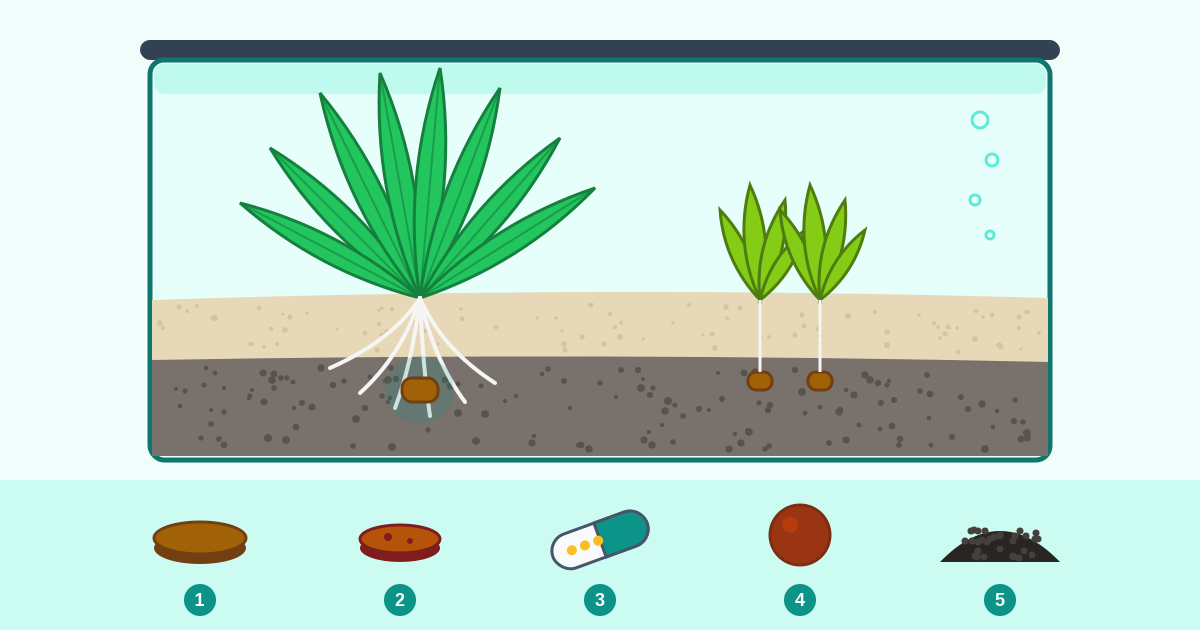
Fish tank root tabs feed the plants that take most of their food through their roots: swords, crypts, Vallisneria, bulb plants and carpeting plants. For most planted tanks, an all-round tab with nitrogen, phosphate, potassium and iron is the one to buy. In a tank with plenty of fish, an iron-rich tab without nitrate or phosphate fits better. Slow-release capsules suit big, hungry plants, fertiliser balls last the longest, and aquasoil does the same job from day one if you're setting up a new tank.
This is a short list of five root-fertiliser types, numbered and kept in the same order, each with what it's best for and a real drawback. None of the slots is sponsored.
How to read this page
The picks are types, not products I've tested side by side. Where I name a product, it's an example from a cited manufacturer or retailer page, or one I use myself, and I say which. Any spacing or timing on this page is quoted from that product's own label or page. Use the instructions on the pack you buy. My own routine is near the end, in "What I use in my own tanks".
The short answer
Pick by your plants first, then by your fish and how often you'll top up:
- A normal planted tank with swords or crypts in plain sand or gravel: an all-round root tab (pick 1).
- Plenty of fish, few plants, or algae already a worry: an iron-rich tab without nitrate or phosphate (pick 2). The fish supply the rest.
- A big Amazon sword or a densely planted bed of root feeders: slow-release capsules placed by the roots (pick 3).
- You want to fertilise the roots and forget about it for months: long-lasting fertiliser balls (pick 4).
- You're setting up a new tank from scratch: a nutrient-rich aquasoil (pick 5). You'll still add tabs later.
If your tank only has Anubias, Java fern, mosses or floating plants, you may not need root tabs at all. Aquarium Co-Op says those plants don't need substrate and use root tabs less. A liquid fertiliser is the better buy for them.
The picks
Quick comparison
| # | Type | Best for | Nitrate & phosphate? | How often to add (example label) | Relative cost |
|---|---|---|---|---|---|
| 1 | All-round root tabs | Most planted tanks | Usually — check the pack | Monthly (Aquarium Co-Op Easy Root Tabs, API Root Tabs) | Low |
| 2 | Iron-rich tabs | Well-stocked tanks | No | Every 3–4 months (Seachem Flourish Tabs) | Low |
| 3 | Slow-release capsules | Big, hungry root feeders | Yes | Nutrients released over 1–2 months (Tropica Nutrition Capsules) | Mid |
| 4 | Fertiliser balls | Topping up rarely | No | About once a year (JBL 7 Balls) | Low |
| 5 | Nutrient-rich aquasoil | New setups | Varies by brand | Once, at set-up; tabs later as it runs down | Highest up front |
The timing column quotes each example product's own page, read on 18 November 2026; other brands of the same type will differ, so go by your pack. "Relative cost" is a rough ranking, not a price — check the retailer's page for current prices.
How I chose
Four questions sort root fertilisers:
Do your plants feed through their roots? Aquarium Co-Op names crypts, sword plants, bulb plants, carpeting plants and runner-producing plants as the root feeders that benefit most. Stem plants can use either route but seem to prefer the water. Plants that grow on wood or rock barely use the substrate.
What's already in your substrate? Aquarium Co-Op says inert gravel and sand contain no nutrients of their own, so root feeders in them need tabs. Enriched aquasoils start rich, but it says their nutrients get used up and need topping up with tabs. Seachem says its Flourite gravel is a rich source of iron and some minerals.
Do your fish already supply nitrogen and phosphate? Fish waste does. That's the split between picks 1 and 2: Seachem says Flourish Tabs contain no phosphate or nitrate "that would promote algae proliferation", while Aquarium Co-Op's Easy Root Tabs list both.
How often will you top up? Labels range from monthly to about once a year. A tab you forget to replace does nothing: the stem plants in my first planted tank died off for exactly that reason (see below).
Free tool
Root-tab labels go by gravel area or tank size, not just 'one per plant'. Measure your tank's real footprint and volume before you count tabs.
Aquarium volume calculator →Each pick in detail
1. All-round root tabs — best overall for most planted tanks. Tablets of fertiliser you push into the substrate by the roots, carrying the main nutrients plus trace elements. Aquarium Co-Op's Easy Root Tabs are a typical example: made with mineralised topsoil containing red clay, with a guaranteed analysis of 2.49% nitrogen, 1.59% phosphate and 9.98% potash plus magnesium, iron and manganese. Aquarium Co-Op says they contain no ammonia-based ingredients and won't cause harmful effects if they get into the water. API Root Tabs are another common choice, but API lists iron, potassium and carbon rather than nitrogen and phosphate, so check what's in the pack you pick up. Drawbacks: both labels say to add new tabs monthly, and as a plant grows it needs more. Aquarium Co-Op says a newly planted baby Amazon sword may only need one tab every six weeks, but the same plant three months later may need six a month.
2. Iron-rich root tabs without nitrate or phosphate — best for well-stocked tanks. These feed iron and trace elements to the roots and leave nitrogen and phosphate to the fish. Seachem says Flourish Tabs are rich in iron, manganese, magnesium, calcium and potassium, carry trace elements, amino acids and vitamins, and contain no phosphate or nitrate. The label says to add new tabs every three to four months, so they're less work than pick 1, and Seachem says they won't alter pH, though they're slightly acidic in very soft or unbuffered water. Drawback: in a heavily planted tank with few fish, root feeders can run short of the nitrogen and phosphate these tabs leave out, and you'd need pick 1 or a complete liquid fertiliser on top.
3. Slow-release root fertiliser capsules — best for big, hungry root feeders. Capsules holding small slow-release balls that sit beside the roots. Tropica says its Nutrition Capsules contain nitrogen, phosphorus, iron and micronutrients, release them over one to two months, and are meant for plants with sturdy roots — stem plants, Cryptocoryne, Echinodorus (swords) and Vallisneria — and for large solitary plants. Drawback: Tropica says the capsules don't fully break down; small resin balls stay in the substrate after the nutrients are gone. Tropica calls the resin biologically harmless, but you'll find the balls when you replant or clean the gravel.
4. Long-lasting root fertiliser balls — best for topping up rarely. Hardened clay balls that release iron and trace elements very slowly. The Aquasabi listing for JBL ProFlora The 7 Balls says they're free from phosphates and nitrates, are pressed into the root zone one or more at a time depending on the plant's size, and should be repeated about once a year. It recommends them for root feeders such as Echinodorus and Cryptocoryne. Drawbacks: like pick 2, they carry no nitrogen or phosphate. JBL is a German brand, and the listing we checked showed them out of stock.
5. Nutrient-rich aquasoil — best when you're setting up from scratch. Instead of adding fertiliser to an inert gravel, the whole substrate carries nutrients from the start. Aquarium Co-Op says enriched aquasoils start out as a nutrient-rich substrate. Drawbacks: it says those nutrients are used up over time and need replacing with root tabs, so aquasoil delays tabs rather than replacing them. And it's only practical at set-up — changing the substrate in an established tank means stripping it out. The planted-tank substrate guide compares aquasoil with the other options.
How to use root tabs
- Push them deep, fast. Aquarium Co-Op says to push the whole tab to the bottom of the substrate, ideally under the plant's roots; its product page says at least 1 inch (2.5 cm) down. Seachem and API say midway into the gravel bed.
- Spread them out as the label says. Aquarium Co-Op's blog suggests one tab about every 5–6 inches (12–15 cm) in a grid, closer in a densely planted tank. Seachem says one Flourish Tab per 10–15 cm (4–6 in) radius, and both Seachem and API say a standard 10-gallon tank takes six of their tabs.
- Put several around big plants. Aquarium Co-Op says larger plants such as Amazon swords may need several tabs in a circle around the base.
- Replace them on the label's schedule. Nutrients run out even in a rich substrate. Aquarium Co-Op lists slow growth, yellowing, browning or melting leaves after a spell of healthy growth as signs they have. Newly planted plants melting in their first weeks is a different problem — see the plant melting guide.
- Skip DIY and houseplant fertiliser. Aquarium Co-Op warns they can cause dangerous ammonia spikes.
What I use in my own tanks
My 90-litre planted community tank is low-tech, with no CO2 injection. Its substrate is a layer of Seachem Flourite under fine white sand mixed with pebbles, over an under-gravel filter that I run as an anoxic filter. Roughly once every six months I push four Tetra InitialSticks, Tetra's substrate fertiliser, into the substrate around the base of each of the two Amazon swords, one at each corner of the plant. The stem plants get them on the same six-monthly routine. That's far less often than any label on this page, so treat it as my habit in a Flourite tank, not a recommendation. None of the plants in that tank has ever shown deficiency symptoms. I also keep corydoras in it, and Aquarium Co-Op says well-fed roots grow stronger and are less likely to be pulled up by fish that dig for food.
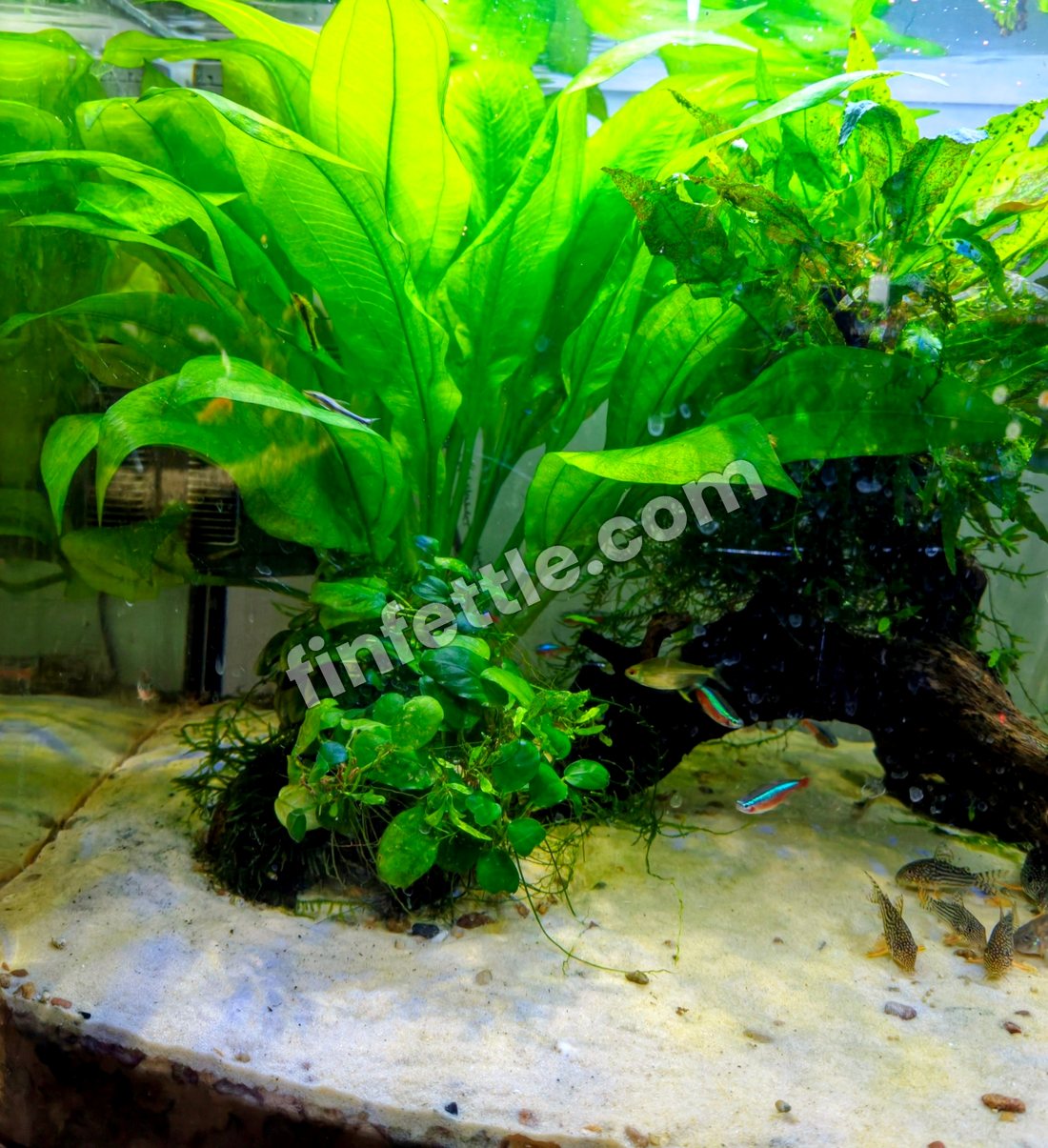
My Juwel Trigon 190 shows the other side. In its first, planted setup, the substrate was a full layer of aquasoil under about 2.5 cm (1 in) of plain aquarium sand. The Amazon swords slowly faded, and the stem plants did well for a while, then died off because I didn't keep replacing the root tabs. That's pick 5's drawback in practice: aquasoil under a thin sand cap wasn't enough on its own, and I didn't top it up.
What you can skip
- Root tabs for Anubias, Java fern, mosses and floating plants. Aquarium Co-Op says these don't need substrate and use root tabs less; a liquid fertiliser suits them better.
- Homemade tabs and houseplant fertiliser. Aquarium Co-Op warns of dangerous ammonia spikes.
- Leaving dug-up tabs on the surface. Aquarium Co-Op says its tabs won't harm the water if fish unearth them, but the nutrients are meant for the roots, so push them back down.
- Tabs as a cure for melting new plants. Plants often melt after planting while they adjust; see the plant melting guide before you add fertiliser.
- Guessing at a deficiency. If leaves are yellowing, the nutrient deficiency guide helps you tell whether roots or the water column are short before you buy anything.
Put it to work
Root tabs cover the roots; most tanks also need something for the plants that feed from the water, and the aquarium plant fertiliser guide covers that side. If you're planning a tank without CO2, the low-tech planted tank guide shows how root tabs fit a light-touch routine.