
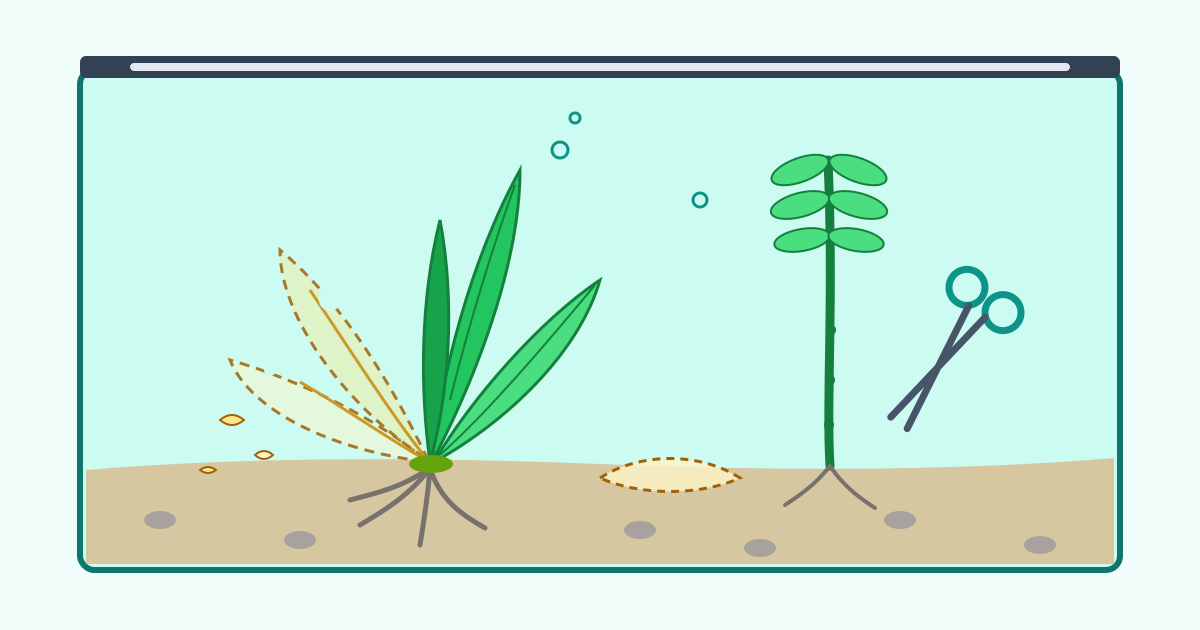
When plants melt in an aquarium, the leaves lose colour, turn see-through and fall apart, usually older leaves first. On a newly added plant this is most often the plant shedding the leaves it grew out of water on the farm. Cut off the mushy leaves, leave the roots where they are, keep conditions steady and feed the water column, and new underwater leaves should follow within a few weeks.
Melting in an established tank is a different problem. It usually follows a change in the tank, or, if nothing has changed, plants that have been underfed for a long time. This guide covers both cases, what to do, how to prevent it, and where the three main sources disagree.
Why new plants melt
Most plants in the shops are grown emersed, out of water. Aquarium Co-Op says farms do this because the plants grow faster, ship better and stay free of algae. Those leaves are built to take light and CO2 from the air. Once you submerge them, the plant has to grow new leaves that can take CO2 and nutrients from the water, and the old ones die off. That's the "melt". Aquarium Co-Op adds that even a plant already grown underwater, bought from another hobbyist, can melt while it gets used to your water.
The 2Hr Aquarist explains why it hits so hard: underwater, a plant suddenly has far less access to CO2 and oxygen, because gas exchange is much poorer in water. The plant puts its energy into new, adapted growth and scavenges nutrients from its older leaves. It says CO2-enriched water greatly eases that transition, which is why melt is more common in tanks without CO2 injection.
Some plants are more prone to it than others:
- Amazon swords, crypts and stem plants. Aquarium Co-Op calls these three notorious for melting in new environments, and Anubias and Java fern pretty hardy by comparison.
- Cryptocoryne in particular. Aquarium Co-Op says crypts are particularly susceptible, hence the hobby name "crypt melt".
- Tissue culture plantlets. The 2Hr Aquarist calls them delicate and particularly sensitive to immature aquasoils or soils with a lot of detritus.
- Demanding species in a low-tech tank. Aquarium Co-Op says a plant that needs CO2, plenty of nutrients and bright light will likely melt away if you put it in a tank with dimmer lighting and no CO2.
Melt isn't always about the water switch. Aquarium Co-Op and Buce Plant also list damage in transit (rough handling, or a plant that froze in its package), and Buce Plant adds fish chewing on the leaves. Aquarium Co-Op notes two look-alikes as well: a Java fern leaf dies off naturally once it has grown a baby plant, and Anubias rot is a rare disease that turns the rhizome mushy. For Anubias rot it says the only option is to cut off the affected part and see whether the rest recovers.
Melting in an established tank
If the plant has been growing happily for months and starts to melt, look for what changed. Aquarium Co-Op lists:
- a sudden rise or drop in fertiliser dosing
- adding CO2 gas
- a break in your normal water-change routine
- lighting changes
- a temperature rise, such as summer heat
- moving the plant to another tank, including from the shop's tank to yours
It also lists too little light or nutrients, for example a small plant shaded by bigger, bushier ones, which it says you can fix by trimming the larger plants.
If nothing has changed, The 2Hr Aquarist says the usual cause is long-term underfeeding. The plants can look fine but are fragile, so the slightest shock makes them melt, often alongside subtle signs of deficiency and minor but persistent algae. It says this is more common in tanks that rely on the substrate to feed the plants, because many aquasoils use up most of their nutrients in the first few months underwater. Its fix is to enrich the substrate over time and make sure fertiliser levels are adequate.
What to do when your plants melt
- Work out whether the plant is new. New plant: assume it's the switch to underwater leaves. Established plant: go back to the list above and find what changed.
- Cut off the melting leaves. Aquarium Co-Op says to cut a dying leaf off at the base of the stem or near the substrate, because rotting leaves can cause nitrogen spikes or algae. You can take them one by one as they go, or trim them all at once so the plant can focus on new growth. Fine scissors and long tweezers make this easier in a planted tank (see the aquascaping tools roundup).
- Leave the roots where they are. Aquarium Co-Op says a plant with healthy roots that isn't moved should send up shoots within a few weeks. Buce Plant says a plant moved before it has rooted has to start over.
- Check how it's planted. Aquarium Co-Op's rules: never bury the rhizome of Java fern, Anubias or Bucephalandra; set bulbs on top of or partly in the substrate; bury stem plants deeply; and bury the roots of swords and crypts with the crown above the substrate. The beginner plants guide covers this plant by plant.
- Feed the water column. The 2Hr Aquarist says new plants have undeveloped roots and can't yet feed from the substrate, but can take nutrients straight from the water. It recommends dosing a broad-spectrum liquid fertiliser from the first day the plants go in. Follow the product's label; this page doesn't set doses.
- Siphon debris and keep the water clean. The 2Hr Aquarist says removing dead tissue takes ammonia and pollutants out of the tank, and recommends extra water changes and low organic waste while plants settle.
- Replant the tops of leggy stems. Aquarium Co-Op says melting stem plants tend to lose their lower leaves, leaving a bare stem with new leaves on top. Once a stem has fully converted, it suggests cutting off the healthy top and replanting it. For mature tanks, The 2Hr Aquarist likewise says to cut and replant new top growth and discard the old.
- Hold everything else steady and wait. Aquarium Co-Op says to keep conditions as stable as possible and wait several weeks. The 2Hr Aquarist says the transition generally takes longer in tanks without CO2 injection, and to resist moving plants around.
Free tool
Fertiliser labels dose per litre or gallon of water. Work out your tank's real volume first, so you're following the label for the water that's actually in the tank.
Aquarium volume calculator →How to stop plants melting
The three sources largely agree here:
- Start with healthy plants. The 2Hr Aquarist says plants with more stored energy cope better, and long transport and poor handling weaken them, so who you buy from matters.
- Plant into a cycled, mature tank. Buce Plant and The 2Hr Aquarist both warn that an uncycled tank, especially one with an ammonia-releasing aquasoil, stresses new plants. See how to cycle an aquarium.
- Trim before you plant. Buce Plant suggests cutting a few emersed leaves off before planting and trimming the ends of stem plants. Once there's a decent amount of new growth, it says to remove the remaining emersed leaves. It adds that some professional aquascapers cut every leaf off crypts and plant just the roots, so there's nothing left to melt.
- Split clumps and space them out. The 2Hr Aquarist says to separate large clumps into smaller groups for better flow and light. Buce Plant says to plant stems at least 0.5 inch (about 1 cm) apart.
- Feed from day one. A broad-spectrum liquid fertiliser for the water column (The 2Hr Aquarist), and a nutrient substrate or root tabs for root feeders such as swords and crypts (Aquarium Co-Op, Buce Plant). Our fertiliser roundup compares the types.
- Get the light right. Buce Plant says too little light can cause melting and too much can cause algae. The planted lighting guide explains how much is enough.
- Consider CO2. The 2Hr Aquarist and Buce Plant both say CO2 eases the transition. The CO2 guide covers what a system involves.
- Remove organic debris from the substrate around rooted plants. The 2Hr Aquarist says too much rots delicate plants, such as tissue culture.
- Don't move plants once planted (Buce Plant).
The 2Hr Aquarist also suggests a lower temperature, saying 22–23°C (about 72–73°F) works well because it slows the plant's demand for CO2, oxygen and nutrients. Check that range suits your fish before you change anything.
In a low-tech tank
Without CO2 injection, The 2Hr Aquarist says the biggest stress factor can't be removed, which is why melting is so common in these tanks. Its advice: choose hardy species such as Java fern, crypts and Anubias, buy plants already grown underwater, plant sensitive ones in open, unshaded spots, keep good flow, and dose an all-round fertiliser. Expect the transition to take longer. Our low-tech planted tank guide and low-light plants list go further.
Melt or nutrient deficiency?
They can look alike, so ask two questions:
- Is the plant new, or did something just change? Melt usually hits a newly added plant, or follows a change in the tank. The leaves go see-through and fall apart.
- Is there a pattern on plants that have been growing for a while? A deficiency builds up slowly. Yellow, translucent older leaves point to nitrogen, pinholes to potassium, pale new growth to iron. Our plant nutrient deficiency guide has the full symptom chart.
The two overlap: The 2Hr Aquarist's point about established tanks is that long-term underfeeding leaves plants fragile enough to melt at the next small change.
Where the sources disagree
- Is melt normal? Aquarium Co-Op calls it common and Buce Plant says a few leaves melting on a new plant is "actually natural in most cases". The 2Hr Aquarist says, "Contrary to popular belief, melting is not normal or inevitable", though extremely common, and that it can be minimised or avoided by controlling the right variables. Our take: expect some melt on new plants, especially without CO2, but treat heavy or repeated melt as a sign that conditions need work.
- How much to trim, and when. Aquarium Co-Op says to prune melting leaves one by one or cut them all at once. Buce Plant suggests trimming some emersed leaves before planting and the rest once new growth is established, and mentions aquascapers who strip crypts to the roots.
My own tanks
My two planted tanks have been my 90-litre planted community tank and my Juwel Trigon 190 during its early planted phase. I haven't run pressurised or DIY CO2 on either.
- New plants that didn't melt, and a later melt. The two Amazon swords in the 90-litre tank came in rock wool, and they didn't melt when I planted them. So swords don't always melt, even though Aquarium Co-Op calls them notorious for it. About six months after planting, though, the leaves on both swords started to melt and turn transparent. Both swords grew new leaves afterwards.
- A tank where nothing has died out. No plant has died out on me in the 90-litre tank. Its stem plants have done very well. The swords and the stems both get Tetra InitialSticks, Tetra's substrate fertiliser; I give the stems theirs roughly once every six months.
- The slow fade. The Trigon is the other side of it. The Amazon swords there slowly faded, and I cut off the melted leaves. The stem plants did well for a while, then died off because I didn't keep replacing the root tabs. That's the pattern The 2Hr Aquarist describes for established tanks: plants fed mainly through the substrate decline once it runs out.
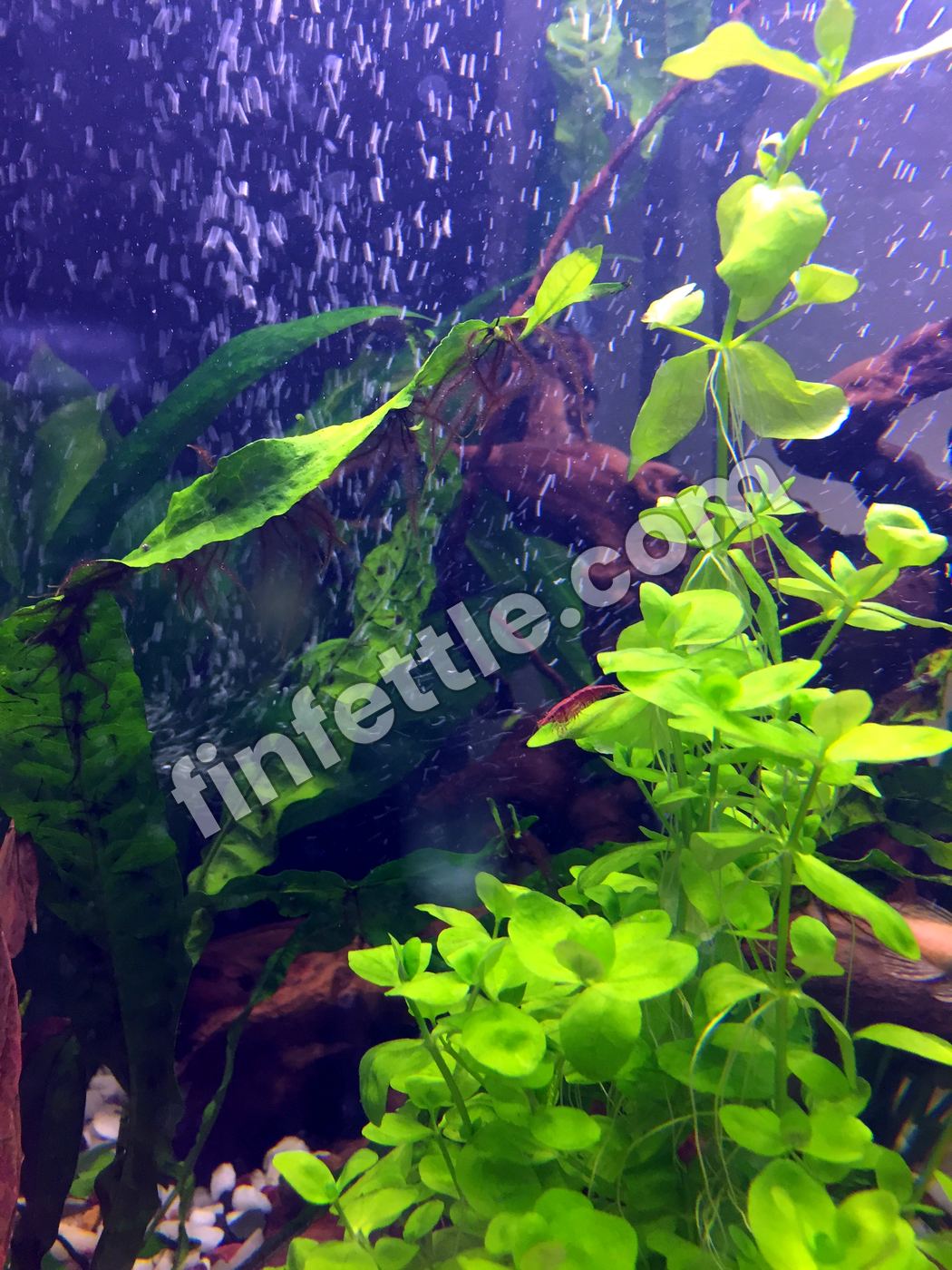
I haven't photographed a plant melting and regrowing, so the timings on this page come from the sources cited, not from my own tanks.