
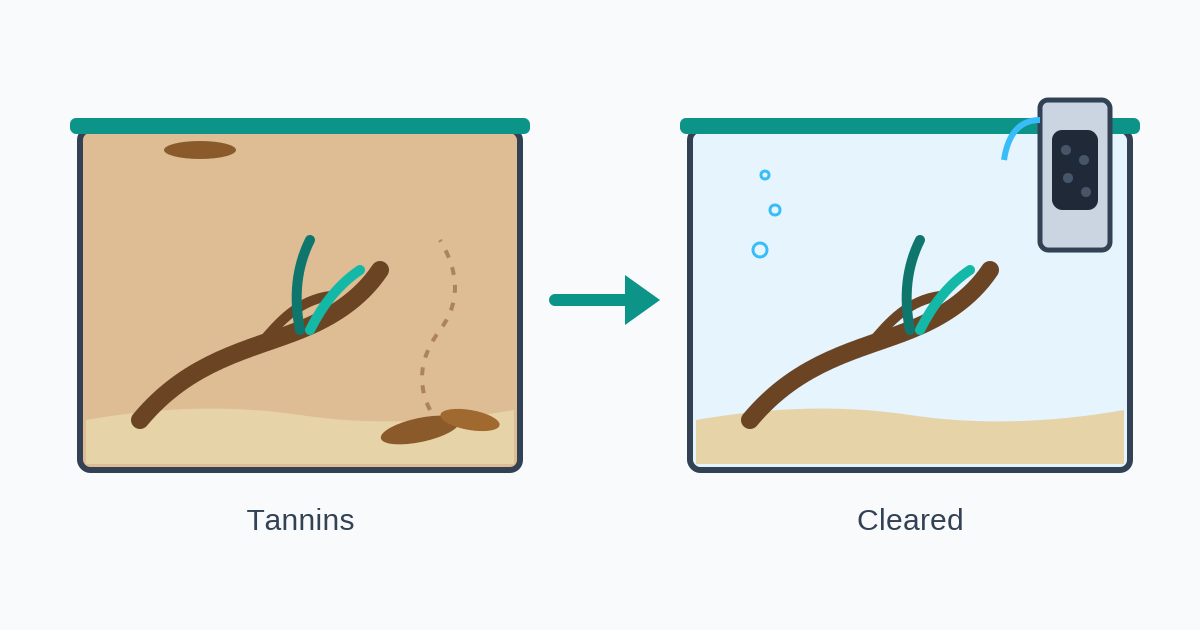
Tannins are natural compounds that leach out of driftwood, dried leaves and seed pods and stain aquarium water a golden to tea-brown colour. They're harmless to fish, though they can lower pH slightly. If you want clear water, do water changes and run activated carbon or a synthetic resin in the filter. If you want the tint, add catappa leaves, botanicals or tannin-rich wood, and test your pH as you go.
This guide covers what tannins are, whether they're safe, how to tell them from other kinds of discoloured water, how to remove them, how to add them on purpose, and what they mean for a planted tank.
What tannins are
BRS Fresh describes tannins as natural compounds released by leaves, seed pods and wood as they break down in water, giving it a golden to brown colour "similar to black tea". Aquarium Co-Op calls them plant-based compounds that gradually lower pH and stain the water yellow-brown.
Brown water from tannins isn't dirt. BRS Fresh makes the point directly: brown water doesn't mean a dirty tank, and clear water doesn't mean a healthy one. What matters more is stable, suitable water chemistry.
Is it the same as blackwater?
Not quite. Practical Fishkeeping explains that real blackwater rivers, such as the Río Negro, are soft, acidic and very low in minerals because of the ground they drain through. Most of their colour comes from humic and fulvic acids, with tannins playing a smaller part. A hard-water tank with brown water looks similar but doesn't have the same chemistry, so "blackwater" on a product label usually means the look, not the river.
Are tannins safe for fish?
For most fish, yes. LiveAquaria says the discolouration won't harm your fish, though it will lower pH slightly over time. BRS Fresh goes further and lists benefits, including less stress for fish from blackwater habitats and better breeding in tetras, bettas and dwarf cichlids.
The exception is fish that need hard, alkaline water. Aquarium Co-Op says catappa leaves are generally not used for high-pH fish such as African cichlids and many livebearers, because of their effect on water chemistry. If you keep those fish, clear the tint rather than adding to it.
Watch the pH, not the colour. Aquarium Co-Op says the slow effect of leaves is sometimes considered safer than pH-lowering chemicals because it's less likely to cause sudden swings. How far pH actually moves depends on your water. Practical Fishkeeping says very soft water makes the pH-lowering effect stronger, while hard water may cancel it out, so test pH, GH and KH rather than guessing.
Where tannins come from
- Driftwood. LiveAquaria says soaking lets excess tannins leach out, but that some wood still releases them after curing. Some types stain far more than others; our driftwood comparison rates each type by how much tannin it releases.
- Dried leaves. Catappa (Indian almond) leaves are the classic choice. Practical Fishkeeping also names guava and magnolia, and fallen oak, sycamore, hazel and hornbeam leaves collected away from roads and railways and dried first.
- Seed pods, cones and bark. Alder cones, seed pods, twigs and bark all release tannins as they break down, Practical Fishkeeping says.
- Leaf extract. Aquarium Co-Op describes boiling leaves to make a tea you pour into the tank.
Brown water but no new wood or leaves?
Tannin-stained water is clear but tinted, like weak tea. If your water is cloudy or milky, that's usually something else: a bacterial bloom in a new or recently disturbed tank. A brown film on glass, plants and decor rather than in the water is more likely brown algae (diatoms).
If the colour came on suddenly and you haven't added anything, test the water before you blame tannins.
Free tool
Rule out a water-quality problem first. Enter your ammonia, nitrite and nitrate readings to see whether the tank itself needs attention.
Water test checker →How to remove tannins
Tannins don't need removing for your fish's sake; this is about how the tank looks. Combining BRS Fresh, LiveAquaria, Seachem and Practical Fishkeeping:
- Do regular water changes. BRS Fresh says regular water changes will gradually clear the water. It's the slowest method, but it's free and you're probably doing them anyway.
- Add activated carbon. LiveAquaria suggests chemical filter media such as activated carbon to clarify tinted water. Put it in a media bag in a part of the filter the water actually flows through.
- Or use a synthetic resin. BRS Fresh and LiveAquaria both name Seachem Purigen, a synthetic adsorbent resin. BRS Fresh says it works faster than water changes alone. Seachem says it darkens as it's used up and can be renewed by treating it with bleach; follow its own directions if you do.
- Replace or renew the media when it stops working. If the water starts tinting again, the media is probably used up.
- Soak new wood before it goes in. LiveAquaria recommends at least one to two weeks of soaking, changing the water whenever it darkens, until it shows no noticeable colour for several days in a row. It says boiling driftwood for one to two hours draws tannins out faster and sterilises it.
Free tool
Water changes are easier to plan when you know how much water your tank really holds. Work out its true volume first.
Aquarium volume calculator →If your filter has no room for a media bag, the aquarium filter shortlist and the canister filter page compare filters with space for extra media.
How to add tannins on purpose
Some keepers want the tint, especially for soft-water fish, shrimp and betta tanks. BRS Fresh says fish from blackwater habitats, such as tetras, bettas and dwarf cichlids, do well in tannin-rich water. The usual sources of tannins for aquarium use are leaves, botanicals and wood:
- Catappa (Indian almond) leaves. Aquarium Co-Op's starting point is one leaf about 10–18 cm (4–7 in) long for every 5–20 gallons (about 19–76 litres), adding more for a darker tank. It says the leaves usually float for three to seven days, can be weighed down with a rock, and last about one to two months; add a new one when holes appear in the old one.
- Don't boil the leaves you put in. Aquarium Co-Op says boiling releases all the tannins at once.
- Or make an extract. If you don't like the look of leaves in the tank, Aquarium Co-Op describes boiling one leaf for every 2 litres (half a gallon) of water, letting it cool and pouring a little in until you reach the colour you want. Too much? Do a water change to dilute it.
- Alder cones, seed pods and bark. Practical Fishkeeping suggests boiling and soaking botanicals first so they sink, and says you can bottle the resulting tea for later.
- Tannin-rich wood. LiveAquaria says that if you want the tea-stained look, a short soak and scrub before adding the wood is enough. See the driftwood comparison for which types release the most.
- Take the carbon out. Practical Fishkeeping says removing activated carbon from the filter stops it pulling the tannins back out. Its compromise, if the tank gets too dark, is to run carbon for about a week each month.
Tannins for betta fish
Aquarium Co-Op says breeders often use catappa leaves with bettas, and that bettas and gouramis sometimes build bubble nests under the leaves while they float. It also says the leaves have very slight antibacterial and antifungal properties. Treat that as a reason keepers like them, not as a treatment: a sick betta needs the cause found, and an aquatic vet if it's serious.
Keep the pH steady
Practical Fishkeeping says even a simple 20% weekly water change can disrupt the pH and dilute the colour in a blackwater tank. Its trick is to prepare the new water a couple of days ahead with a few old leaves or pre-boiled botanicals in it. For most blackwater set-ups it suggests aiming for around pH 6.0–6.5, depending on the fish, rather than chasing very low numbers.
Tannins in a planted tank
Tinted water lets less light through. BRS Fresh says that by reducing light penetration and lowering pH, tannins help limit algae. The same effect means less light reaching your plants. Practical Fishkeeping suggests low-light plants such as Anubias, Bucephalandra and Cryptocoryne for blackwater set-ups, and floating plants such as Amazonian frogbit to diffuse the light further.
On the plus side, BRS Fresh says tannins help keep nutrients such as iron and manganese soluble for plants. If you want bright, clear water for a high-light planted layout, clear the tannins; for a low-tech tank of slow, shade-tolerant plants, a light tint is less of a concern.
Where the sources disagree
- How much it matters. BRS Fresh lists a string of benefits, from less stress to algae control. LiveAquaria treats tannins as mostly a matter of looks with a small pH effect. Both agree they don't harm fish.
- What "blackwater" means. Retailers use it for any tannin-tinted tank; Practical Fishkeeping says the real thing is defined by soft, acidic, mineral-poor water, not by colour.
- Boiling. LiveAquaria boils driftwood to speed up tannin release; Aquarium Co-Op doesn't boil the leaves it puts in a tank, because that releases the tannins all at once.
My own tanks
My 90-litre planted community tank has a Java fern growing on driftwood. My own driftwood floated at first, so I anchored it with rocks for a couple of months. Everything else on this page about removing and adding tannins comes from the sources cited, not from my own tanks.
For choosing and preparing wood, see driftwood for an aquarium.