
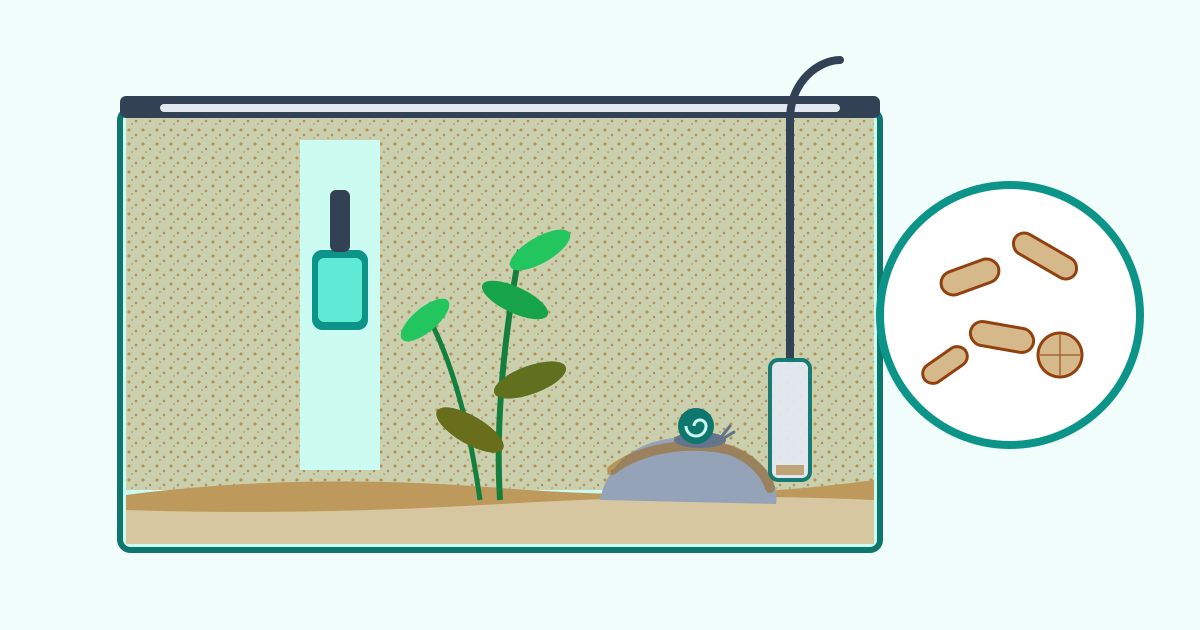
Brown algae in an aquarium is almost always diatoms: a dusty, yellow-brown film on the glass, plant leaves, rocks and sand. It shows up in most new tanks within the first few weeks, it's harmless to fish, and it normally fades on its own as the tank matures. To clear it faster: wipe or siphon it off, keep the light moderate, don't over-fertilise, and add plants.
This guide covers what the brown film actually is, why it appears, how to get rid of it, how long it lasts, what eats it, and what to check if it keeps coming back in an established tank — including the silicate question, where the main sources disagree. It's written for freshwater tanks, planted or not.
What brown algae actually is
The 2Hr Aquarist describes diatoms as single-celled algae with glass-like cell walls made of silica. They form a dusty brown layer on glass, rocks and plant leaves, and the same source calls them the first algae to take over the bare surfaces of a new tank.
Two caveats on the name:
- It isn't "true" brown algae. Aquasabi notes that true brown algae (Phaeophyceae) are a separate group that, with a few exceptions, doesn't occur in fresh water. "Brown algae" is a hobby name for diatoms.
- It's rarely just diatoms. Aquarium Science says that under a microscope the brown film is roughly half porous detritus and organic slime and half a mix of diatoms, other algae, cyanobacteria, bacteria and other microscopic life. The brown film that coats the inside of an established filter is mostly beneficial bacteria, even though it looks the same.
If the film is soft, brown and wipes off with a finger, it's this. Hard green dots that need a blade are green spot algae; dark, brush-like tufts are black beard algae. And if it's the water itself that's cloudy rather than a film on surfaces, that's a bacterial bloom.
Is brown algae harmful?
Not to your fish. The 2Hr Aquarist calls a diatom bloom in a new tank a normal stage of cycling, not a sign of poisoned tap water or bad water, and Aquasabi says no countermeasures are needed during the cycling phase.
The cost is mainly how the tank looks. On plants, the 2Hr Aquarist notes it clings mostly to older, stressed leaves, while healthy new leaves resist it.
What causes brown algae
- A new tank. This is the big one. Aquasabi says diatoms classically appear one to three weeks after setup; the 2Hr Aquarist gives two to three weeks. They spread across bare surfaces before the microbes that keep them in check have built up — the 2Hr Aquarist says those algae-eating microbes multiply more slowly than diatoms do.
- Strong light plus spare nutrients. The 2Hr Aquarist says strong light combined with available ammonia and phosphate speeds diatom growth in a new tank, and that a newly planted tank's plants take up little at first.
- Stressed new plants. Plants adapting to a new tank release waste and ammonia from their leaves, according to the same source, which gives diatoms somewhere to attach. Healthy new leaves resist them.
- Mostly blue light. Aquarium Science says diatoms use blue light, so lights with only blue and white LEDs can encourage them more than lights that also include red.
- Silicate — maybe. Diatoms build their shells from silica, so silicate in tap water is often blamed. This is where the sources split; see "Silicate: does it matter?" below.
How to get rid of brown algae
In a new tank, you're mostly helping it through a phase. In order:
- Wipe and siphon it off. Diatoms usually come off easily, though Aquasabi notes they can form stubborn coats on the glass of low-light tanks. Wipe the glass with an algae pad or sponge, and siphon the film off the sand and rocks during a water change — the method both Aquasabi and the 2Hr Aquarist suggest.
- Do large, regular water changes. The 2Hr Aquarist says large water changes remove spores, excess nutrients and organic waste, and don't slow the tank's maturing because the useful microbes live mostly on surfaces, not in the water.
- Keep the light moderate. The 2Hr Aquarist suggests a photoperiod of 6 to 7 hours at sensible intensity for the first few weeks, then raising it later if the plants need it.
- Go easy on fertiliser. Keep nutrient levels low until the plants start growing strongly, per the same source. Follow any fertiliser's label — this page doesn't set doses.
- Add plants and trim old leaves. More plants means more competition for nutrients and fewer bare surfaces. Remove older, deteriorating leaves the film clings to.
- Seed the tank with mature media. The 2Hr Aquarist suggests adding used filter media, a squeeze of a mature sponge or a little mulm from an established tank to speed up the microbes that keep diatoms in check.
- Add grazers once the tank is stable. See "What eats brown algae" below — but not in week one.
You don't have to do any of this. Aquarium Science's advice is the opposite extreme: leave the film alone, feed lightly, and let the tank's ecology settle, because a film you keep cleaning off never matures into something fish will graze. Most people will want the front glass clean, though — Aquarium Science's author cleans only the front and side glass every few weeks and leaves the rest.
Free tool
Large water changes are a percentage of the water actually in the tank. Work out your tank's real volume first, so you know how much to take out and replace.
Aquarium volume calculator →How long does brown algae last?
Usually a few weeks, but the sources give different timescales:
| Source | What it says |
|---|---|
| The 2Hr Aquarist | Visible about 2–3 weeks after setup; disappears on its own within a few weeks as the microbes establish |
| Aquasabi | Crowded out by green algae a few weeks into the tank's life, and then doesn't come back |
| Aquarium Science | Can get worse before it improves in about three months; lessens in four to six months if left alone; a properly planted tank has little to moderate brown film once settled, typically six months or more |
The difference partly reflects what each source counts. Aquasabi and the 2Hr Aquarist are talking about the first-weeks diatom bloom; Aquarium Science is talking about the brown film in general, which it says never fully disappears from any tank.
What eats brown algae
- Snails. Aquasabi says all algae-eating snails eat diatoms; the 2Hr Aquarist names nerite snails, and Aquarium Science says nerites can control it to some degree.
- Shrimp. Aquasabi includes all algae-eating shrimp; the 2Hr Aquarist names Amano and cherry shrimp.
- Otocinclus. Good diatom eaters, per the 2Hr Aquarist — but delicate, so it says to wait until the tank is at least a month old, with plants growing steadily and the diatoms already declining.
- Suckermouth plecos. Aquasabi lists the different suckermouth plec species; Aquarium Science says bristlenose (bushy-nosed) plecos and snails can normally remove most of it.
Grazers polish off what's left; they don't fix an immature tank. In a very new tank, the 2Hr Aquarist says your best algae eater is still your own hand and a sponge during the weekly water change. Check any grazer suits your tank's size and community before adding it.
Brown algae in an established tank
If the film keeps coming back months after setup, first decide whether it's actually a problem. Aquarium Science says some brown film forms in every aquarium, mature ones included, and on all surfaces — even without light. It suggests decorating so that a little brown on rock, wood and plants looks natural, rather than chasing every trace.
If it's heavy and persistent:
- Check the light. Is it running long or strong for the plants you have, or is it a blue-and-white-only LED? The planted lighting guide covers hours and intensity, and the best planted aquarium light shortlist sorts lights by tank type.
- Look at nutrients and old leaves. The 2Hr Aquarist's points for new tanks — spare nutrients, struggling older leaves — apply here too.
- Consider a silicate test. Aquasabi's suggestion if the problem persists despite enough grazers — but read the next section first.
Silicate: does it matter?
This is the part of the advice online that contradicts itself most.
- Aquasabi says diatoms need silicate to build their cell walls, and that tap water high in silicate gives them material to reproduce. For a persistent problem, it suggests testing silicate and, if it's high, using reverse osmosis water or a filter medium that removes silicate — with the warning that those media also strip phosphate, which can harm plants.
- The 2Hr Aquarist says silicate is rarely the limiting factor, because it's present in most tap water and substrates, and that both low- and high-silicate tanks get diatoms in the first weeks. It calls switching to RO water or silicate resins an edge-case tool, not standard practice.
- Aquarium Science goes further: it calls the silicate question academic, says there's no practical way to remove silica from the water because every water change adds more, and says quartz sand can't leach silica at aquarium temperatures.
The common ground: in a new tank, silicate isn't what you need to fix. Only consider it for a persistent problem in an established tank, and treat any silicate-removing medium as a last resort because of the phosphate trade-off.
Low-tech vs high-tech tanks
- Low-tech tanks (lower light, no injected CO2): the 2Hr Aquarist says diatoms tend to be milder and fade without drama after a few weeks of water changes, gravel vacuuming and patient plant growth.
- High-tech tanks (strong light, CO2, rich nutrients): blooms can be more dramatic in the second week, mainly where too much light is used. The same source's approach is to start lean on nutrients, keep the light reasonable, plant heavily from day one and ramp up slowly.
My own tanks
Since my first tank, every new filter I've set up has been seeded with media from an established tank plus a bottled bacteria starter — the same mature-media step the 2Hr Aquarist recommends above. My 90-litre planted community tank is low-tech, with no pressurised or DIY CO2.
My own experience didn't follow the first-weeks pattern. In my Juwel Trigon 190, brown algae took a couple of months to appear, then spread across the substrate, stuck to the rocks and wood, and coated parts of the glass. I peeled it off the glass with an algae razor, and took the rocks and wood out of the tank, sprayed them with a 0.3% hydrogen peroxide solution and scrubbed them clean with a brush.
Apart from that, the timelines and fixes above come from the sources cited, not from my own tanks. The cycling guide covers getting a new tank to the point where diatoms fade on their own.