
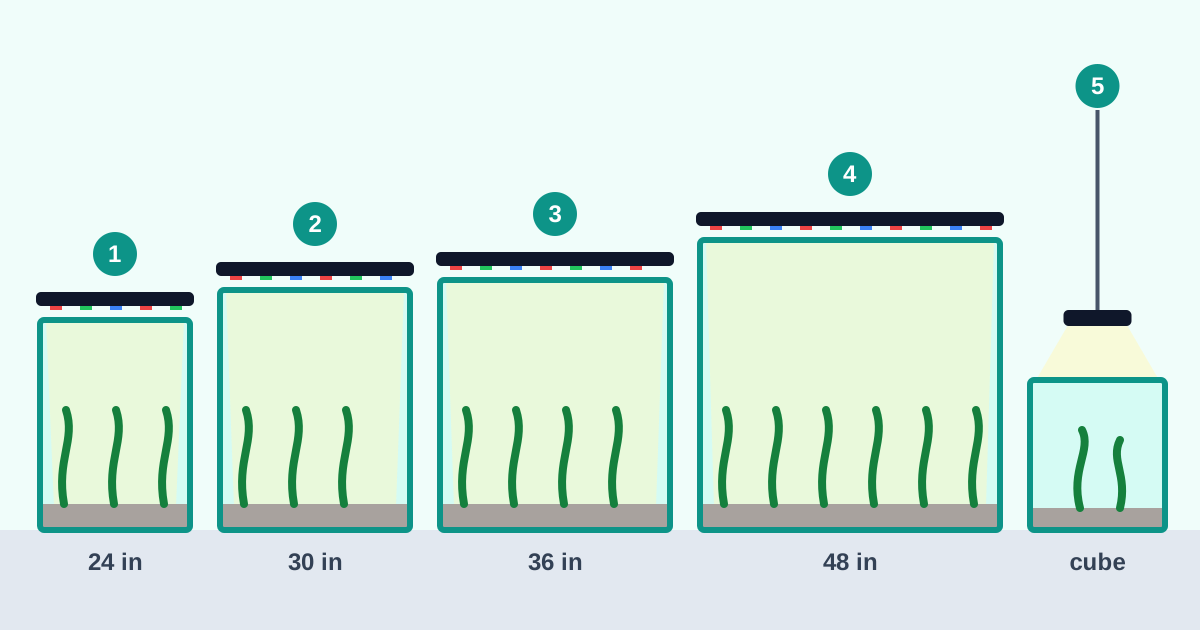
For aquarium plant lighting, an LED should be chosen by your tank's length first and its depth second. Get a fixture that spans the tank, then check it delivers enough light at the depth your plants sit. Length decides whether the ends stay dark; depth decides whether anything reaches the bottom.
This page is the size-led companion to the best planted aquarium light, which picks by light type and plant demand. If you know you want an LED and just need to know which size, start here.
How to read this page
The picks are fixture sizes, not lights I've tested side by side. The models named are examples with published specifications or a cited reviewer's recommendation, not results from my own bench. Prices change too often to quote, so check the retailer's page.
The short answer
Measure the tank's length, then match it:
- Up to 24 in (60 cm): pick 1.
- 24–34 in (60–85 cm): pick 2.
- About 36 in (90 cm): pick 3.
- 48 in (120 cm) and up: pick 4.
- A cube, or a tank you want open above: pick 5.
If your tank is 16 in (about 40 cm) or taller, Sunken Treasure Aquatics counts it as deep and says to go stronger than its size suggests. In practice that means more watts, a more powerful model at the same length, or a second bar.
The picks
Size guide
The tank-to-light pairings below are from Sunken Treasure Aquatics' size list. The 1-to-1 column is its rule of thumb of about one watt per gallon, and the litres are my conversions.
| # | Tank | Light length | Rough volume | 1-to-1 watts |
|---|---|---|---|---|
| 1 | 10-gallon | 18 in (45 cm) | 38 L | 10 W |
| 1 | 20-gallon high | 24 in (60 cm) | 76 L | 20 W |
| 2 | 20-gallon long | 30 in (80 cm); most 60 cm lights also work | 76 L | 20 W |
| 2 | 29-gallon | 30 in (80 cm); needs a bright light | 110 L | 29 W |
| 3 | 40-gallon | 36 in (90 cm) | 151 L | 40 W |
| 4 | 55–75 gallon | 48 in (120 cm); needs a bright light | 208–284 L | 55–75 W |
| 5 | Cube | Pendant or clip-on, not a bar | Varies | Varies |
Not a standard tank? Work out its real volume first, because the fixture length comes from the tank but the watts rule works from the gallons.
Two real fixture ranges, size by size
Two published ranges show how this looks when you shop. These are examples, not recommendations over other lights.
| Tank length | Fluval Plant 3.0 | PAR at 3 / 6 / 12 in (Fluval's figures) | Chihiros WRGB II Slim (Aquasabi's listing) |
|---|---|---|---|
| About 12–18 in | — | — | 30: 23 W, tanks 30–45 cm |
| 15–24 in | 22 W | 442 / 227 / 80 | 45: 35 W, tanks 45–60 cm |
| 24–34 in | 32 W | 453 / 252 / 107 | 60: 45 W, tanks 60–80 cm |
| 36–46 in | 46 W | 470 / 267 / 112 | 90: 69 W, tanks 90–110 cm |
| 48–60 in | 59 W | 545 / 288 / 136 | 120: 90 W, tanks 120–140 cm |
Three things to notice:
- Longer fixtures aren't much stronger per spot. Fluval's 12-in figure only rises from 80 to 136 between its smallest and largest light, because the extra watts are spread over more length.
- Light falls away fast. In Fluval's chart, PAR at 12 in is a quarter or less of the 3-in figure. The chart stops at 12 in, so it won't tell you what a taller tank gets at the substrate.
- Watts vary between brands at the same length. Measured against the 1-to-1 rule, Fluval's 59 W model passes on a 55-gallon but falls short on a 75-gallon; the 90 W Chihiros passes on both. That's a quick comparison only: watts don't tell you how much of the light plants can use, and The 2Hr Aquarist calls the watts rule a rough legacy shortcut.
Reviewers also disagree on brands. The 2Hr Aquarist puts Chihiros in its top tier and Fluval in its programmable middle tier. Sunken Treasure Aquatics rates Chihiros among the best but expensive, calls Fluval overpriced and prefers Week Aqua. Treat any single ranking, including this one, as a starting point.
How strong does it need to be?
Fixture size only gets the light across the tank. How much you need depends on your plants. The 2Hr Aquarist's PAR bands, measured at the substrate:
- About 20–40: low-light plants such as Anubias, Java fern and crypts.
- About 40–90: most medium plants.
- About 90–150 or more: demanding red plants and dense carpets.
Charterhouse Aquatics gives slightly lower bands for the top two groups (40–70 and 70–120+), and says high-light tanks generally need both CO2 and regular fertiliser. Either way, a bright light with nothing to back it up feeds algae.
So if you keep low light plants, you can buy on length and cost alone. If you want red stems or a carpet, read the PAR chart at your own depth and read the aquarium CO2 system guide before you spend.
Free tool
Measure your tank once: you'll need its length to size the fixture, and its real volume for the watts rule, fertiliser and CO2 later on.
Aquarium volume calculator →Each pick, honestly
1. 24-inch planted LED — best for 10-gallon and 20-gallon high tanks. This is the size most planted-tank buyers need, so it has the widest choice. Sunken Treasure Aquatics' guide uses a 24-in light on a 20-gallon high as its default size and tests budget and premium lights at that length, from a HITOP light it calls its best budget pick to the Week Aqua L Series for high-tech tanks. Drawback: it's a tight fit on anything longer. Sunken Treasure says most 60 cm lights still work well on a 20-gallon long, but The 2Hr Aquarist warns that a fixture shorter than the tank can leave poor growth at the sides.
2. 30-inch planted LED — best for 20-gallon long and 29-gallon tanks. Fluval's 32 W model covers tanks of 24–34 in, and Sunken Treasure Aquatics says most 60 cm lights also work well on a 20-gallon long. The two tanks behave differently, though: the 20 long is shallow, and the 29 is tall. Drawback: the 29-gallon needs what Sunken Treasure calls a "BRIGHT" light, so a budget 30-in bar that's fine on a 20 long can fall short there.
3. 36-inch planted LED — best for 40-gallon tanks. A single fixture spans this length, which keeps the install simple. Fluval's 46 W light fits 36–46 in, and Aquasabi lists the Chihiros Slim 90 at 69 W for tanks of 90–110 cm. Drawback: wood and rock shade plants at this size, and The 2Hr Aquarist says two lights often beat one in a hardscape-heavy tank.
4. 48-inch planted LED — best for 55- to 75-gallon tanks. These tanks are long and tall, so this is where a budget bar is most likely to disappoint. Sunken Treasure Aquatics says both need bright lights. Drawback: cost, and depth. Fluval's 59 W light reads 136 PAR at 12 in, and the chart stops there. If your plants sit deeper and you want more than low-light species, budget for a stronger model or a pair of bars.
5. Pendant or clip-on planted LED — best for cubes and open-top tanks. Sunken Treasure Aquatics says bar lights look bad on cube tanks and suggests a pendant or clip-on such as the Week Aqua Z250 Pro (up to 29 gallons, it says; it used two on a 60-gallon) or the LEDSTAR AQ-N. The 2Hr Aquarist says hanging lights give cleaner access and a better look. Drawback: a pendant hung high has to be powerful enough for the extra height, and The 2Hr Aquarist warns that raising a light a long way lowers the light levels in the tank. A single point of light can also leave the edges dim.
What to check on the box
Whichever size you buy, four details matter:
- The stated tank-length range. Read it as a fit for your tank, not the fixture's own length. Fluval and Aquasabi both list a range of tank lengths for each model.
- Dimming and a timer. Aquarium Co-Op suggests starting at around 20–40% brightness and raising it slowly if no algae appears. A light that dims and schedules itself saves you a separate timer.
- How it mounts. Check whether it needs a rimmed tank, open top or legs. Aquasabi says the Chihiros Slim isn't suitable for use under an aquarium cover, while Fluval says the Plant 3.0 can be mounted directly above the water without a sliding top.
- The warranty. Aquarium Co-Op warns that the cheapest lights may have short warranties and LEDs that fail within months.
My own lights
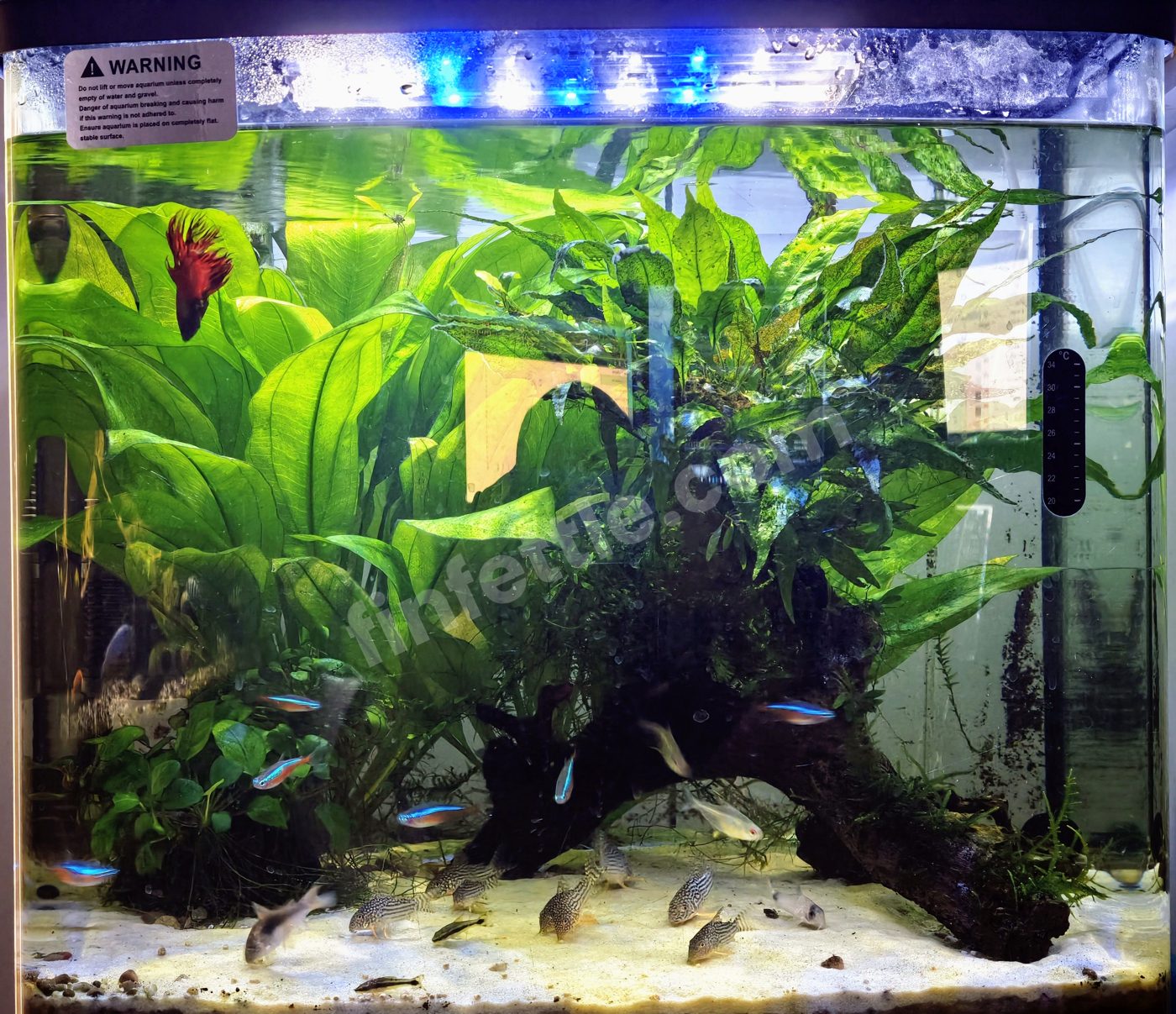
I don't run a dedicated planted fixture, so this is a kit-light report, not a fixture test. My 90-litre Love Fish Vantage tank still runs its stock light: three LED strips, a mix of blue and white, switched by a GHome Smart plug. Under it I grow two Amazon swords, an Anubias nana, a Java fern and stem plants, which have done very well: the stems always grow up to the surface and keep their colour.
My Juwel Trigon 190 started out planted too, with two LED tubes fitted into its original fluorescent tube holders, and the plants grew without problems.
That's a useful counterpoint to Sunken Treasure Aquatics' view that hood strips won't grow plants well: for the plants I keep, mine have. I can't give you PAR readings for either light, though, so read that as one tank's result rather than a rule.
What you can skip
- A fixture longer than the tank. Most bars rest on the rim, so one that overhangs has nothing to sit on. Check the stated range.
- Paying for high output with easy plants. If you keep Anubias and Java fern, the 20–40 PAR band doesn't call for a premium light.
- Judging by the words "full spectrum". Sunken Treasure Aquatics says full-spectrum lights aren't ideal for planted tanks, and its advice is to look for red and blue peaks.
- Running it all night. Aquarium Co-Op says never to leave the light on overnight, even in moonlight mode.
Put it to work
Once the fixture is on the tank, the planted aquarium lighting guide covers how many hours to run it and how to set the brightness. If you're still weighing up types of light, compare them in the best planted aquarium light. And if algae turns up after an upgrade, start with the black beard algae guide or hair algae guide, whichever matches what you see.