
Aquarium hair algae is a filamentous green algae that grows in soft, tangled strands over plants, rocks, wood and equipment. It turns up when plants are stressed, when ammonia or organic waste builds up, and when the light is stronger than the plants can use. To get rid of it, turn the light down, do big water changes, twirl out and trim what you can, then hold conditions steady and grow more plants — and don't cut your fertiliser to "starve" it.
This guide covers how to recognise it, what causes it, a step-by-step removal plan, the fertiliser question, what eats it, and how to keep it from coming back. It's written for freshwater planted tanks; reef tanks get their own hair algae and need saltwater-specific advice.
What hair algae looks like
Aquasabi describes hair algae as a coat of densely packed filaments that forms carpet-like layers over plants and decoration. "Hair", "fuzz", "string" and "thread" algae are hobby labels for how it looks, not scientific groups. Aquarium Science says the strands can belong to several different genera — and even some cyanobacteria and red algae grow in threads — so any identification by eye is a guess.
The 2Hr Aquarist's rough guide to the labels:
| Name | What you see |
|---|---|
| Fuzz algae | A short (1–5 mm), dense green coating on leaf edges, often on new leaves of fast-growing stem plants |
| Hair algae | Longer (2–15 cm), soft, bright green strands in tangled clumps around leaves, hardscape and equipment; snaps easily when pulled |
| String / thread algae | Very fine single strands, often 5–20 cm, hanging from leaf tips |
| Cladophora | Looks like hair algae but is tough and rubbery; won't snap cleanly with a fingernail |
The snap test matters: Cladophora doesn't clear up when plant health improves the way soft hair algae does, according to the same source.
Is hair algae harmful?
Not to your fish directly. The damage is to plants: the coats grow over leaves, and Aquasabi says one stubborn short-filament type grows so fast and densely that it smothers them. And because it so often follows plant stress or an ammonia spike, it's worth reading as a signal that something in the tank has shifted — not just as an eyesore.
What causes hair algae
- Stressed plants. The 2Hr Aquarist names this as the main cause. When conditions change sharply — a jump in nutrient dosing, a CO2 drop, heat in summer, heavy replanting — plants put their energy into adapting, stop producing the protective chemicals on their leaves, and leak organic waste from the leaf surface. That's where algae attaches.
- Ammonia and organic waste with strong light. The same source calls ammonia spikes plus high light an ideal environment for filamentous algae. Rotting wood, decaying leaves and mulm on the substrate feed it too. If plants are clean but algae is growing on the glass and hardscape, it often points to organic waste or ammonia. The aquarium ammonia guide covers testing and sources.
- More light than the plants can use. Aquasabi lists lighting that runs too long or is too intense for the plants and the nutrient supply as a cause, and says to adjust plant mass and fertiliser whenever you change the light or its hours.
- Nutrient or CO2 imbalance. Aquasabi links hair algae to a shortage of some nutrients or of CO2. In CO2-injected tanks, the 2Hr Aquarist points to slow, silent drops — a clogged diffuser, a choked filter — that weaken plants until the tank tips over.
- New tank. Aquasabi says hair algae appears mainly while a tank is still cycling, and often fades once the system settles.
It can also arrive on new plants, fish or snails, or in water moved from another tank.
How to get rid of hair algae
The 2Hr Aquarist frames the fix as two jobs: remove the algae, then stabilise the tank so clean new leaves replace the infected ones. In order:
- Turn the light down. Stressed plants can't use strong light; algae can. For high-light tanks the 2Hr Aquarist suggests dropping from 100+ µmol PAR to around 60–70 until the outbreak is over. If your light has no dimmer, shorten the hours instead — the planted aquarium lighting guide covers both.
- Test for ammonia and change water. Ammonia feeds filamentous algae. During an outbreak the 2Hr Aquarist does large water changes — up to 70%, two to three times a week — and siphons detritus off the substrate at the same time. Aquasabi's baseline is at least 50% once a week.
- Find the trigger. Check CO2 if you inject it (the 2Hr Aquarist recommends the 1 pH drop method, not just a drop checker — see the CO2 system guide), check the filter hasn't slowed, and look for decaying old growth or mulm.
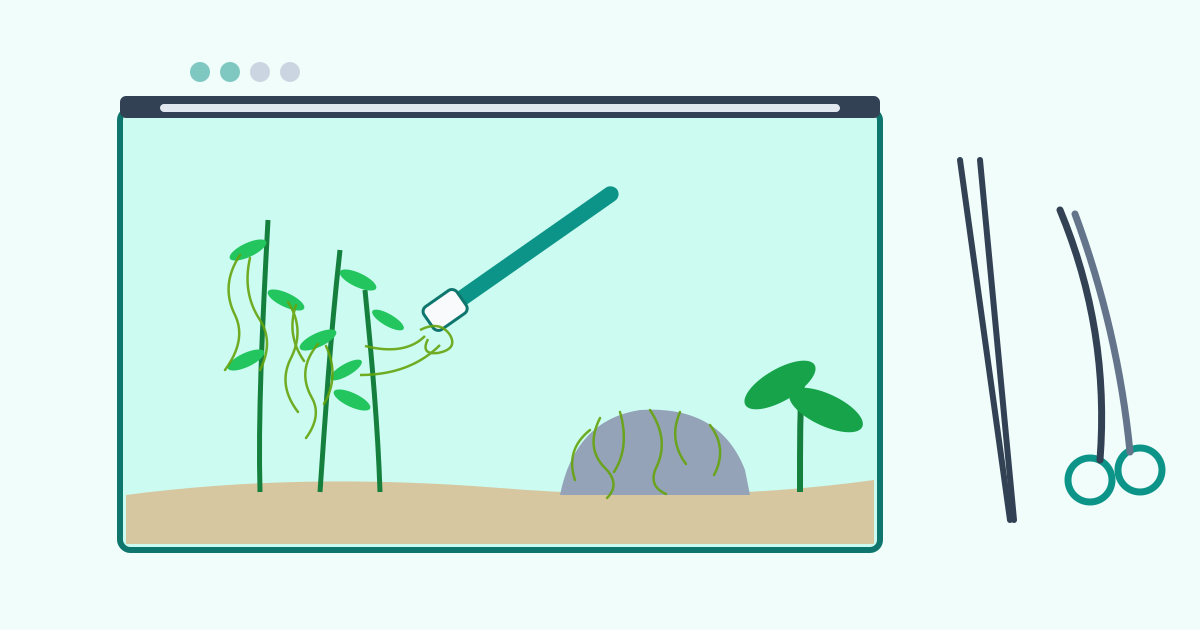
- Remove what you can by hand. Twirl hair algae onto a soft toothbrush, pluck fine strands with tweezers, and trim fuzz-covered leaf edges with curved scissors. The strands already there won't shrink by themselves.
- Trim and replant. Badly covered old leaves won't recover. Cut them off, replant clean stem tops, and let new growth take over. In very bad cases the 2Hr Aquarist replaces infected plants with fresh, clean ones.
- Hold everything steady. Keep light, CO2, fertiliser and flow constant. Constant tweaking keeps the plants adapting — and the outbreak going.
- Add plants and a clean-up crew. Fast-growing stem plants or floating plants compete for light and nutrients; grazers keep regrowth down while plants recover (see below).
For whatever is left after manual removal, both sources mention algicides or hydrogen peroxide spot treatments, and both suggest a blackout — covering the tank completely for several days — for very heavy outbreaks. If you use a product, follow its label exactly; this page doesn't relay those doses.
Free tool
A 50–70% water change and any product label are measured against the water actually in the tank. Work out your tank's real volume first.
Aquarium volume calculator →Should you cut fertiliser to starve it?
This is the most repeated advice online, and the sources disagree.
Some guides blame excess nutrients — iron or phosphate — for hair algae. The 2Hr Aquarist argues the opposite: cutting fertiliser starves the plants before the algae, and weak plants with undefended old leaves are exactly what hair algae exploits. As evidence, it points to a heavily fertilised tank that holds nitrate and phosphate high around the clock and stays algae-free because the plants dominate. Aquasabi, too, recommends a balanced supply of macronutrients and gives target ranges rather than telling you to stop dosing.
The useful distinction, per the 2Hr Aquarist: a sudden spike in dosing can stress plants and trigger algae — then hold the new level steady and let plants adapt. Underfed plants are a different problem, and starving them makes it worse. Test before you change anything.
What eats hair algae
- Amano shrimp — the 2Hr Aquarist calls them the most effective grazer for filamentous algae, especially fresh growth, and suggests 2–5 per 38 litres (10 US gallons).
- Other dwarf shrimp such as cherry shrimp help, but need larger numbers.
- Siamese algae eaters graze it.
- Mollies will eat it occasionally, but the 2Hr Aquarist notes they produce a lot of waste, which works against you during an outbreak.
- Ramshorn snails go after soft hair algae coats, according to Aquasabi.
Check any grazer suits your tank's size and community before adding it. I keep Amano shrimp in my 90-litre planted community tank, but green hair algae has never taken hold there, so I've never actually watched them eat it. The honest rule from the sources is that none of these animals is a cure: they keep regrowth in check while you fix the cause.
Low-tech tanks vs CO2 tanks
- Low-tech tanks (no CO2 injection): the 2Hr Aquarist says the number one culprit is usually too little carbon for the plants. Choose plants that cope with low CO2 — Cryptocoryne, Anubias, Java fern, Vallisneria — use a nutrient-rich soil substrate if you can, add fast growers or floating plants, keep light modest (30–60 µmol PAR at the substrate), and use a comprehensive fertiliser. Recovery is slower, but algae also takes longer to set in.
- CO2-injected tanks: the usual trigger is unstable CO2 — often a clogged diffuser or a failing device — or a shock such as an ammonia spike. Restore stability first, then clear what's left.
My 90-litre planted community tank is low-tech: I don't run pressurised or DIY CO2 on it. It grows two Amazon swords, an Anubias nana and a Java fern, and I changed its light hours because of black beard algae, which helped — the lighting guide has the schedule. I've never had green hair algae in my planted tanks; the algae I've dealt with are black beard algae and green spot algae. If your problem is dark, brush-like tufts rather than green strands, see the black beard algae guide; hard, round green dots on the glass are green spot algae; a soft brown film is brown algae (diatoms).
Keeping it from coming back
- Keep plants healthy and dense. Trim and replant old growth instead of letting it decline.
- Keep conditions boringly steady. Change one thing at a time, and give plants time to adapt.
- Keep up the water changes. Aquasabi recommends at least 50% weekly; siphon mulm while you're at it.
- Ramp light up slowly on new tanks. Aquasabi suggests starting a new tank on about 6 hours a day and adding 30 minutes a week, up to 10 hours for a moderate-to-strong light or 12 for a weak one.
- Match the light to the plants. Slow growers don't need a powerful light; the best planted aquarium light shortlist sorts lights by tank type.