
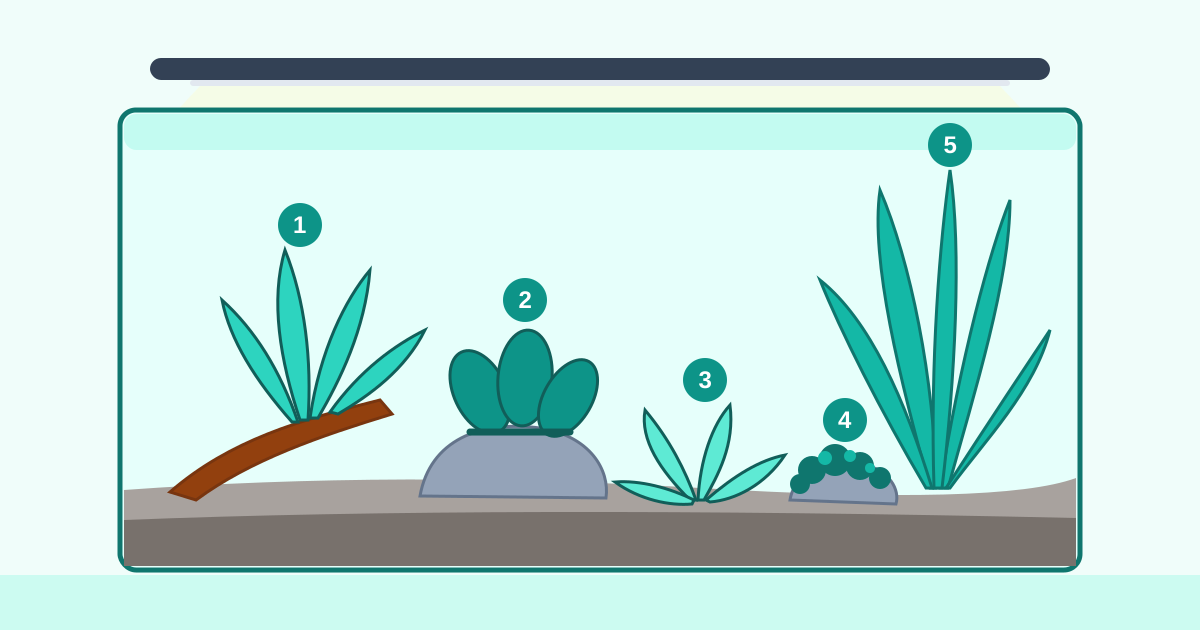
The most dependable low light aquarium plants are Java fern and Anubias: they grow on wood or rock, need no CO2 injection, and cope with a basic light. Cryptocoryne, Java moss and the Amazon sword round out the list. All five grow slowly in dim light, and the two rooted ones — crypts and swords — need root tabs if your substrate is plain sand or gravel.
This is a short list of five plant types, numbered and kept in the same order, each with what it's best for and an honest drawback. None of the slots is sponsored.
How to read this page
These are plant types, not a side-by-side test. Three of them — Java fern, Anubias and Amazon sword — grow in my own 90-litre planted tank under the light it came with; for the others I rely on the sources cited, and I say which is which. My own setup is near the end, in "My own planted tank".
The short answer
Pick by where the plant will live:
- On driftwood or rock, anywhere in the tank: Java fern — pick 1.
- The darkest corners, under overhangs or floating plants: Anubias — pick 2.
- Rooted in the substrate at the front or middle: Cryptocoryne — pick 3, with root tabs.
- A green carpet over wood, or cover for shrimp and fry: Java moss — pick 4.
- One big plant at the back: Amazon sword — pick 5, with plenty of root tabs.
The 2Hr Aquarist says Anubias can grow from about 10 µmol PAR and "grow perfectly well in shade" — that's the level these plants are built for.
The picks
Quick comparison
| # | Plant | Best for | Where it grows | Feeds mainly from | Speed | Main drawback |
|---|---|---|---|---|---|---|
| 1 | Java fern | Most tanks | Tied to wood or rock | Water column | Slow | Leaves blacken if neglected |
| 2 | Anubias | Darkest spots | Tied to wood or rock | Water column | Slow | Green spot algae on old leaves |
| 3 | Cryptocoryne | Rooted front/midground | Substrate | Roots | Slow | Melts after planting |
| 4 | Java moss | Covering wood, shrimp tanks | Wood, stone, decor | Water column | Moderate | Stringy in dim light; needs trimming |
| 5 | Amazon sword | Background centrepiece | Substrate | Roots | Grows large | Hungry for root tabs |
"Feeds mainly from" and "Speed" summarise what the cited sources say about each plant in general. Sources disagree on Java moss's growth rate — Aquasabi's own page lists it as both slow and medium, and says it can grow 3–4 cm a month.
How I chose
Four things decide whether a plant suits a low-light tank:
Does it grow without much light? Each pick is described as low-light tolerant by at least one source cited here: The 2Hr Aquarist for Java fern and Anubias, Practical Fishkeeping and Aquarium Co-Op for crypts, Aquasabi for Java moss, and Aquarium Co-Op for the Amazon sword, where it says lighting and substrate matter less than feeding.
Does it need CO2? None of the five does. The sources say CO2 speeds some of them up, but a low-light tank usually doesn't have it, so every pick had to grow without it.
Where does it feed? Plants that grow on wood and rock take most of their food from the water, so they need a liquid fertiliser; rooted plants need food at the roots. That decides what else you'll buy — see "What they need to grow" below.
Will it survive a beginner's mistakes? Slow growth is a strength here: The 2Hr Aquarist notes that Java fern won't show nutrient deficiencies until many weeks later, which gives you time to notice and fix things.
Each pick, honestly
1. Java fern — best overall. The 2Hr Aquarist calls it tolerant of low light and a wide range of water conditions, and says it grows well without CO2 injection or powerful lights — which is why it's so common in low-tech tanks. Tie or glue it to rock or wood; its roots can go into the substrate, but the rhizome must not be buried. Aquarium Co-Op says it absorbs nutrients mainly from the water column and lists narrow leaf, Windelov (lace) and trident varieties. Drawbacks: it's slow, and The 2Hr Aquarist says poor water quality or a lack of nutrients leads to blackening leaves, so it still wants regular liquid fertiliser.
2. Anubias — best for the darkest spots. The 2Hr Aquarist says Anubias "are not demanding about light and grow perfectly well in shade", growing from about 10 µmol PAR. It grows fully submerged on wood or rock and doesn't need substrate at all; a small dab of gel superglue on the rhizome holds it in place. Drawbacks: very slow growth, and The 2Hr Aquarist says green spot algae tends to appear on the oldest leaves in bright light — its advice is to trim old leaves rather than reach for chemical dips. It also warns against starving it: "Low demand is real; minimal fertilization is the wrong conclusion."
3. Cryptocoryne — best rooted plant for the foreground and midground. Practical Fishkeeping describes crypts as low light tolerant and slow growing. Aquarium Co-Op says Cryptocoryne wendtii doesn't need liquid fertiliser or CO2 and grows under almost any light and substrate, but prefers root feeding: in an inert substrate, add root tabs about every three months. It also says Cryptocoryne lutea can take about three months to establish. Drawback: melt. Aquarium Co-Op says the leaves may melt when first added and to leave the plant in the substrate so it can recover; Practical Fishkeeping says crypts are sensitive to changes in water parameters and that big water changes done only sporadically can trigger crypt melt.
4. Java moss — best for covering wood and sheltering shrimp. Aquasabi rates it very easy, says fertiliser and CO2 help but are not necessary, and says the moss soon attaches itself to whatever it grows on with its rhizoids (you can tie it on with nylon line to start). Aquarium Co-Op says Christmas moss, another moss sold for the same job, gives cover to baby fish and shrimp. Drawbacks: low light shows. Aquasabi says it branches more under stronger lighting, while under low light its shoots get thin, thread-like and poorly branched, and it looks best under good lighting with a complete nutrient supply. It also needs regular trimming, and Aquasabi warns not to let it overgrow slow epiphytes such as Java fern and Anubias.
5. Amazon sword — best centrepiece, if you'll feed root tabs. Aquarium Co-Op says lighting and substrate are not as important for the Amazon sword as feeding it lots of root tabs, and that yellowing new leaves are a sign it needs more. Drawbacks: it grows very large, so it suits the back of a bigger tank. Aquarium Co-Op also explains that the leaves it's sold with were grown out of water and melt back once submerged, to be replaced by longer, narrower leaves — normal, but alarming the first time.
What they need to grow
Low light means slow growth, not no care:
- Picks 1, 2 and 4 feed mainly from the water. A complete liquid fertiliser covers them — see aquarium plant fertilizer picks.
- Picks 3 and 5 feed at the roots. In plain sand or gravel, add root tabs; the planted tank substrate guide explains when a richer substrate is worth it.
- Light hours still matter. LiveAquaria suggests 10–12 hours a day and stresses that "low light" is about strength, not duration; other sources suggest about 6–8 hours, and less in a tank fighting algae. The planted aquarium lighting guide compares them, and the planted light picks cover upgrades if you want faster growth.
My own planted tank
My 90-litre planted community tank is low-tech — no CO2 injection — and still runs the stock light it came with: three LED strips, blue and white. The light runs from 09:00 to 14:30 and again from 16:30 to 22:30 every day. Under it I grow three of the plants on this list: an Anubias nana on a coconut shell, a Java fern on a piece of driftwood, and two Amazon swords.
For the swords I've added Tetra InitialSticks, Tetra's substrate fertiliser, to the substrate. I dose Seachem Flourish, a liquid fertiliser, only about once every three months, mainly to avoid algae. No plant has died out in that tank, and none has shown deficiency symptoms. The one problem I've had with these plants is green spot algae: in that tank it grew mostly on the glass, but it also formed hard spots on the Java fern leaves — the same issue The 2Hr Aquarist describes on old Anubias leaves. The Anubias nana itself has never had it, which I put down to its always being partly shaded by an Amazon sword and the Java fern. The green spot algae guide covers what to do about it.
The counter-example is my Juwel Trigon 190's first planted setup: the Amazon swords slowly faded under a thin sand cap, and because I rarely dosed liquid carbon or added root tabs, every other plant in that tank eventually died off too. I put that down to the thin sand bed and too little feeding, not the light. Java moss (pick 4) was the exception in that tank: it thrived, growing into a thick bush on top of the rocks.
What you can skip
- CO2 for these plants. None of the five needs it; the sources say it only speeds growth.
- Burying rhizomes. The 2Hr Aquarist says the rhizome of Java fern and Anubias should not be buried — tie or glue them to wood or rock instead.
- Pulling up melting crypts or swords. Aquarium Co-Op's advice is to leave them in place while they adjust.
- An expensive substrate for a tank of epiphytes. Aquarium Co-Op says Anubias and Java fern don't need substrate at all.
Put it to work
If you're planning a whole tank around these plants, the low-tech planted tank guide covers the substrate, light and fertiliser that go with them. For how to plant each type — and a wider set of beginner plants, including Vallisneria and floating plants — see aquarium plants for beginners. If leaves start yellowing or developing holes, the nutrient deficiency guide helps you tell a root-feeding problem from a water-column one.