
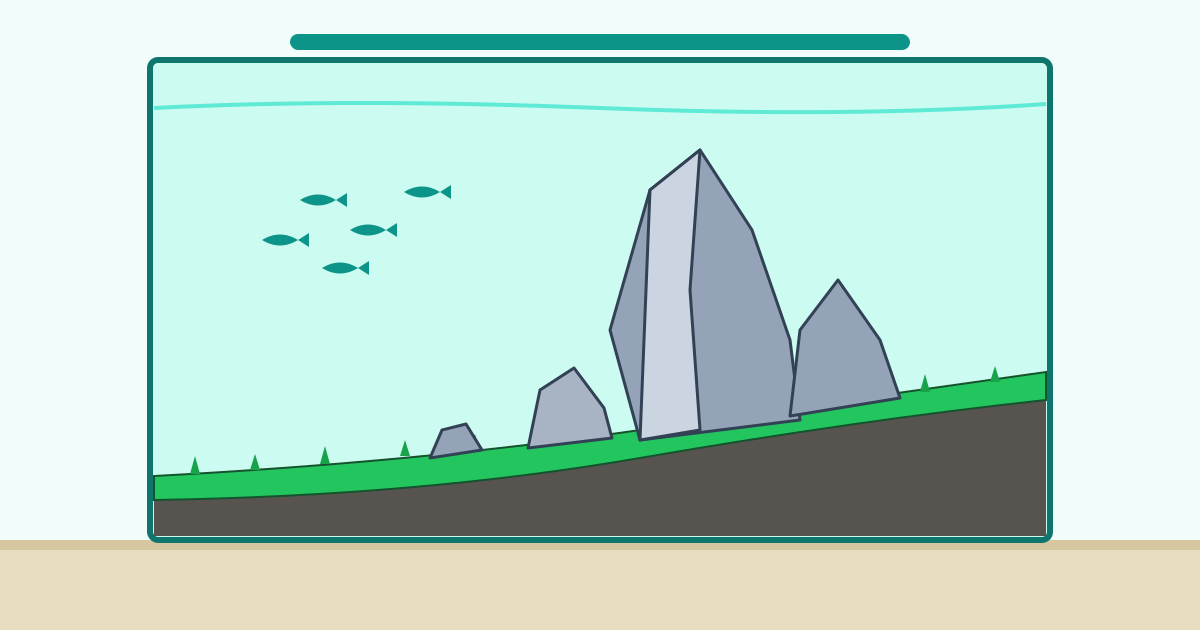
An iwagumi aquascape is a planted tank built around stones: an odd number of one stone type, the largest set off-centre, over a low carpet plant, with no wood. Most sources call for aquasoil and injected CO2, and the main thing that goes wrong is algae on the rocks.
The style looks simple, and it isn't. This guide covers the stones and what each one does, how to place them, which carpet to grow, CO2 and light, fish, and the places where the sources disagree.
What makes an aquascape an iwagumi?
Iwagumi means "rock formation" in Japanese. The Green Machine traces it to Japanese gardens, where stones formed the "bones" of the garden. Takashi Amano brought the idea into aquariums, in the 1980s according to The 2Hr Aquarist.
The defining rules are short:
- Stones are the only hardscape. Aquasabi and The 2Hr Aquarist both exclude driftwood and roots. If you want wood, you're building something else, and driftwood for an aquarium covers that route.
- One type of stone throughout, with matching grain and colour.
- An odd number of stones, because even numbers invite symmetry and split the layout in two.
- Very few plants. The 2Hr Aquarist says one type is common and more than three is rare. Aquasabi quotes the purist principle "Tanshoku Tanei": one type of plant, one type of fish.
- Open space. The 2Hr Aquarist's line is that negative space isn't empty space.
Modern versions relax some of this, with sand areas, sculpted hills, several plant species or stems. Aquasabi and Horizon Aquatics both accept stems, while The 2Hr Aquarist points out that every addition moves you further from the pure form and adds maintenance. For the opposite approach, a plants-only layout with no stone at all, see our Dutch aquascape guide.
The four stones and what each one does
| Stone | Role | Notes from the sources |
|---|---|---|
| Oyaishi | Main stone | The largest and most striking. Placed off-centre and tilted |
| Fukuishi | Second stone | Second largest, beside the Oyaishi. Balances it and adds tension |
| Soeishi | Third stone | Sits near the first two and reinforces the main stone |
| Suteishi | Small "sacrificial" stones | Not meant to stand out, often half-buried or hidden by plants. Left out of a Sanzon layout |
A Sanzon Iwagumi is the three-stone version, which The Green Machine likens to a Buddhist triad: one larger stone and two smaller ones leaning towards it.
Which stone to use
Seiryu is the classic choice, and Aqua Essentials describes it as hard and blue-grey with sharp edges and pale veining. Dragon stone is warmer and more organic in texture. Aquascaping Love also lists Maten and Shou, and Horizon Aquatics adds Hakkai, Frodo and mountain stone. Aquasabi's advice is to look for heavily furrowed stone with a pronounced texture. Buy from one batch if you can, so that colour and grain match.
Seiryu changes your water. The 2Hr Aquarist says it slowly leaches carbonates and raises KH and GH, and that an iwagumi carries more rock per litre than any other style, so the effect is more pronounced. Aquasabi says weekly water changes of about 50% can offset it. Re-measure your degassed pH now and then if you use a pH-drop target for CO2, because the baseline drifts. If you want soft-water shrimp or fish, check the stone against what they need before you buy.
Buy bigger than you think. The 2Hr Aquarist says most hobbyists use rocks far too small, and that the largest should be at least three-quarters of the tank's height. Burying the base, tilting the stone and growing a carpet around it all shrink it visually. For scale, Aquasabi's Seiryu set for tanks of about 54–84 litres is nine stones weighing around 6 kg (product page, read 2026-11-09).
How to set up an iwagumi aquascape
1. Plan the stones before you add water. Aqua Essentials suggests moving them around on dry substrate, photographing the front view and checking balance from several angles. Look for each stone's best face first. Horizon Aquatics reports ADA's Yusuke Homma saying the main stone, once placed, decides which way the layout flows.
2. Add the substrate and slope it. The 2Hr Aquarist calls nutrient-rich aquasoil one of the most effective tools here: carpets feed through their roots, so nitrogen and phosphorus can stay low in the water, which keeps algae off the stones. Inert substrates can grow carpets with water-column feeding, but it says that makes algae harder to control in such a lightly planted tank. Aqua Essentials suggests at least 6 cm at the front, rising to 8–10 cm at the back, and the slope makes the tank look deeper. Soils are compared in substrate for a planted tank.
3. Place the main stone first. Put the Oyaishi off-centre, about a third of the way in from one side. The 2Hr Aquarist calls centring it the most common beginner mistake. Tilt it, so the face turned downward falls into shadow and the stone looks three-dimensional. Bury the bottom few inches so it seems to rise out of the ground.
4. Add the other stones in order of size. The Green Machine works from largest to smallest, then suggests leaving the layout for a day or two before you commit, because it may take a couple of attempts. The 2Hr Aquarist's trick is to tilt all the stones at a similar angle so they read as one formation. Finally, The Green Machine pours more substrate around them so it flows naturally between the stones.
5. Fill the tank and let it mature. The 2Hr Aquarist runs a dark start: fill the tank and run the filter for 3–4 weeks with lights and CO2 off, so the soil's early ammonia release is spent before planting. The dry start is the other route, covered below. Either way, read our cycling guide before adding fish.
6. Plant the carpet. Few species doesn't mean few plants. The 2Hr Aquarist says to buy a good amount, split it into the smallest portions you can handle and give each one room to spread. For dwarf hairgrass it plants clusters of fewer than 10 blades, 2–4 cm apart, because larger clumps float up and crowd their own centres. Aqua Essentials adds that bare substrate invites algae. Long tweezers do this job, and our aquascaping tools page covers them. The aquarium carpet plants page compares the five main carpet options by light and CO2 need.
7. Start CO2 and a moderate light. The figures are in the next section.
8. Add one school of fish, after the tank has cycled. See the fish section below.
Free tool
Stones and soil take up a surprising share of an iwagumi tank. Work out the real water volume before sizing a filter or following a fertiliser label.
Aquarium volume calculator →Which carpet plant to grow
| Plant | How The 2Hr Aquarist rates it | Other notes |
|---|---|---|
| Dwarf hairgrass (Eleocharis acicularis / parvula) | Reliable and the most forgiving; moderate growth | Upright blades conceal the base of the stones |
| Monte Carlo (Micranthemum tweediei) | Easy, moderate growth | Hugs the substrate. Aqua Essentials calls it the most popular choice for beginners |
| Glossostigma (Glossostigma elatinoides) | Spreads fast, runners can be aggressive | Needs a lot of light without CO2 |
| HC Cuba (Hemianthus callitrichoides 'Cuba') | "Significantly more demanding" | Aqua Essentials says it needs strong light, stable CO2 and rich substrate |
| Utricularia graminifolia | "Slightly pickier" | Listed by Horizon Aquatics; 2Hr's low-tech page rates it difficult and wants a mature tank |
Whichever you choose, carpets need thinning. The 2Hr Aquarist says that as a carpet thickens the shaded lower layer dies back, and the mat eventually lifts off the substrate in sheets. Cut out older growth regularly so new growth has room.
CO2 and light
CO2. The 2Hr Aquarist compares an iwagumi without injection to crossing the ocean in a small boat: possible, with failures far outnumbering successes. With CO2, it says carpets are among the easiest plants to grow. Aqua Essentials strongly recommends injection too, so plants outgrow algae in the early weeks.
- Target: The 2Hr Aquarist aims for a 1-point pH drop from your degassed baseline, which it puts at about 30 ppm. A drop checker gives you a rough second reading.
- Stability matters more than the kit list. It says fluctuating CO2 is one of the most common triggers for sudden algae and plant decline, and it prefers an inline atomizer or reactor on a regulator with a solenoid timer.
- Timing: on 2–3 hours before the lights, off near the end of the light period (The 2Hr Aquarist). Aqua Essentials starts a couple of hours before and stops an hour before lights-off.
The basics are in our aquarium CO2 guide.
Light. The 2Hr Aquarist calls excessive light intensity the number one reason iwagumi tanks fail, and targets 30–60 PAR at the substrate. If the rocks start to turn green, turn the light down before changing anything else. Aqua Essentials keeps the photoperiod to about eight hours at the start. Our planted lighting guide explains PAR, and our LED picks by tank length cover fixtures.
Without CO2. If you try anyway, the 2Hr low-tech carpet method has four parts: a tank 12 inches deep or less, stronger light of more than 50 PAR at the substrate (it uses close to 100), a soil base, and a fully matured tank before planting. It rates Monte Carlo and dwarf hairgrass moderate without CO2, and says stronger light raises the algae risk. That's a direct trade-off in a style where clean rock is the point. Its example hairgrass carpet took about three months to fill in. Low-tech planted tanks covers the wider approach.
Dark start or dry start?
| Dark start | Dry start | |
|---|---|---|
| Who recommends it | The 2Hr Aquarist | Buce Plant |
| What you do | Fill the tank and run the filter with lights and CO2 off, then plant underwater | Plant into damp soil with no water, cover tightly with plastic wrap, and flood later |
| How long | 3–4 weeks before planting | On average 4–6 weeks for roots to establish |
| Daily work | None beyond running the filter | Mist 2–3 times a day, air for 20–30 minutes |
| Light | Off until planted | 10–14 hours a day |
| Main risk | None named by the source | Mould, and plants that struggle to convert to underwater growth |
Buce Plant calls the dry start the easiest and quickest way to grow carpet plants. The 2Hr Aquarist says it doesn't recommend it, because failure rates among hobbyists are higher and you still have to learn to keep a submerged carpet in the long run. Buce Plant advises against it for plants already adapted to growing underwater, and says to expect some melting after flooding if you won't be injecting CO2.
Which fish suit an iwagumi?
The 2Hr Aquarist suggests one species of small, peaceful schooling fish in a dozen or more, such as cardinal or neon tetras or rasboras. Horizon Aquatics lists green neon tetras, least rasboras, rummynose tetras, black neons and cardinals, for what it calls "the illusion of birds over mountains". Aquasabi adds that fish must still suit your water, which matters if Seiryu has pushed your hardness up.
Avoid large, boisterous or digging fish, which The 2Hr Aquarist says can lift a young carpet and shift smaller stones. Amano and other dwarf shrimp can graze algae and pick through detritus.
Keeping algae off the stones
Algae is the usual way an iwagumi goes wrong, and The 2Hr Aquarist explains why: a sparse tank has little plant mass to hold it back. Its checklist:
- Light first. Stay in the 30–60 PAR range.
- Flow. It calls detritus collecting at the base of the stones the primary driver of hardscape algae, and says good circulation keeps it moving.
- Weekly water changes, siphoning the substrate surface. It uses a turkey baster to stir detritus up while siphoning. Aqua Essentials suggests around 50% weekly in the first weeks.
- Lean nutrients in the water. Feed through the soil rather than dosing heavily into the water column.
- Grazers. Amano shrimp and other dwarf shrimp pick at algae continuously.
Aquascaping Love suggests breaking the lighting period for about an hour at midday as another option. If hard green dots appear on the rocks, see green spot algae, and for black tufts see black beard algae.
Where the sources disagree
- How tall the main stone should be. The Green Machine and Aquascaping Love say about two-thirds of the tank's height. The 2Hr Aquarist says at least three-quarters, and shows a rock at about 80% still working once tilted. Our take: buy at the taller end, since burying and tilting will bring it down.
- Dry start. Buce Plant favours it for carpets, and The 2Hr Aquarist advises against it. See the table above.
- How much light carpets need. 2Hr's iwagumi guide calls the need for high light a myth and stays at 30–60 PAR with CO2. Its low-tech carpet page wants above 50 and uses close to 100 without CO2. Both can be right, because the higher figure stands in for the missing CO2.
- "Schooling" or "shoaling". Aquascaping Love says to avoid shoaling fish because they break away individually. Horizon Aquatics recommends a shoaling species, and both lists include cardinals and rummynose tetras, so they differ in the word and not the fish. Choose small fish that move as a tight group.
- How strict to be. Aqua Essentials says a single carpet species. The 2Hr Aquarist allows one or two, rarely three, and Aquasabi and Horizon Aquatics accept stems.
My own tanks aren't iwagumis
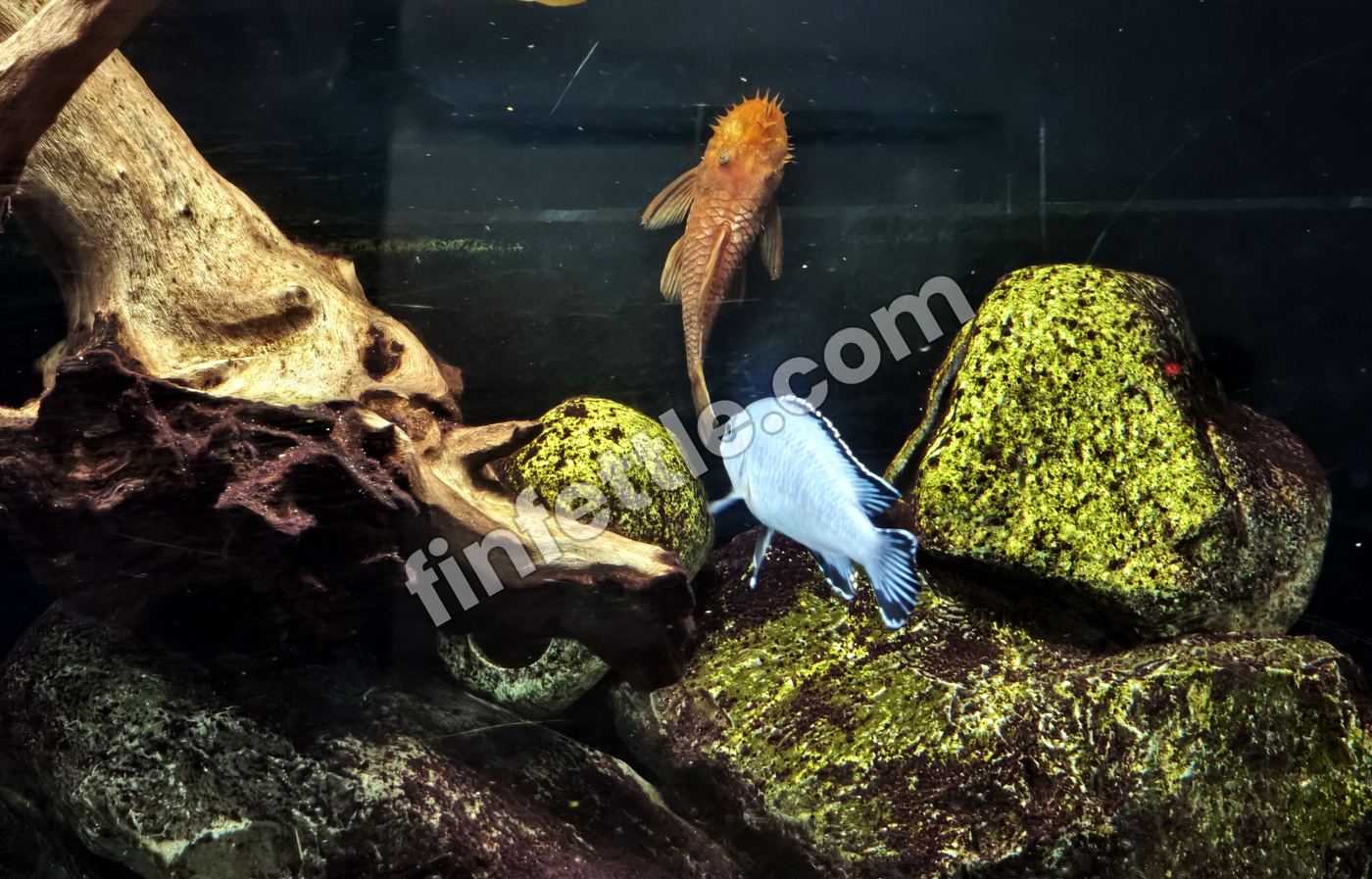
Neither of my planted tanks has been an iwagumi. The 90-litre community tank has driftwood, and the Juwel Trigon 190 has had wood in it too. I also haven't run pressurised or DIY CO2 on any of my tanks, I've never grown a carpet plant in either planted tank, and I haven't measured KH or GH after adding rock to any tank. So the stone rules, water-hardness effects, CO2 targets, light levels and carpet advice on this page come from the sources cited, not from my own setups.
What I can speak to is algae on rock, which is the main risk in this style:
- Green spot algae. The rocks in my mbuna tank have a solid coat of it. It doesn't wipe off, and I need a blade to shift it.
- Brown algae. In the Trigon, it spread across the substrate and stuck to the rocks and wood. I took them out of the tank, sprayed them with a hydrogen peroxide solution and scrubbed them clean with a brush. In an iwagumi, pulling out the stones would mean rebuilding the layout, which is a strong argument for getting the light right from the start.