
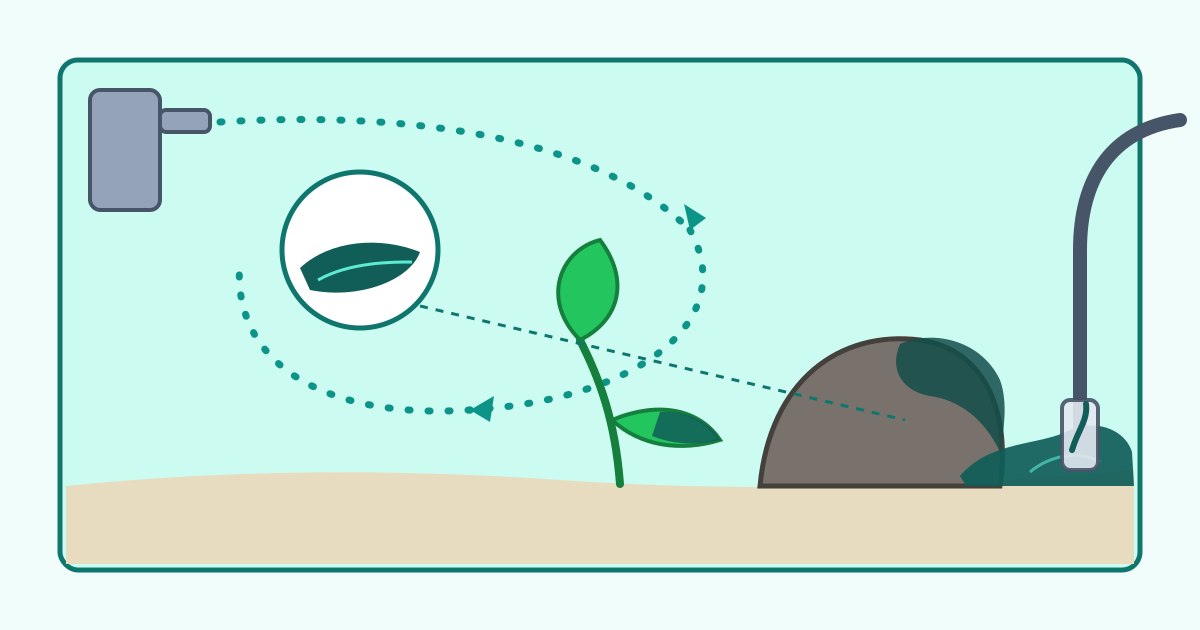
Blue-green algae isn't algae at all: it's cyanobacteria, a bacterium that photosynthesises and spreads as dark green, slimy sheets over sand, plants and decor, often with a musty smell. To get rid of it, siphon and scrub off as much as you can, then fix the cause: dead spots where water barely moves, low oxygen, and waste building up in the substrate. A blackout or a chemical treatment only buys time if those stay the same.
This guide covers how to identify it, whether it's harmful, what causes it, a step-by-step removal plan, when a blackout makes sense, and how to keep it from coming back.
What blue-green algae is
Aquarium Co-Op, Aquarium Science and Buce Plant all make the same point first: "blue-green algae" (often shortened to BGA) is a group of photosynthetic bacteria called cyanobacteria, not an alga. It uses light to make energy the way plants do, which is why light matters to it, but it's a bacterium, so it responds to different conditions than the true algae covered in our other algae guides.
Aquarium Science also notes that cyanobacteria are found almost everywhere, including in the air and in tap water. You can't keep it out of a tank. What you can control is whether the tank gives it a place to thrive.
How to identify blue-green algae
Look at texture and smell as much as colour:
- Slimy sheets, not tufts or spots. The 2Hr Aquarist says it starts as translucent sheets along the substrate and around poorly growing plants, and can form filaments that drift in the current. Aquarium Co-Op describes it starting as a small spot and growing into a thick slime over gravel, decorations and plants.
- It comes off easily. The sources remove it by siphoning it off the sand and brushing it off decor, which sets it apart from tufted algae that clings tightly.
- A musty smell. Aquarium Co-Op describes the smell as earthy, musty, swampy and foul, and says that once you know it you can notice an outbreak up to two weeks before you can see it. Aquarium Science adds that it's also common for there to be no smell.
- Not always blue-green. It can be brown, black or red as well (Aquarium Co-Op), or yellow-green, reddish brown or even purple (Aquarium Science).
Blue-green algae or something else?
| What you see | Likely | How to tell |
|---|---|---|
| Dark green slimy sheets that peel off, musty smell | Blue-green algae (cyanobacteria) | Slime, not hair or spots; often on the sand first |
| Soft brown dusty film, wipes off easily, common in new tanks | Brown algae (diatoms) | Dusty rather than slimy; no strong smell |
| Fine dark tufts clinging to leaf edges | Black beard algae | Tufts that won't wipe off |
| Soft green threads | Hair algae | Strands, not sheets |
| Hard green dots on glass and slow leaves | Green spot algae | Needs a blade to remove |
| Coarse grey branching tufts | Staghorn algae | Branches like antlers |
Is blue-green algae harmful?
To fish: usually not directly. Aquarium Co-Op says it doesn't usually harm fish, and Buce Plant says fish are usually unharmed. The conditions that tend to come with it — low oxygen and rotting waste — are worth fixing for the fish's sake anyway.
To plants: yes. Both say it can kill plants when it covers their leaves, because the leaves can no longer photosynthesise.
To you: the sources disagree. Aquarium Science says the types found in aquariums don't have the conditions to produce toxins and are safe to work around. The 2Hr Aquarist says algae eaters avoid it because it can be toxic. We'd treat it with ordinary caution: wear gloves or wash your hands after handling it, and don't start a siphon by mouth.
What causes blue-green algae
The sources agree on the core pattern — still water where waste collects — and differ on nutrients:
- Slow or still water. Aquarium Co-Op says it pops up wherever organic waste can stagnate, including when the current is too slow or when hardscape blocks off a corner that still gets light. Aquarium Science and Buce Plant both name low water movement.
- Organic waste in the substrate. Uneaten food and decaying plant matter in gravel that hasn't been vacuumed for a while, especially with no animals turning it over (Aquarium Co-Op, Buce Plant).
- Low oxygen. Aquarium Science, Buce Plant and The 2Hr Aquarist all list it.
- Warm water. Aquarium Science says most cyanobacteria prefer warmer water and that severe outbreaks usually happen in warm water.
- Nutrients. Aquarium Science names high phosphate; Buce Plant names an excess of nitrogen and phosphorus, often from overfeeding. The 2Hr Aquarist, writing about planted tanks, names low nitrate: plants short of nitrogen get stressed and start to deteriorate.
- A young or unstable tank. The 2Hr Aquarist lists an unstable or immature biological filter.
Free tool
Before you change anything about nutrients, test. Enter your ammonia, nitrite and nitrate readings to see where your water stands.
Water test checker →How to get rid of blue-green algae
Taking the slime out is quick; keeping it out means changing the conditions it grew in. Combining Aquarium Co-Op, Aquarium Science, Buce Plant and The 2Hr Aquarist, in the order we'd do it:
- Remove as much as you can. Siphon it off the sand and scrub it off decor, glass and equipment with a toothbrush or algae scraper. Buce Plant suggests cleaning any tools afterwards so you don't carry it into another tank.
- Change water and vacuum. Do a water change straight after, siphoning debris out of the substrate. Aquarium Science recommends large water changes to bring phosphate down.
- Cut the waste going in. Aquarium Co-Op suggests more frequent water changes, cleaning the filter regularly, and reducing the food or the number of fish if you're overfeeding or overstocked.
- Fix the dead spots. Look at where the slime grows first: usually a corner, behind rocks, or in sand the current never reaches. Aquarium Co-Op suggests a stronger filter, adding a powerhead, or moving decorations and equipment; Aquarium Science suggests a wavemaker.
- Add oxygen. Aim the filter outflow or a pump at the surface so it ripples, or add an air pump and air stone, as Aquarium Science suggests.
- Check the temperature. If the tank runs at the warm end of what your fish need, Aquarium Science suggests bringing it down. Stay within your fish's range.
- Steady the light. Buce Plant suggests adjusting the intensity and duration of your lighting and keeping the schedule consistent. See the planted aquarium lighting guide for hours.
- In a planted tank, check nitrate. The 2Hr Aquarist suggests raising nitrate if the plants are short of nitrogen. Test first: Buce Plant warns that too much nitrogen and phosphorus feeds outbreaks, so only correct a reading that's actually low.
- Repeat the clean-up. Siphon off any regrowth at each water change while the fixes take effect. Early outbreaks are easier to deal with, so don't wait for it to cover the tank.
Free tool
Large water changes are easier to plan when you know how much water the tank really holds. Work out your tank's true volume first.
Aquarium volume calculator →If a stronger filter is the fix, the aquarium filter shortlist compares the main types by flow.
The blackout method
Because cyanobacteria needs light, one common fix is to starve it. Aquarium Co-Op and Buce Plant describe turning the aquarium lights off for three to seven days; The 2Hr Aquarist says a three-to-five-day blackout may solve serious outbreaks.
The catch, which all of them mention in some form:
- Your plants need light too. Aquarium Co-Op and Buce Plant both say a blackout can harm plants.
- It often comes back. Both say the slime can return within a few weeks.
- Fish can squabble. Aquarium Co-Op mentions it can cause spats among the fish.
So treat a blackout as a reset after you've removed the slime and started fixing flow, oxygen and waste, not as the fix itself.
Antibiotics and chemical treatments
Because cyanobacteria is a bacterium, some keepers treat it with antibiotic products, and several sources recommend them. We don't name or recommend antibiotics on FinFettle. In the US, antibiotics for ornamental fish can't legally be marketed, and Aquarium Science's own assessment is that their effect is only temporary, that they can sometimes knock out the beneficial bacteria in the filter (spiking ammonia or nitrite), and that the cyanobacteria comes back unless the root causes are removed.
Aquarium Science is also blunt about general algae killers: it says chemicals that kill algae can also kill fish. If you're considering any product, read its label, follow it exactly, and speak to an aquatic vet if your fish are showing signs of illness. This guide is husbandry advice, not a substitute for a vet.
Will anything eat blue-green algae?
Don't rely on it. Aquarium Co-Op says animals don't like the taste, so a clean-up crew won't be much help, and The 2Hr Aquarist says algae eaters often avoid it. Aquarium Science disagrees, saying catfish, mollies and algae eaters do eat it. Either way, an algae eater doesn't touch the still water, low oxygen or waste behind an outbreak.
Where the sources disagree
- Nutrients. Aquarium Science and Buce Plant point to too much phosphate (and, for Buce Plant, nitrogen); The 2Hr Aquarist points to too little nitrate in planted tanks. Test before you act, and correct only what's actually out of range.
- Toxins. Aquarium Science says aquarium cyanobacteria doesn't produce toxins; The 2Hr Aquarist says it can be toxic. Handle it with gloves or wash your hands either way.
- Vacuuming. Aquarium Co-Op links outbreaks to substrate that hasn't been vacuumed in a while; Buce Plant suggests vacuuming only every one to two months to protect the beneficial bacteria. If debris is visibly collecting where the slime grows, vacuum that area.
- Algae eaters. See the section above.
Keeping blue-green algae away
- Keep water moving everywhere, including corners and behind rocks and wood.
- Keep the surface rippling so oxygen stays up.
- Don't let waste settle: feed what's eaten, keep up regular water changes, clean the filter, siphon debris where it collects.
- Keep the light schedule steady.
- Grow plants that compete for nutrients. Buce Plant suggests fast growers and floating plants, naming Vallisneria and hornwort as plants that hold up well against cyanobacteria. Our low-tech planted tank guide covers easy options.
My own tanks
I've had blue-green algae in my Juwel Trigon 190. It usually grew near the top of the tank, along the edge of the waterline, and it was easy to clean off. In my 90-litre planted tank, the air stone sits inside the lift tube of the under-gravel filter's plenum at the back of the tank.
The causes, blackout and treatment advice on this page come from the sources cited rather than from my own tanks. The other algae I've dealt with, black beard algae, green spot algae and brown algae (diatoms), each have their own guide.
If what you're seeing isn't slime, the other algae guides cover black beard algae, hair algae, green spot algae, brown algae (diatoms) and staghorn algae.