
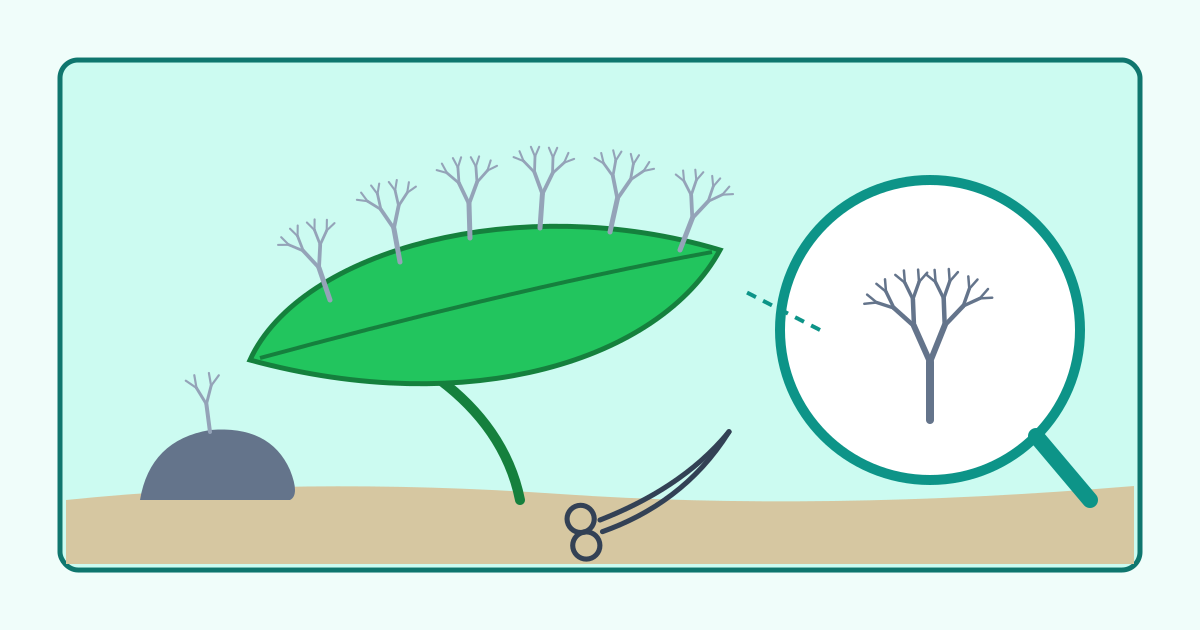
Staghorn algae is a red alga that grows as coarse, grey, branching tufts on the edges of slow-growing leaves, on hardscape and on equipment. It's a sign the plants it sits on are stressed — by being new to the tank, by unstable CO2 or fertilising, by too much iron, or by a spike in organic waste. To get rid of it, trim the affected leaves, spot-treat only mild cases, then fix the cause, or it grows straight back.
This guide covers how to tell it apart from look-alikes, what causes it, a step-by-step removal plan, what liquid carbon and algae eaters can and can't do, and how to stop it returning.
What staghorn algae looks like
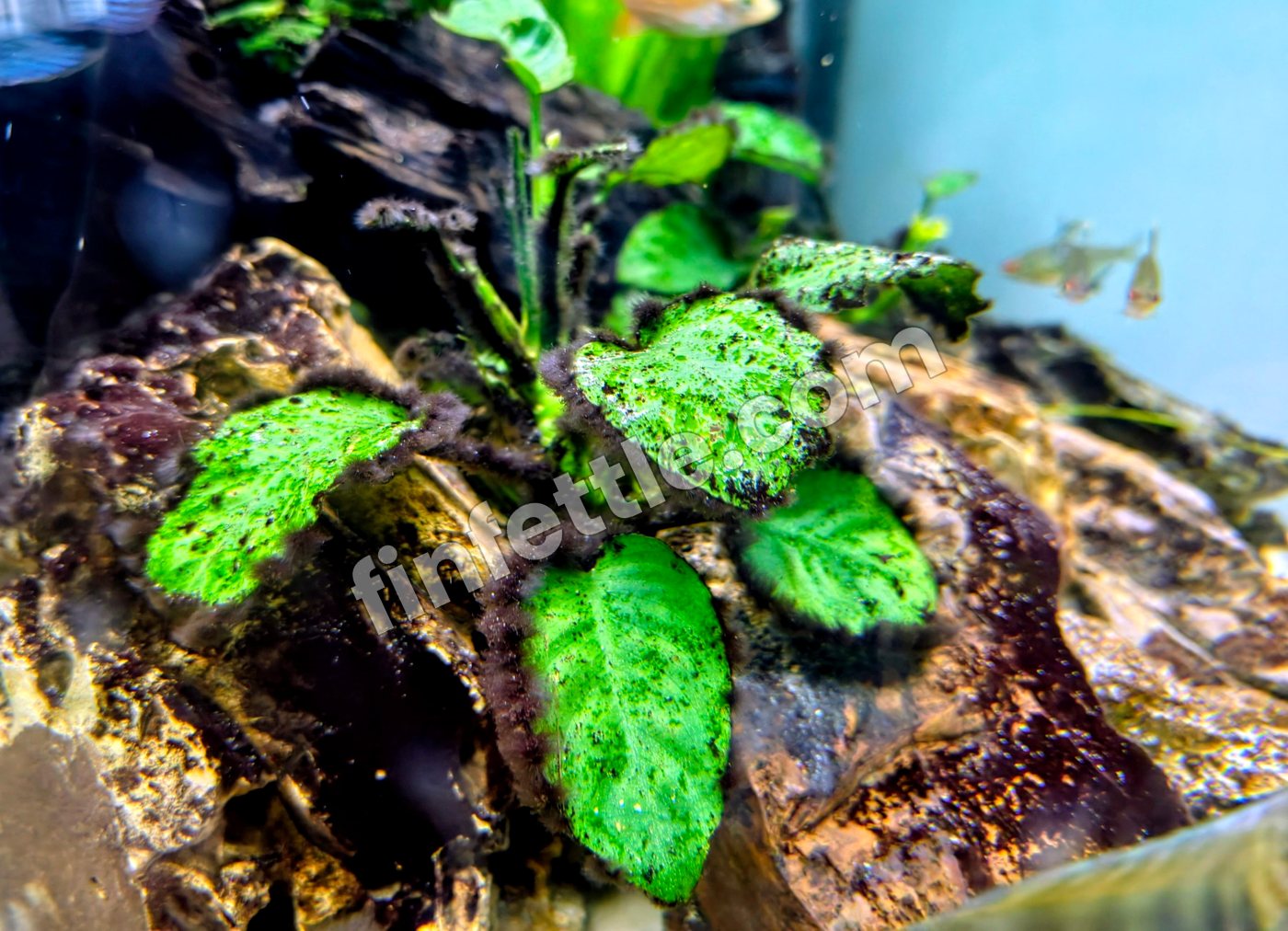
Staghorn (Compsopogon species) gets its name from the way its strands fork, like the antlers of a stag. Aquasabi describes it in shades of grey; Aquarium Science describes coarse strands from grey-green to solid green, sometimes almost white, and says it can grow into strands six inches (about 15 cm) or longer that wave in the current. It clings tightly, and Aquasabi and The 2Hr Aquarist both say it's hard to remove by hand.
You'll usually find it:
- On leaf edges, especially of slow-growing plants, where The 2Hr Aquarist says it's commonly found.
- On decoration and hardscape — rocks, wood and ornaments.
- On equipment — filters, heaters and other kit in the tank.
To confirm it's a red alga, Aquasabi suggests dropping a piece in alcohol: it turns red.
Staghorn or something else?
| Algae | What it looks like | What sets it apart |
|---|---|---|
| Staghorn | Coarse, thick grey to grey-green strands that fork like antlers | Thicker and paler than BBA; branching |
| Black beard algae | Dense, fine tufts, dark green to black | Finer texture and usually darker, says The 2Hr Aquarist |
| Hair algae | Soft, fine green threads | Green and soft rather than coarse and grey; see the hair algae guide |
| Java moss (a plant) | Green, branching fronds | Aquarium Science says beginners confuse green staghorn with it — moss stays where you put it |
Is staghorn algae harmful?
None of the sources here describe it as harmful to fish, shrimp or snails. The trouble is what it says about your plants. The 2Hr Aquarist's point is that algae growing on plants rather than on glass or rock is always a sign the plant is stressed or adjusting: stressed plants release metabolites at their leaf edges, and that encourages algae to attach there.
So it isn't an emergency. It's a signal to look at what changed.
What causes staghorn algae
Plant stress is the common thread. The specific triggers the sources name:
- New plants adapting. The 2Hr Aquarist calls this the most common cause: a plant introduced to a new tank has to adjust to the new conditions, and that's stressful. If your tank or your plants are new, staghorn may pass on its own once the plants settle — see the plant melting guide for the same adjustment from the plant's side.
- Unstable CO2 or irregular fertilising. In established tanks, The 2Hr Aquarist lists swinging CO2 and fertilising on no regular schedule as plant stressors.
- Too much iron. Aquasabi says that in planted tanks dosed with liquid fertilisers, staghorn is often an indicator of an iron fertiliser overdose. Aquarium Science also links it to high iron.
- Nutrients out of balance. Aquasabi explains that if CO2 or one of the macronutrients (nitrate, phosphate, potassium) runs short, plant growth stalls and the unused iron and trace elements build up — which may favour red algae such as staghorn and black beard algae. Aquarium Science links staghorn to high nitrate too.
- Ammonia and organic waste spikes. The 2Hr Aquarist names a spike in ammonia or organic waste as a trigger in mature tanks.
- Lax maintenance. Aquasabi ties the nutrient build-up to too few water changes.
How to get rid of staghorn algae
Removing the tufts is the easy part; keeping them away means fixing whatever stressed the plants. Combining The 2Hr Aquarist's and Aquasabi's advice, in the order we'd do it:
- Trim the affected leaves. Cut off older leaves carrying staghorn to make room for new growth. It's hard to pull off by hand, so scissors are quicker than fingers.
- Prune and replant. For stem plants, The 2Hr Aquarist suggests replanting the healthy tops and discarding the old growth.
- Scrub hard surfaces. Staghorn on rocks, wood and equipment is just as hard to pick off by hand, so take a stiff brush to it, ideally outside the tank.
- Check your iron and trace dosing. If you dose a liquid fertiliser, Aquasabi suggests reducing the amount step by step for as long as the plants show no deficiency signs (it gives white shoot tips as an example). If you have an iron test, Aquasabi aims for 0.05–0.1 mg/l; a higher reading over a longer period means the fertiliser is overdosed. The plant fertiliser shortlist covers the main types.
- Balance CO2 and macronutrients. Keep CO2 stable and fertilise on a regular schedule. As a reference point, Aquasabi's targets are roughly 20–30 mg/l CO2, 10–25 mg/l nitrate, 5–10 mg/l potassium, 0.1–1 mg/l phosphate and more than 10 mg/l magnesium. The aquarium CO2 system guide covers keeping CO2 steady.
- Keep up large water changes. Aquasabi recommends changing around 50% of the water every week, which stops nutrients and waste building up. Siphon debris off the substrate while you're at it.
- Spot-treat only mild cases. For a mild to moderate outbreak, The 2Hr Aquarist spot-doses an algicide straight onto the algae. Use whatever product you choose exactly as its label directs. A tank that's overrun needs the steps above, not more chemicals.
- Don't panic. The 2Hr Aquarist's last point: it may be temporary and will pass.
Free tool
A 50% water change and any product dose both depend on how much water is really in the tank. Work out your tank's true volume first.
Aquarium volume calculator →Liquid carbon, peroxide and algicides
Spot treatments come up again and again in the search results for staghorn, so it's worth being precise about what the sources actually say.
- Liquid carbon. Aquasabi recommends adding a liquid carbon product at the manufacturer's dose and says that after a few days the staghorn turns white or pink — the sign you can stop. Seachem, which makes Flourish Excel, says it doesn't produce or market Excel as an algicide, and that overdosing it or applying it directly to a plant as a spot treatment can cause damage. If you use one, follow its label.
- Hydrogen peroxide. If liquid carbon doesn't work, Aquasabi says you can treat the algae directly, either with the product again or with hydrogen peroxide by the "fogging" method. It's an off-label use, so research it carefully before trying it in a tank with fish and shrimp.
- Algicides. The 2Hr Aquarist spot-doses an algicide directly onto the tufts, for mild to moderate cases only.
None of these fixes the cause. They kill what's there; the steps above stop it coming back.
I've dealt with black beard algae, staghorn's close red-algae relative, in both of my tanks with plants: the 90-litre community tank and the Juwel Trigon 190. I tried spot-treating the affected leaves with Seachem Flourish Excel from a syringe, with the filter switched off, but I didn't keep it up and it never cleared the algae. I also cut back the lighting and how often I fed, and the lighting change helped. Direct application is what Seachem cautions about, so weigh it against the label. I haven't had staghorn algae itself in either tank, so the staghorn-specific advice on this page comes from the sources cited.
Will anything eat staghorn algae?
Not reliably. Aquasabi says staghorn seems to be quite unattractive to most algae-eating animals. Where algae eaters earn their keep is afterwards: once a treatment has killed the algae, Aquasabi says shrimp and other tank inhabitants eat the dead strands.
You'll see Siamese algae eaters suggested on forums. Our black beard algae guide covers what The 2Hr Aquarist says they pick at; for staghorn, treat any algae eater as the clean-up crew after you've fixed the cause, and check it suits your tank's size and community first. I keep Amano shrimp in my 90-litre planted tank, but that doesn't change the rule above.
Low-tech vs CO2 tanks
The same causes weigh differently depending on how the tank is run:
- CO2-injected tanks: unstable CO2 is a plant stressor The 2Hr Aquarist names, and Aquasabi's point about balancing CO2 with nitrate, phosphate and potassium applies directly. Steady CO2 and a regular fertilising routine come first.
- Low-tech tanks: with no CO2 injection, the CO2 point drops out, leaving new or stressed plants, too much iron, organic waste and too few water changes as the causes from the list above to check. See the low-tech planted tank guide.
My 90-litre planted community tank is low-tech: I don't run pressurised or DIY CO2 on it.
Keeping staghorn away
- Give new plants a steady start. Staghorn follows plant stress, and The 2Hr Aquarist names a plant's first weeks in a new tank as the most common cause of that stress.
- Fertilise regularly, not heavily. A regular schedule, iron in check, macronutrients not running out.
- Keep CO2 steady if you inject it. Swinging CO2 stresses plants.
- Change water every week. Aquasabi's figure is around 50%.
- Don't let waste build up. Siphon debris, don't overfeed, and keep the filter flowing.
- Keep the light routine steady. The planted aquarium lighting guide covers hours and intensity.
If what's on your plants is something else, the other algae guides cover black beard algae, hair algae, green spot algae, brown algae (diatoms) and blue-green algae (cyanobacteria).