
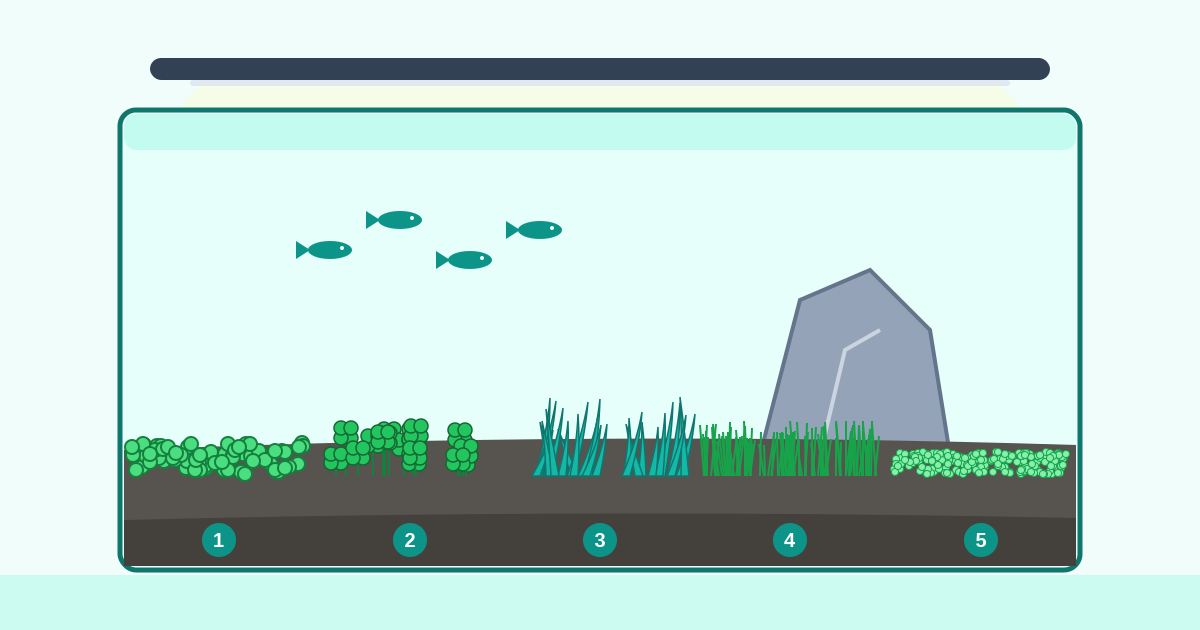
Monte Carlo is the most forgiving aquarium carpet plant and the one The 2Hr Aquarist rates best without injected CO2. In a dimmer, no-CO2 tank, Marsilea and dwarf sagittaria are easier; dwarf hairgrass gives a true grass lawn if your light is medium to high; and HC Cuba has the smallest leaves of all but needs strong light and injected CO2.
This is a short list of five plant types, numbered and kept in the same order, each with what it's best for and an honest drawback. None of the slots is sponsored.
How to read this page
I haven't grown a carpet plant in either of my planted tanks, so everything about these five comes from the sources cited — mainly Tropica, which grows and sells four of them, and The 2Hr Aquarist. Where the sources disagree, I say so.
The short answer
Pick by what your tank already has, not by the photo you liked:
- No CO2, a basic or medium light: Monte Carlo — pick 1. It's the best chance of a real carpet.
- No CO2 and a dim light, or shade from wood and taller plants: Marsilea — pick 2.
- No CO2, plain gravel or hard water, and you like a grassy look: dwarf sagittaria — pick 3, with root tabs.
- Medium-to-high light, ideally with CO2, and you want a lawn: dwarf hairgrass — pick 4.
- Strong light, injected CO2 and a small tank: HC Cuba — pick 5.
The general rule, from The 2Hr Aquarist: carpets sit furthest from the light, and most spread faster and grow shorter and denser when they get more of it. The shorter, finer carpets usually need CO2.
The picks
Quick comparison
| # | Plant | Best for | Tropica light | Tropica CO2 | Height (Tropica) | Main drawback |
|---|---|---|---|---|---|---|
| 1 | Monte Carlo | Most tanks, incl. no CO2 | Medium | Medium | 3–5+ cm | Needs hard, frequent trimming |
| 2 | Marsilea hirsuta | Dim, low-tech tanks | Low | Low | 5–20+ cm | Slow (2Hr); odd leaf forms at first |
| 3 | Dwarf sagittaria | No-CO2 grass look, hard water | — | — | — | Grows tall in low light |
| 4 | Dwarf hairgrass ('Mini') | Grass lawn | Medium | Medium | 3–5+ cm | Needs medium-to-high light |
| 5 | HC Cuba | Tiny leaves, small tanks | High | High | 3–5+ cm | Needs CO2 and strong light |
The light, CO2 and height columns are Tropica's own ratings from its plant pages (read 2026-11-13); the hairgrass row is Tropica's Eleocharis pusilla 'Mini'. Tropica's plant pages don't cover dwarf sagittaria, so that row is blank: Aquarium Co-Op rates it easy, with medium light (20–35 PAR) and no CO2.
If you want a PAR target, Aquarium Lesson suggests about 30 µmol at the substrate for Marsilea, about 50 for Monte Carlo and hairgrass, and 70 or more for HC Cuba and Glossostigma. Treat those as rough guides — they're one site's figures, not a standard.
How I chose
Three questions decide which carpeting aquarium plants will work in your tank:
Does it need injected CO2? Plenty of planted tanks run without it — mine included — so I wanted at least three picks that can carpet without it. The 2Hr Aquarist names Monte Carlo, Marsilea and (with enough light) dwarf hairgrass; Aquarium Co-Op lists dwarf sagittaria as needing no CO2.
How much light reaches the bottom? A carpet is the plant furthest from the light. Tropica's light rating for each plant is the simplest way to match plant to tank.
Will it spread on its own? A carpet is only a carpet if it spreads across the substrate by itself. All five picks do; Cryptocoryne parva, which some lists include, doesn't (see "Also worth knowing").
Each pick, honestly
1. Monte Carlo — best overall. Tropica says that when it first trialled Micranthemum 'Monte Carlo' in 2013 alongside HC Cuba and Glossostigma, it grew in a similar way to HC Cuba but was far more adaptable and easier — faster, and forming a carpet even with lower light and CO2. Tropica's guidance is moderate or high light plus CO2 for the best results, but says it can survive in lower light and nutrient conditions, and that a nutrient-rich substrate helps considerably. The 2Hr Aquarist calls it "by far the best carpet plant for low tech tanks" because of its hardiness, and says it takes trimming well long term. Drawbacks: once established it's a fast grower; Tropica says it needs frequent, hard trimming, and a carpet that gets too thick lifts and floats while the layers underneath die from lack of light.
2. Marsilea — best for dimmer, low-tech tanks. Tropica rates Marsilea hirsuta low for both light and CO2. It's usually sold with four-leaf-clover leaves; after a transition it may grow as a low carpet of single leaves or with two- to four-lobed leaves 2–10 cm tall, depending on conditions. The 2Hr Aquarist says Marsilea (crenata, hirsuta or minuta) works without CO2 and tolerates a little more shade than Monte Carlo, and that crenata is the smallest. Drawbacks: The 2Hr Aquarist says it grows slowly — though Tropica rates its growth medium and says it spreads rapidly by runners, so expect anything from slow to steady. And you don't choose its final leaf form; the tank does.
3. Dwarf sagittaria — best no-CO2 grass look. Aquarium Co-Op describes Sagittaria subulata as a great plant for people new to planted tanks: relatively undemanding, spreading by runners into a grass-like carpet, needing no CO2, and tolerant of hard water. It recommends medium light (20–35 PAR) and root tabs in an inert substrate. Drawbacks: it's taller than the other four — Aquarium Co-Op lists it as a midground plant and says it stays shorter in brighter light but can grow quite tall in lower light. Like many shop plants, it arrives grown out of water and may melt back while it converts.
4. Dwarf hairgrass — best grass lawn. Aquarium Co-Op calls dwarf hairgrass (Eleocharis acicularis) moderately easy and says the lawn effect needs medium to high light; CO2 is "not required but preferred". Tropica sells smaller forms: it calls Eleocharis pusilla 'Mini' one of the most reliable species for creating a carpet, with little maintenance because the leaves stay short, and says E. acicularis 'Mini' can go many weeks between trims if light and circulation are good. The 2Hr Aquarist gives hairgrass a good chance without CO2 "if you have enough light". Drawbacks: the light. Tropica says E. acicularis 'Mini' needs moderate-to-strong light and CO2 for best results, and that the carpet needs regular vacuuming to stop algae building up in it. Names are messy too: small hairgrasses are sold as E. parvula, E. pusilla 'Mini', E. acicularis 'Mini' and Eleocharis sp. 'Belem', and sources don't always agree which is which.
5. Dwarf baby tears (HC Cuba) — best for the smallest leaves. Tropica calls Hemianthus callitrichoides 'Cuba' one of the smallest aquarium plants in the world, with millimetre-sized round leaves, and a popular foreground plant for small aquariums. The 2Hr Aquarist agrees it's great for smaller tanks, but adds that from a distance most people can't tell it from Monte Carlo. Drawbacks: Tropica rates it high for light and CO2 and says it needs enough light, added CO2, circulation and fertiliser — and suggests Monte Carlo as the less demanding alternative. The 2Hr Aquarist calls it a rather difficult carpet that "should not be attempted without CO2". It also needs regular trimming: Tropica says that otherwise the lower parts don't get enough light and the roots die.
Also worth knowing
Three more aquarium carpeting plants turn up on most lists:
- Glossostigma elatinoides. Tropica calls it one of the smallest aquarium plants (2–3 cm tall) and a difficult one that demands a lot of light, growing upwards if light is poor. The 2Hr Aquarist says it spreads very fast and is easy in a CO2-injected tank, and can grow without CO2 only with "a ton of light". Sources split on its speed: Aquarium Lesson's profile calls it slow-growing, while its own overview card and The 2Hr Aquarist call it fast.
- Cryptocoryne parva. The 2Hr Aquarist says it's a very slow grower that won't spread on its own, so covering an area means planting a lot or dividing clumps yourself. Aquarium Lesson calls it an extremely slow grower but ideal for low-tech tanks.
- Mosses. Aquarium Lesson suggests Java or Christmas moss tied to mesh or stones for an unstructured ground cover, and recommends moss-based options for a sand-only tank. The low light aquarium plants page covers Java moss.
How to plant a carpet
- Start with fine, nutrient-rich substrate if you can. The 2Hr Aquarist says many carpets root better in finer substrates, and Tropica says Monte Carlo grows considerably better in a nutrient-rich soil. In sand or gravel, Aquarium Co-Op recommends lots of root tabs. The options are compared in substrate for a planted tank.
- Split the plants small. Aquarium Lesson suggests dividing each pot into 5–8 tufts about the size of a fingernail; Tropica suggests clumps of about an eighth of a pot for Glossostigma.
- Plant deep, at an angle, with gaps. Aquarium Lesson suggests pushing each tuft in at a slight angle at least 2–3 cm deep, 1–2 cm apart; Tropica says a few centimetres apart helps HC Cuba and Glossostigma grow together quickly. Long tweezers are the right tool — see aquascaping tools.
- Or try a dry start. Buce Plant and Aquarium Lesson describe the dry start method: plant into moist substrate, cover the tank with plastic wrap, mist at least daily (Buce Plant says two to three times a day), keep the light on about 6–8 hours a day, and flood after about 4–6 weeks. The plants root out of water first, so they're less likely to float up.
- Expect some melt. Aquarium Co-Op says shop plants are often grown out of water and may melt back while they convert; leave the roots in place. The plant melting guide covers what's normal.
- Trim from the top once it fills in. Aquarium Co-Op trims hairgrass and dwarf sagittaria to an even height with curved scissors, "much like mowing a lawn"; Tropica recommends curved scissors for Monte Carlo too.
What a carpet needs
Light and CO2 matter more than either of these for picks 4 and 5. The planted aquarium lighting guide explains PAR, LED lighting for planted tanks compares lights, and the aquarium CO2 system guide explains what injected CO2 involves. If you're sizing a light or CO2 kit, the aquarium volume calculator gives your tank's real volume.
What you can skip
- "Carpet seeds". Buce Plant says the instant-carpet seeds sold online are most likely falsely advertised: hobbyists who grew them out found garden weeds and other plants such as Oxalis corymbosa and holy basil. Plants like these die underwater and rot, and the rot can spike ammonia and lead to algae. Buy real plants as pots, portions or tissue-culture cups.
- HC Cuba in a tank without CO2. The 2Hr Aquarist says it shouldn't be attempted; Monte Carlo looks similar from a distance and is far easier.
- One big clump. Tropica, Aquarium Co-Op and Aquarium Lesson all say to split plants into small portions, and Tropica and Aquarium Lesson also say to space them out; Aquarium Lesson adds that plants that float up after filling weren't planted deep enough.
My own tanks
My 90-litre planted community tank is low-tech — no CO2 injection — and runs the stock light it came with. I've never grown a carpet plant in it, or in my Juwel Trigon 190 when that tank was planted, and I've never bought "carpet seeds". So I can't tell you from my own tank which of these would carpet under a basic light; the picks above rest on what Tropica and The 2Hr Aquarist report.
Put it to work
If you're planning a stone layout around a carpet, start with the iwagumi aquascape guide. For a whole tank without CO2, the low-tech planted tank guide covers light, substrate and fertiliser, and the low light aquarium plants page lists plants for the rest of the tank. In a small tank, the nano planted tank guide covers what changes, and aquarium plant fertilizer compares liquid feeds for the water column.