
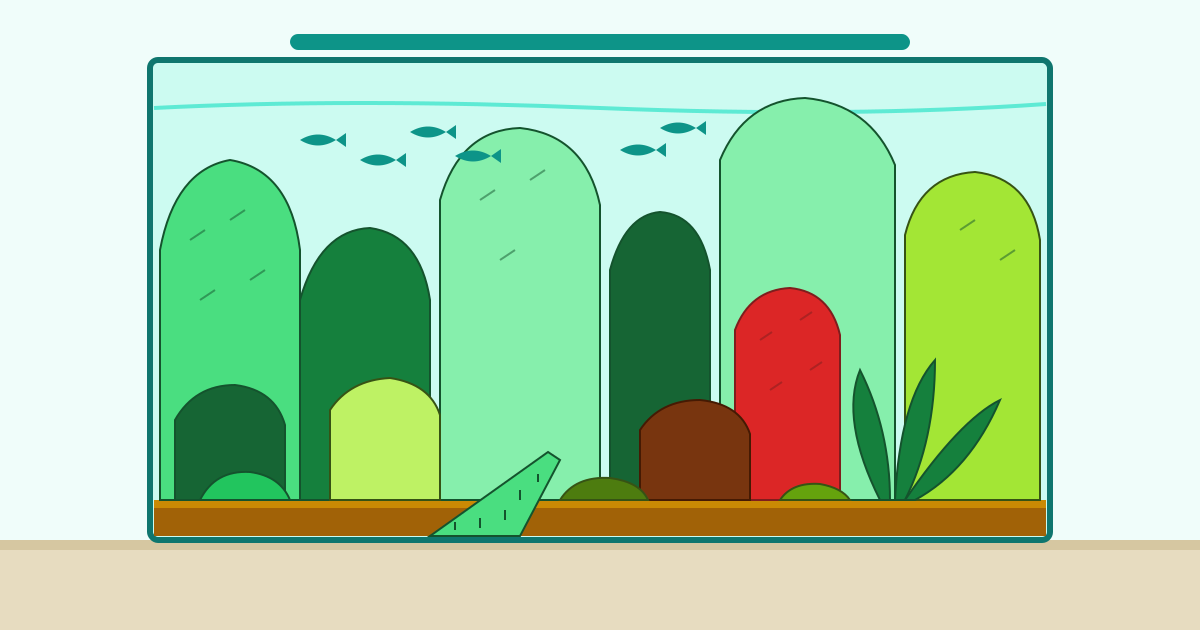
A Dutch aquascape is a planted tank built from plants alone: tight groups of one species each, chosen to contrast in colour, leaf shape and leaf size, stepping up in height towards the back, with a diagonal "plant street" to give depth. It needs pressurised CO2, strong light and regular trimming, and The 2Hr Aquarist says its algae risk is higher than any other freshwater style.
It's the opposite of an iwagumi, where stones do the work and plants are few. This guide covers what makes a tank Dutch, the rules, plant choice, setup, CO2 and light, fish, upkeep, and the places where the main sources disagree.
What makes an aquascape Dutch?
The Dutch style is the oldest planted-tank style in the hobby. The 2Hr Aquarist says it emerged in the Netherlands in the 1930s and was later codified by the NBAT, the Dutch society for aquarium and terrarium keeping, into a judged competition standard. That's why a strict Dutch style aquascape is the most rule-bound style you'll meet.
The core ideas:
- The plants are the subject. The 2Hr Aquarist says the style showcases the colours, leaf shapes and growth habits of individual species.
- Little or no hardscape. Aquascaping Love says the style doesn't use wood, rocks or other hardscape. The 2Hr Aquarist says small pieces aren't prohibited but are often left out, and the AGA guide allows small moss-covered wood pieces to separate similar groups, while warning against iwagumi-style rock clusters.
- Groups, not mixtures. Each group is one species, and neighbouring groups are meant to contrast sharply. Blending species is a Nature Aquarium technique, the AGA guide says.
- Neat and ordered. The 2Hr Aquarist says classic Dutch tanks aim for uniform growth and neatly trimmed bushes.
The rules of Dutch aquascaping
These come from Vin Kutty's guide for the Aquatic Gardeners Association (AGA) and The 2Hr Aquarist, which agree on most of them. The AGA guide's point is that you only need to follow them strictly if you plan to enter a contest, but they evolved for a reason and get you a better-looking tank.
| Rule | What the sources say |
|---|---|
| Species count | One species per 10 cm (4 in) of tank length, or three per foot (both). The AGA guide's ideal for a six-foot tank is 18 |
| No repeats | Don't use the same species in more than one place (both) |
| Gaps between groups | AGA: start with an inch or two, so a finger's width or two remains once grown. 2Hr: an inch or half an inch |
| Contrast | 2Hr: neighbours should differ in at least two of colour, leaf shape and leaf size. AGA adds texture, brightness and height |
| At least one big leaf | AGA: you need at least one large-leaved plant, such as an Echinodorus, Aponogeton or Anubias |
| Ration the reds | AGA: one or two red plants at focal points, no more than a quarter of the species. 2Hr: about a quarter of the planted area. Never two red groups side by side (both) |
| Coverage | Plants over roughly 80–90% of the substrate (both) |
| No symmetry | No showy plant in the centre and no mirror-image bushes either side. The AGA guide also warns about "secondary symmetry" |
| One or two focal points | AGA: place them by the rule of thirds; with two, go front-left and back-right, or back-left and front-right |
| Midground plants | Missing midground groups are a chronic beginner problem (AGA, 2Hr) |
| No single-species foreground | AGA: a wall-to-wall carpet of one plant gives a "golf course effect" and loses depth |
The AGA guide adds two finer points: let a little of the back wall show through between groups, which adds depth, and consider a moss wall on the back glass. It also suggests a "20-foot squint test": step back, squint, and check that every group still stands out.
Plant streets and how Dutch tanks get depth
The plant street (plantenstraat) is the signature device. The 2Hr Aquarist describes it as a group running diagonally from the front glass towards the back, tapering strongly as it recedes, so a 60 cm tank reads like a garden path disappearing into the distance. It says species that grow densely and vary a little in height make better streets. The AGA guide adds: don't forget to make a street, and don't plant foreground groups perfectly parallel to the front glass.
Height comes from the plants, not the substrate. Both sources say Dutch tanks don't usually slope the substrate up to the back, as an iwagumi does. Instead, foreground plants sit at the front, mid-height groups behind them and tall bushes at the rear. The AGA guide says a slight incline is fine but not needed, and warns against even heights: if every background bush is the same height, it looks wrong.
Tank depth helps. The AGA guide recommends a tank at least 24 in (about 60 cm) front to back. With 18 in or less, it says you need extra midground groups and a strongly tapering street to compensate.
Which plants to use
Stem plants carry most Dutch tanks. The 2Hr Aquarist explains why: there are a huge number of species, they're fast-growing and intensely coloured, and you can trim them to exactly the height a group needs. Both sources warn against a tank of stems alone, though.
| Plant type | Role in a Dutch tank | Examples named by the sources |
|---|---|---|
| Stem plants | Colour, height and most of the background | Rotala, Ludwigia, Hygrophila, Limnophila, Bacopa (AGA) |
| Large-leaved plants | Scale and leaf-size contrast; at least one is needed | Echinodorus, Aponogeton, Barclaya, Nymphaea, Anubias, Nuphar (AGA) |
| Rosettes and grasses | A foil to the stems | Eriocaulon, Cryptocoryne, Echinodorus, grasses such as Eleocharis (AGA) |
| Slow growers | Foreground and midground, because they hold their shape between trims | Cryptocoryne, Anubias, Bucephalandra, Staurogyne (2Hr) |
| Dark greens and browns | Breaking up a "sea of light green" | Mosses, Cryptocoryne wendtii 'brown' and other earthy crypts (AGA) |
| Curtain plants | Tall plants in the front corners, like a theatre curtain (optional) | Vallisneria, tall Cryptocoryne, tall Hydrocotyle (AGA) |
The AGA guide's specific pairings are worth borrowing: put a fine-leaved red such as Rotala wallichii next to broad-leaved Hygrophila corymbosa, and never put two green stem plants side by side. If two light-green groups must touch, make one a stem and the other a grass, or put a dark or red group between them.
Pick plants you can grow. The AGA guide says that in the early 1990s the top Dutch tanks used an assortment of only about 20 species, because everyone knew how those plants grew. Its advice today is to be ruthless: if a Rotala or Ammannia stunts in your tank, move on to something that grows well. If you're new to planted tanks, beginner plants and low-light plants are a gentler start.
How to set up a Dutch aquascape
1. Count your species. Measure the tank's length and allow one species per 10 cm (three per foot). A 90 cm tank gets about nine groups.
2. Draw a floor plan. The AGA guide says to know the floor plan before you plant. Sketch the street, the midground groups, the background bushes and one or two off-centre focal points. Vary the widths: the AGA guide warns against five equal background bushes, or a foreground group exactly as wide as the group behind it.
3. Lay the substrate. Keep it nearly flat (see the substrate section below). Soils and gravels are compared in substrate for a planted tank.
4. Plant in single-species blocks. Pack each group densely enough to read as one block. The AGA guide says stems planted too loosely look messy, but some species, such as Eriocaulon, melt if crowded in poor conditions. Leave the gaps between groups. Long tweezers make this easier; see our aquascaping tools page.
5. Start CO2 and light. The figures are in the next section.
6. Fill in the details as it grows in. Add a moss wall if you want one, check for symmetry, and do the squint test. The AGA guide says groups that feel over-separated at first will look natural with time.
7. Add fish once the tank has cycled. See the fish section below, and our cycling guide first.
Free tool
Fertiliser labels and CO2 kits are sized by water volume. Work out your tank's real volume before you dose anything.
Aquarium volume calculator →CO2, light, substrate and fertiliser
CO2. The 2Hr Aquarist says dense, colourful stem growth needs stable, meaningful CO2, and that liquid carbon and DIY yeast systems won't deliver that stability. Its targets:
- a 1-point pH drop from your baseline, with 30+ ppm helping more demanding species;
- CO2 on 2–3 hours before the lights, so it peaks when they come on;
- stability above all: it says erratic CO2 levels trigger black brush algae (black beard algae; see our BBA guide).
Aquascaping Love gives a lower range of 15–20 ppm, and the AGA guide advises "moderate" CO2 and light. A drop checker gives a rough second reading, and the kit basics are in our CO2 guide.
Light. The 2Hr Aquarist targets at least 100 PAR at the substrate, with more for the most demanding reds and purples, and calls an adjustable-spectrum LED genuinely non-negotiable for this style, because tuned red and blue channels render the plant colours. It also says more light raises the algae risk and the maintenance. See our planted lighting guide for PAR and LED picks by tank length for fixtures.
Substrate. Both the AGA guide and The 2Hr Aquarist say traditional Dutch tanks used inert natural brown gravel, with nutrients delivered mostly through the water. The 2Hr Aquarist likes inert gravel for replanting, because it's less messy, but says water-column nutrient levels then have to be controlled precisely. Aquasoil is the alternative: it stores nutrients and makes difficult plants easier, but it depletes, it's costly, and it's messier to replant in. The AGA guide says dark soils such as ADA Aquasoil aren't traditional, but won't count against you in a contest unless large patches of substrate show. Aquascaping Love lists clay or laterite under small gravel.
Fertiliser. Aquascaping Love says Dutch tanks get iron and minerals on a regular basis. The AGA guide warns against full Estimative Index (EI) dosing, a US method that adds nutrients and CO2 in excess: it says plants then grow so fast the tank always looks freshly planted, and that expert Dutch scapers in the Netherlands dose far less. It suggests a lighter water-column regime with moderate CO2 and light, plus fertiliser tablets pushed deep under hungry plants. Follow the label of whatever you use; our fertiliser comparison covers the types.
Which fish suit a Dutch aquascape?
In a Dutch tank the plants are the subject and the fish are the accompaniment, as The 2Hr Aquarist puts it. Both sources say:
- One main species, a dozen or more. The AGA guide calls a dozen the minimum, and The 2Hr Aquarist says four species in threes reads as clutter.
- Fill the levels. The AGA guide notes that cardinal tetras keep to the bottom third, so a cardinal-only tank looks empty at the top. A few top-level swimmers, or bottom dwellers such as loaches, corydoras or dwarf cichlids, balance it.
- Stock lightly. Too many fish make a busy tank look busier.
Trimming and weekly upkeep
This is the real cost of the style. The 2Hr Aquarist calls Dutch tanks high-metabolism systems and recommends:
- Weekly water changes of 50–80%, with substrate siphoning and regular filter cleaning;
- topping and replanting any stem bush whose lower stems are deteriorating, and discarding the old stems and roots;
- watching for foreground plants that shade the groups behind, and for midground groups that were cut hard and never recovered.
The AGA guide's trimming standard is a bush that rises and falls smoothly, with no runaway stems. It says to trim evenly across the tank, so one side doesn't look heavier, and to follow every major trim with a large water change. Before a contest photo, it says to expect an hour a day for a couple of weeks. Curved and spring scissors are compared on our aquascaping tools page.
The 2Hr Aquarist's warning is blunt: people who resist this cycle tend to find their tanks declining into algae within a few months.
Where the sources disagree
- The U-shaped layout. The 2Hr Aquarist calls the classic U shape, with tall plants at both ends sloping to an open centre, the easiest version to execute well. The AGA guide says a U-shaped (or inverted-U) layout is a Nature Aquarium component, not Dutch, and that judges will eventually disqualify it. Our take: if you might ever enter a contest, follow the AGA; if not, the U shape is a forgiving first layout.
- How much red. The AGA guide caps reds at a quarter of the species; The 2Hr Aquarist says a quarter of the planted area. Both agree reds are focal points and never sit side by side.
- How much CO2 and light. The 2Hr Aquarist pushes for 30+ ppm and at least 100 PAR. Aquascaping Love gives 15–20 ppm, and the AGA guide advises moderate levels, noting that Dutch experts use far less than many US tanks. Both can work; the higher figures grow faster and need more trimming.
- Gaps between groups. The AGA guide says an inch or two at planting (and about half an inch in its trimming section). The 2Hr Aquarist says an inch or half an inch. The aim is the same: groups that stay distinct.
- Substrate. Tradition says inert brown gravel; The 2Hr Aquarist says either inert gravel or aquasoil works, with different trade-offs.
My own tanks aren't Dutch
Neither of my planted tanks has been a Dutch aquascape. My 90-litre community tank has an Anubias nana on a coconut shell and a Java fern on a piece of driftwood, and the Juwel Trigon 190 has had wood in it too. I haven't run pressurised or DIY CO2 on any of my tanks. So the rules, CO2 and light figures, and trimming advice on this page come from the sources cited, not from my own setups.
What I can speak to are the two things this style leans on hardest: stem plants and algae.
- Stem plants. In the 90-litre tank they've done very well under the light that came with the tank, without pressurised CO2: they always grow up to the surface and keep their colour, and they get Tetra InitialSticks, Tetra's substrate fertiliser, roughly once every six months. They grow fast, so I trim their edges at every weekly water change and throw the cut tops away rather than replanting them. I haven't measured the light's brightness, and I haven't grown a red stem plant in either planted tank, so the advice on reds comes from the sources cited.
- What happens when feeding stops. In the Trigon's planted phase, the stem plants did well for a while, then died off because I didn't keep replacing the root tabs.
- Black beard algae. I've had it in both planted tanks, and dealt with it partly by cutting the lighting hours. The 2Hr Aquarist links it to erratic CO2, which is why it puts stability first in a CO2-driven Dutch tank.